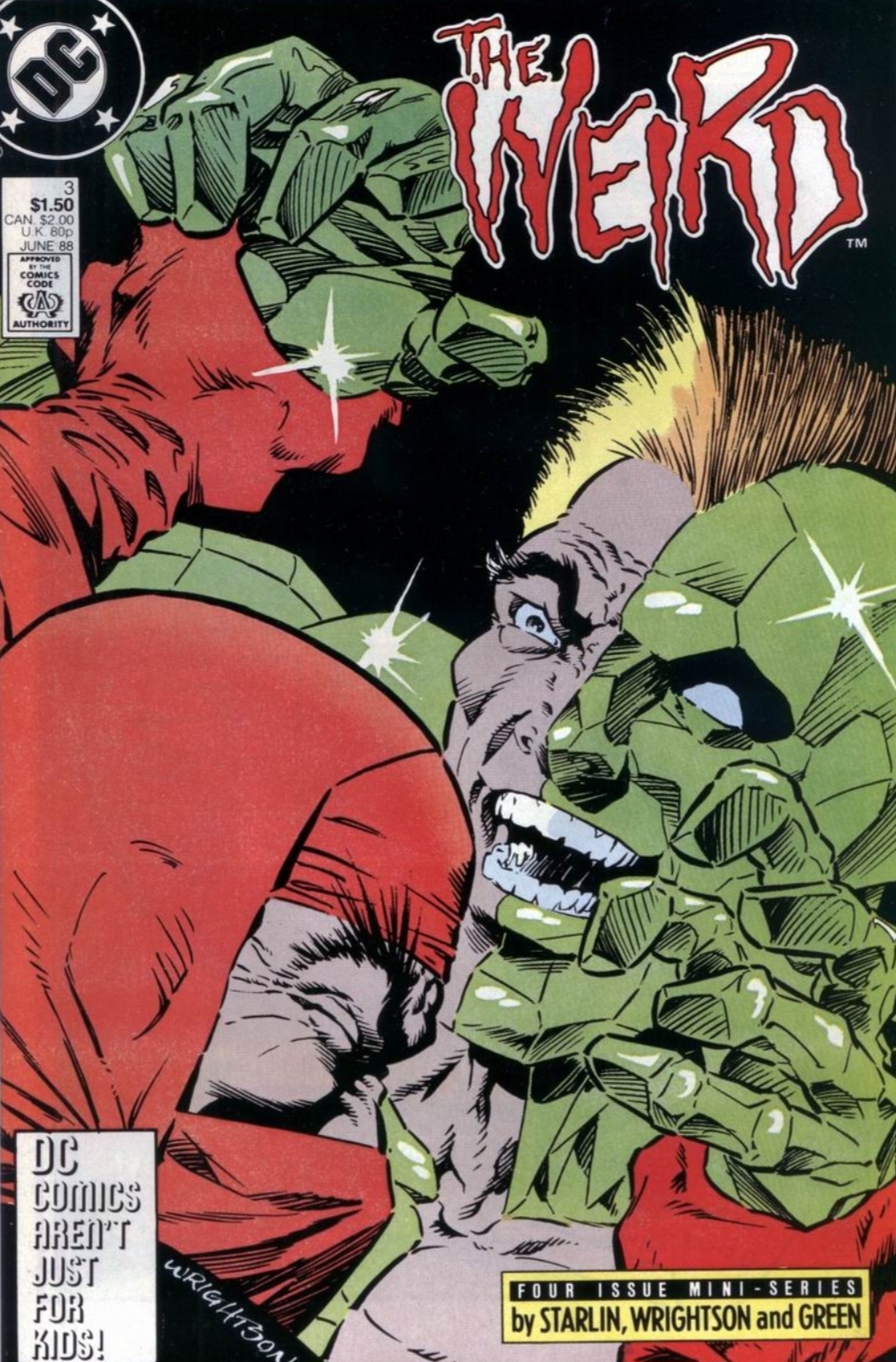
Written by Jim Starlin – Art by Bernie Wrightson – Colored by Bill Wray – Lettered by John Costanza
When we last left The Weird, the story had moved beyond mystery and into something more personal.
A being who had spent his existence powerless had suddenly discovered both power and freedom, and with it came the confidence — and danger — of believing he could control it.
Issue #1 asked: What happens when a power appears that no one understands?
Issue #2 asked: What happens when someone who has never had power suddenly gains it?
Issue #3 asks: What happens when power belongs to those who are isolated?
A Secret No One Can Share
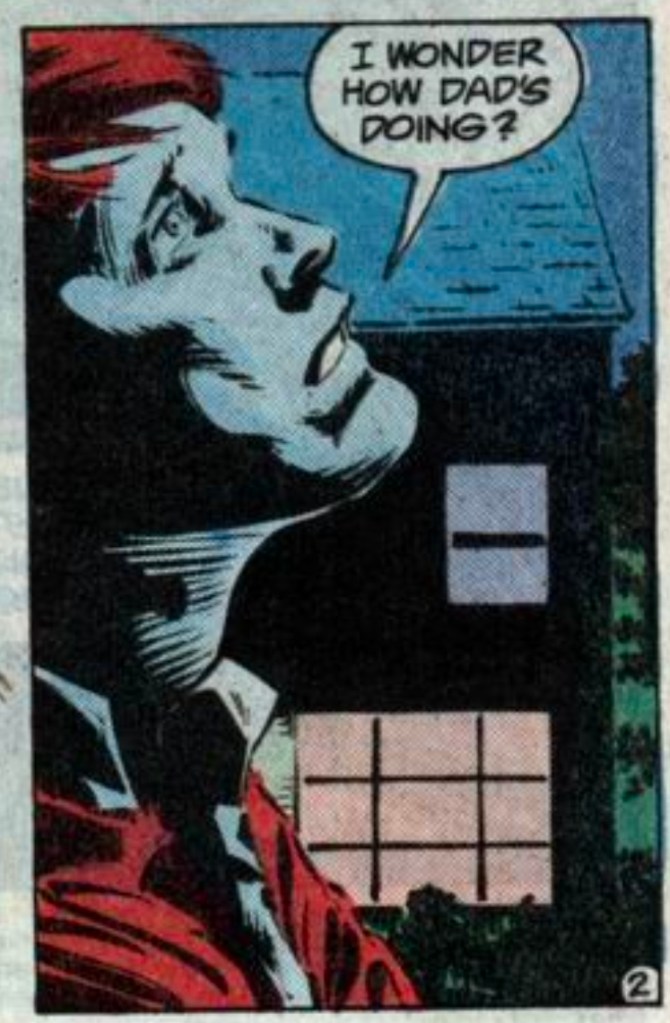
The issue opens quietly, almost deceptively so.
Billy Langley is left holding something he can’t explain to anyone. What he’s seen — what’s happened to his father — doesn’t fit into the world around him. There’s no version of this story that makes sense out loud.
So he talks to his dog.
It’s a small, almost throwaway moment. It’s presented as exposition for the reader, but it lands harder the longer you sit with it. Billy knows something important. Something real. And he has absolutely no way to share it.
That’s where the issue plants its flag early.
There is power in having that knowledge. But this kind of power doesn’t bring resolution.
It isolates.
And that idea is about to play out on a much larger scale.
Starlin & Wrightson’s Contained Chaos
As the story escalates, Jim Starlin and Bernie Wrightson shift the visual language again.
Where Issue #1 leaned into horror and Issue #2 balanced emotion with character moments, Issue #3 becomes far more action-driven — but in a way that never loses its sense of unease.
The central conflict is framed through layers of separation.
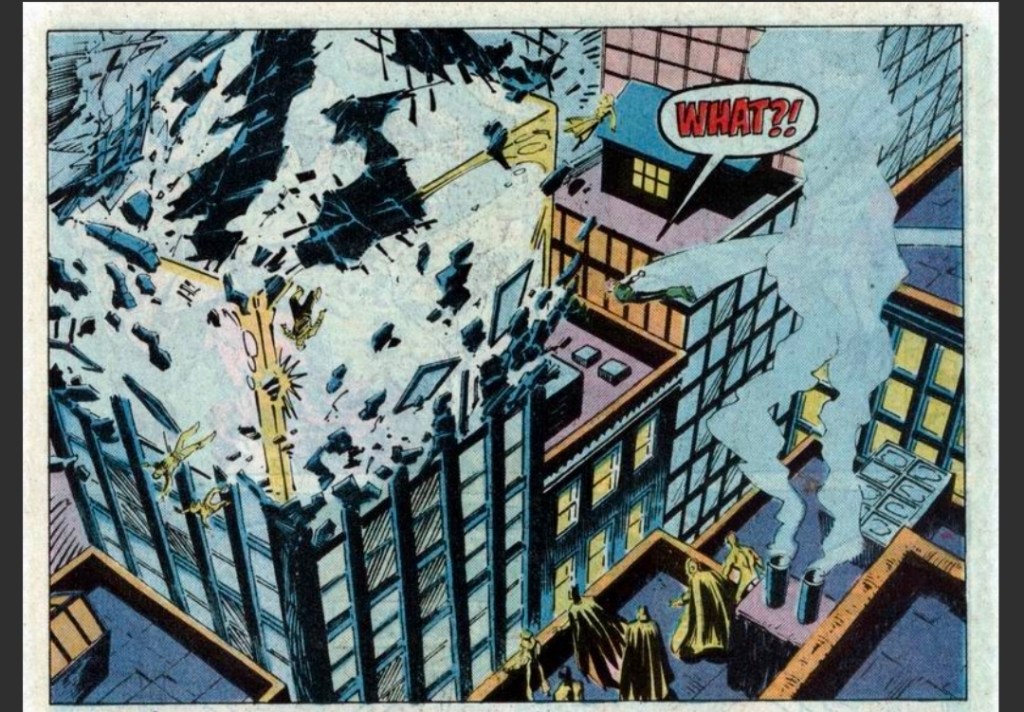
The Weird and The Jason are locked inside a rigid, geometric energy cube — completely cut off from the rest of the world. Within that space, the fight intensifies, but Starlin and Wrightson add another level of isolation.
The Weird becomes trapped inside a secondary field — a contained pocket within the larger structure.
A prison inside a prison.
It’s a striking visual choice, and it reinforces the idea that even within the conflict itself, the Weird is increasingly isolated.
Outside the cube, the Justice League gathers.
They can see that something is happening. They can feel the scale of the threat. But they don’t understand it.
They don’t hear the conversation between the Weird and the Jason. They don’t know what’s at stake inside that barrier. All they see is a volatile, dangerous situation involving a being they already don’t trust.
So they react the only way they know how.
They try to break in.
Starlin and Wrightson stage these moments with weight and tension. The League throws everything they have at the barrier. Their strength, normally overwhelming, feels suddenly ineffective.
The result is a sequence where immense power is present on all sides, but completely disconnected.
The Weird is isolated within the conflict.
The Justice League is isolated from the truth.
And the outcome is decided in a space where power, without understanding, can’t bridge the distance between them.
The Jason: Power as Entitlement
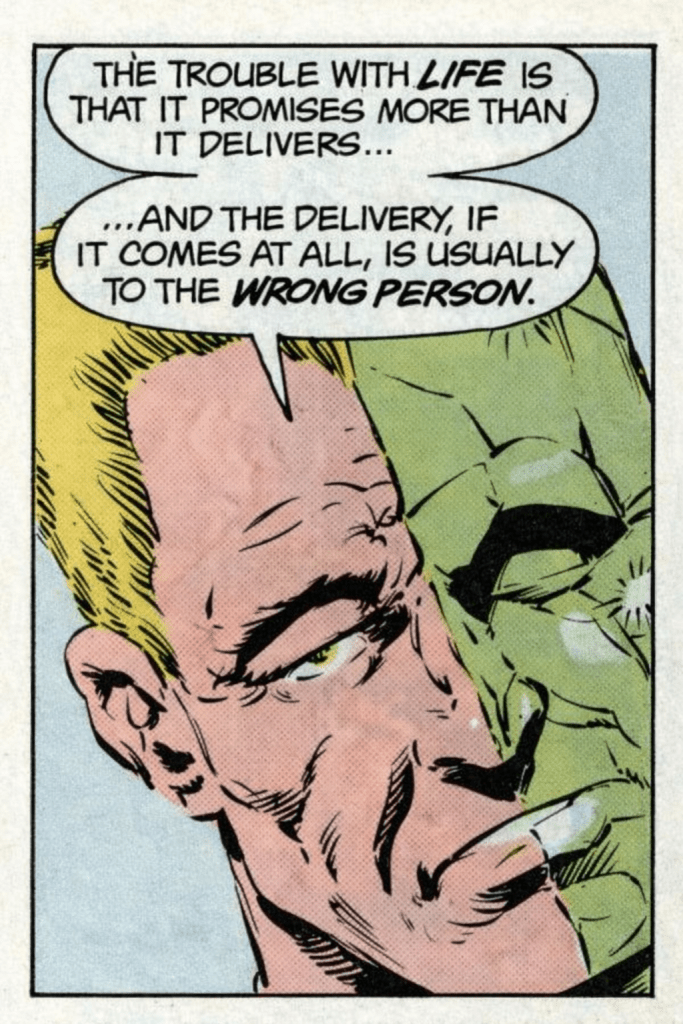
Jason’s story is uncomfortable because it feels familiar in a way you don’t necessarily want it to.
He grows up neglected, abused, and largely unseen. He experiences immense childhood trauma. It hardens Jason. He doesn’t internalize the pain so much as reinterpret it.
Somewhere along the line, he decides that he isn’t just a victim of circumstance — he’s someone important who has been overlooked. That the problem isn’t him, or what he’s become, but the world’s failure to recognize what he already believes to be true.That belief becomes foundational. It shapes the way he sees people, authority, relationships — especially women.
Everything becomes filtered through the idea that he is owed something he hasn’t received.
So when power finally enters his life, it doesn’t disrupt that worldview. It completes it.
The Macrolatts don’t just give him abilities. They give him confirmation. They choose him. They elevate him. They treat him as someone worth empowering, reinforcing the narrative he’s already built for himself — that he was always meant for more, that he was always special.
And once that validation clicks into place, nothing else really matters.
When the Weird tries to explain what the Macrolatts actually are — what they do, what they will inevitably do to him — Jason doesn’t reject the logic because he misunderstands it. He rejects it because it threatens the feeling.
Because for the first time in his life, he isn’t invisible. He matters. And that matters more to him than anything that comes after.
That’s what makes him dangerous. Not just the power, but the reason he uses it.
Jason’s isolation isn’t something he’s trying to escape. It’s something he reshapes into justification — a way to explain why the world hasn’t given him what he believes he deserves. And once he has power, that isolation doesn’t disappear. It intensifies, turning outward into anger, entitlement, and ultimately destruction.
Power doesn’t change him. It gives him the means to act on everything he already believed.
The Justice League: Power Without Understanding
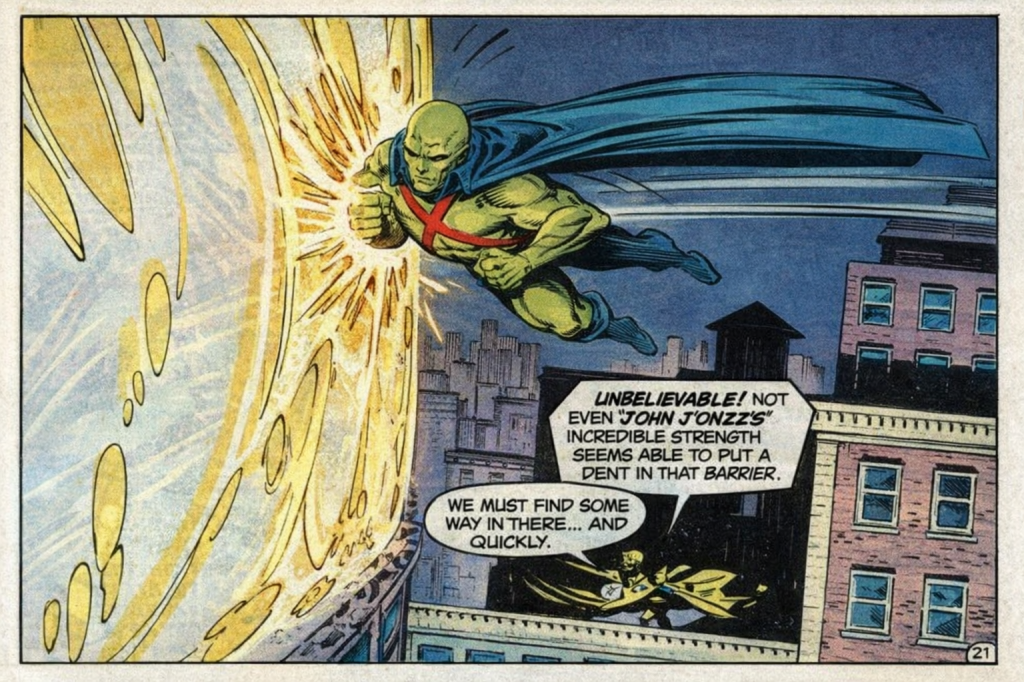
Outside the barrier, the Justice League represents the third — and perhaps most frustrating — version of isolation.
They are cut off from a conflict that will decide the fate of their world.
From their perspective, the situation is simple — or at least it appears to be. There is a volatile, immensely powerful being inside an energy construct, engaged in a confrontation they cannot fully see or hear. That being has already fought them once. He has already demonstrated that he is unstable, unpredictable, and potentially catastrophic.
So they interpret what’s happening the only way they can. As a threat. Their vantage point from what is happening inside the barrier isolates them from context.
They don’t hear the conversation between the Weird and Jason. They don’t understand the Macrolatts, the nature of the bridge, or the stakes of what’s unfolding inside that cube.
All they can see are fragments. So they respond the way they always do. They try to contain it. To break through, to assert control, to bring the situation back into something recognizable. It’s not the wrong instinct — it’s the only one they have — but it’s completely ineffective. Their strength, which normally defines them, becomes irrelevant in the face of something they don’t understand.
And when the barrier finally drops, that lack of understanding doesn’t resolve. Like The Jason, it hardens.
The Weird tries to explain. He tries to communicate what’s coming, what he’s just done, why it mattered. But by that point, the League has already made its decision.
They subdue him. And they do it at the exact moment when understanding would have mattered most — when the Macrolatts arrive, when the real danger finally steps into the open.
That’s what makes their failure so striking. It isn’t a failure of strength. It’s a failure of perception.
They have the power to help. They have the ability to change the outcome. But they are too isolated from the truth.
A Battle No One Can Share
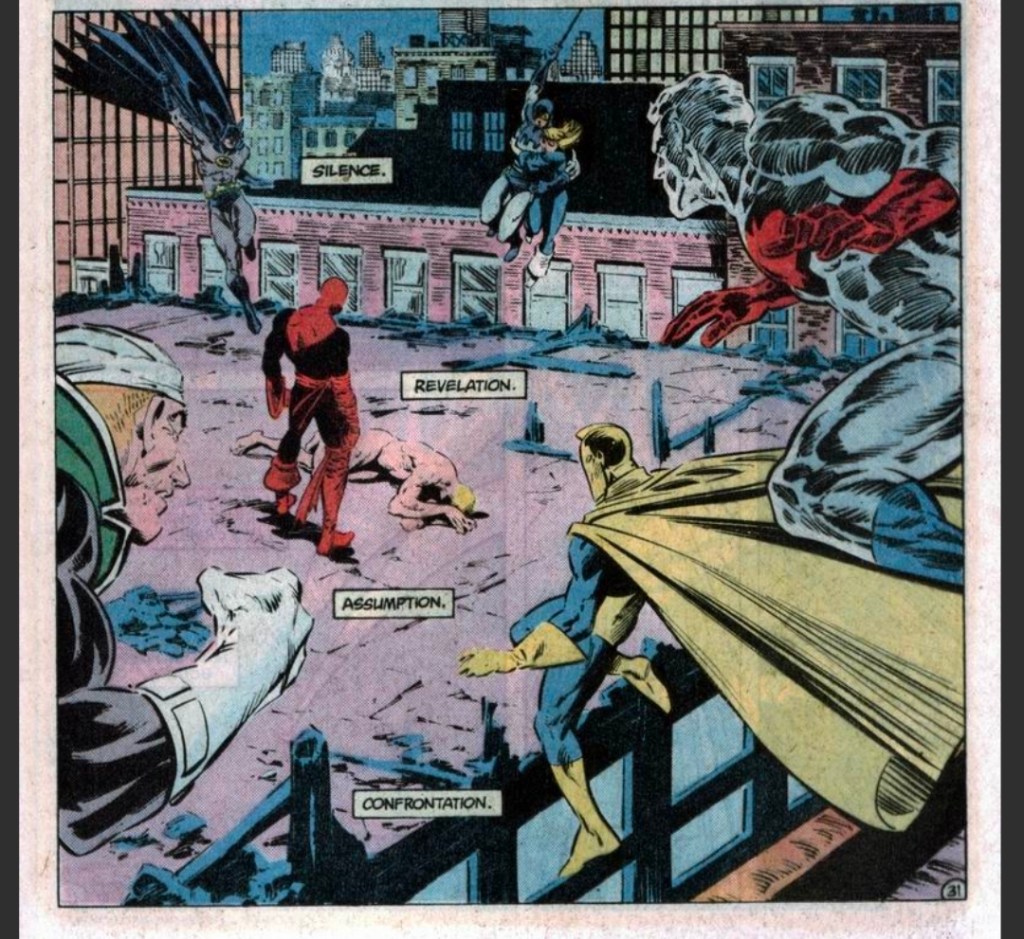
What makes the central conflict so effective isn’t just the action. It’s the number of battles happening at once — and the fact that only one of them is visible.
On the surface, the Weird and the Jason are locked in a physical fight. Power against power. Energy against energy. It’s the kind of confrontation you expect from a story like this — two beings colliding in a space too volatile for anyone else to enter.
Then we get a different kind of battle as the Weird tries to reach Jason theough his humanity. He’s trying to reach Jason.
He explains the Macrolatts. He explains the bridge. He explains what will happen if this continues. Again and again, he tries to pull Jason out of the path he’s chosen, to make him see what’s actually at stake.
And every time, he fails. That’s the second battle — the one between understanding and denial. And it’s the one the Weird loses.
Which leaves him with the third and final conflict. The one he can’t avoid.
Up to this point, the Weird has existed in a strange space between observer and participant. He studies humanity. He learns from it. He begins to feel what it feels. But he still operates with a kind of distance — as if he can understand human behavior without fully stepping into it.
This is the moment that changes. Because now he’s forced into a decision that has no clean answer.
He has to stop Jason.
And that means doing something he has already decided he wouldn’t do. He has to take a life. That’s the real battle no one else can share.
Not the fight inside the cube, but the one happening inside the Weird himself — the moment where understanding gives way to action, and observation gives way to consequence.
He doesn’t come out of it unchanged. He acts. And then he mourns. For the first time, he isn’t just studying humanity. He’s part of it.
Up to this point, the Weird has been isolated from the messier parts of being human — the compromises, the moral gray areas, the decisions that don’t have a right answer. In making this choice, he crosses into that space for the first time.
And in doing so, he becomes isolated in a new way. Because some experiences don’t bring you closer to others.
They separate you from them.
Power and Isolation
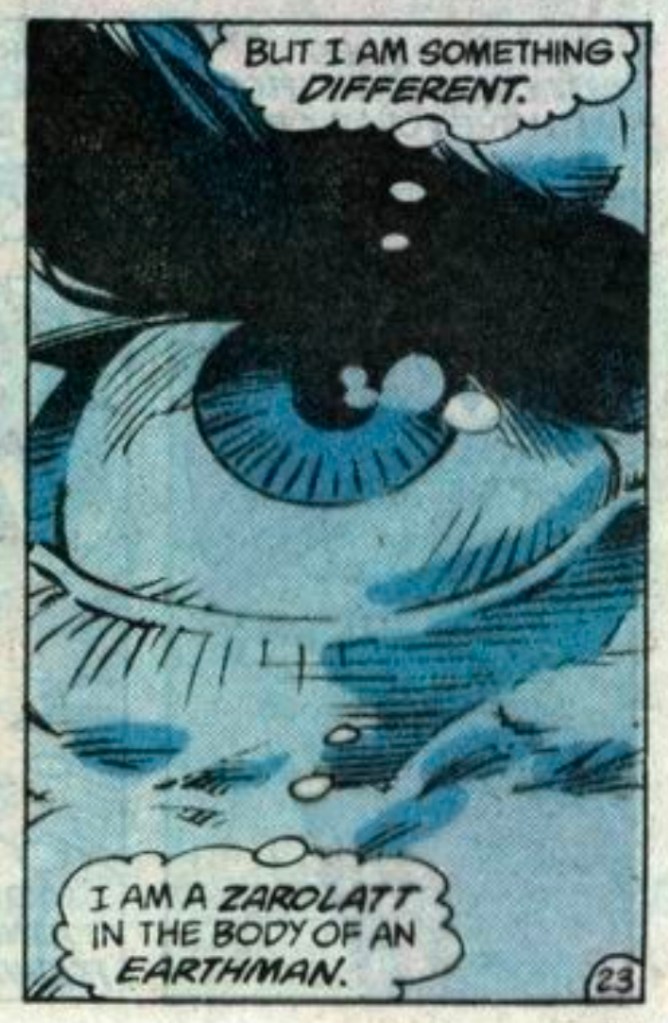
By the end of Issue #3, the pattern the series has been building comes into focus. If Issue #1 showed how power creates fear, and Issue #2 showed how power can create arrogance, Issue #3 reveals something quieter, but far more dangerous. Power doesn’t resolve isolation. It deepens it.
Jason’s isolation turns power into entitlement — a way to force the world to recognize him, to validate something he already believed about himself.
The Weird’s isolation turns power into responsibility — forcing him to act alone and carry consequences no one else will share.
And the Justice League, for all their strength, find themselves isolated in a different way — not by distance, but by perception. They have the power to intervene. But they lack the understanding necessary to apply it.
That’s what makes this issue land the way it does. Not because power fails. But because power, without connection, has nowhere to go.
In the end, the question isn’t who has the power.
It’s who is able to use it in a way that actually reaches beyond themselves.
The Weird – Entry #3
 Everything
Leave a comment