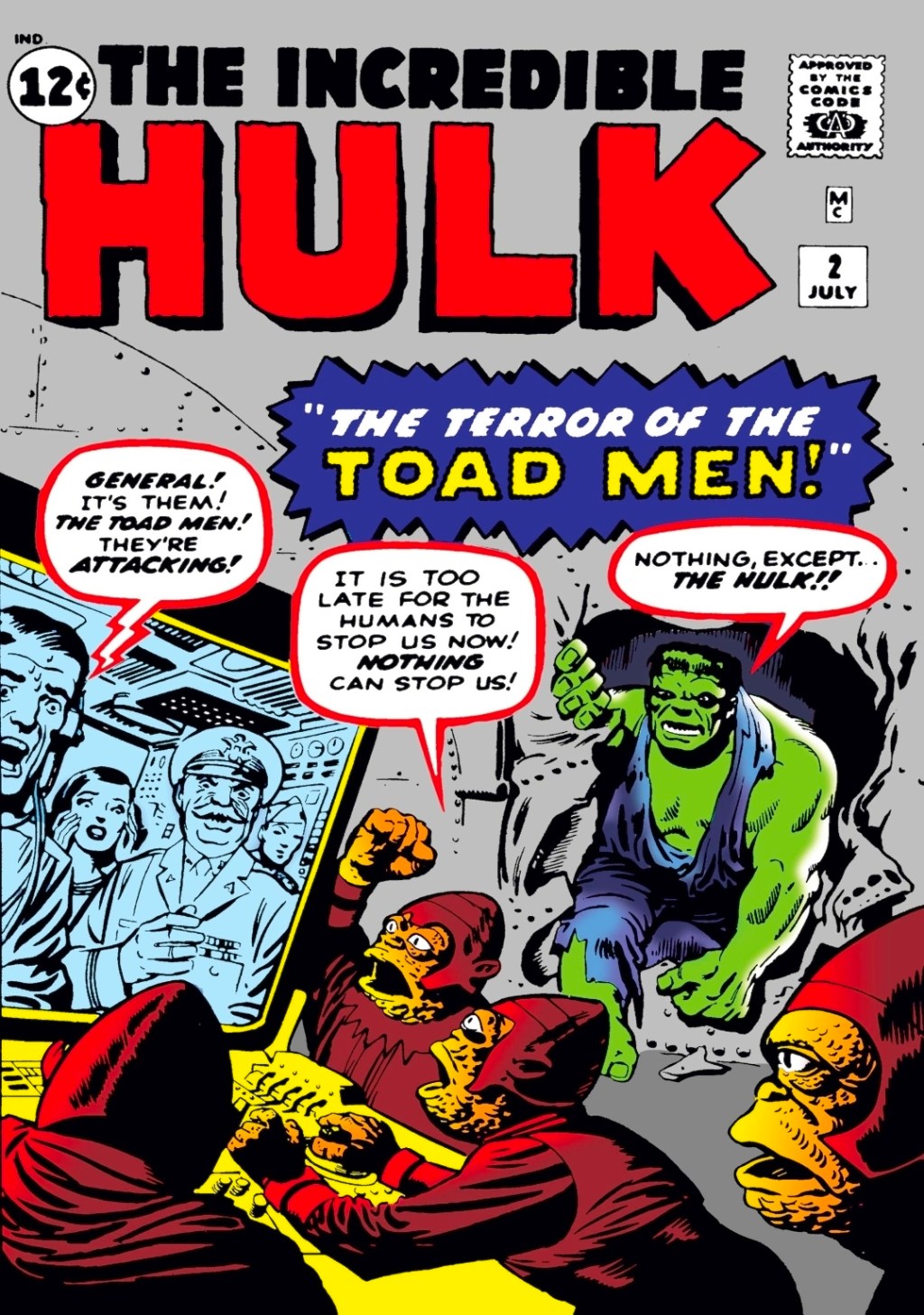
Written by Stan Lee – Penciled by Jack Kirby – Inked by Steve Ditko – Lettered by Art Simek
The issue where the Hulk turns green.
Right away: he’s green.
No explanation. No in-story justification. Just suddenly green.The face is more gaunt too, thanks to Ditko. He looks closer to Universal’s Frankenstein now — especially with that green skin evoking those old Boris Karloff posters. It’s funny how casually it happens, considering how iconic that color becomes.
Seeing Steve Ditko ink Jack Kirby is wild. You can feel two dominant visual styles colliding. Kirby’s explosive layouts filtered through Ditko’s sharper, more angular finishes. It doesn’t feel smooth. It feels like two heavyweights boxing each other in every panel.
The story itself? Pure 1950s B-movie chaos.
Toad Men from outer space. Alien abduction. Mind control. Nuclear brinkmanship. At times it feels like every sci-fi paranoia trope got dumped into a single issue. It’s the kind of plot that would absolutely play on Mystery Science Theatre 3000 at 2 a.m.
Lee and Kirby are still pulling from that anthology well. The exposition is thick. The threat is cosmic and immediate but also disposable. Everything seems to be business as usual for an early Marvel comic.
And then the Hulk picks up a ray gun.
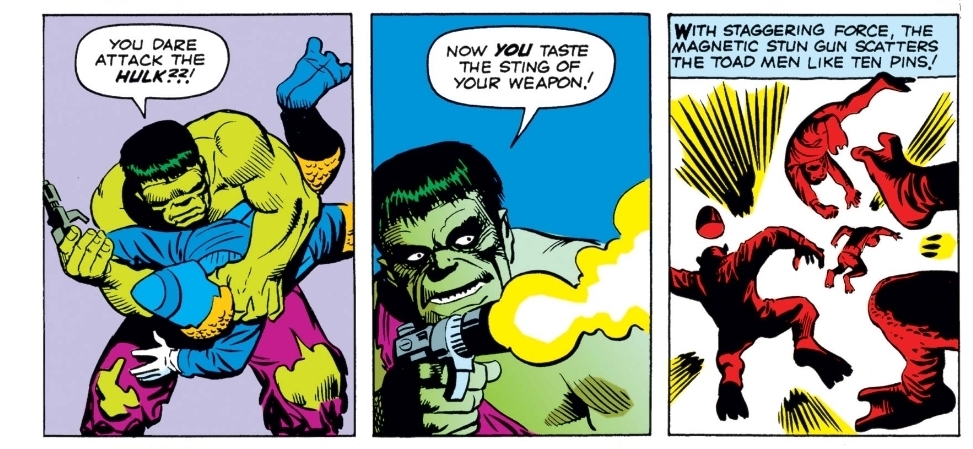
That panel alone deserves to be preserved forever and displayed in a museum. The Hulk — the future symbol of raw, primal strength — casually firing alien tech like he hadn’t just wandered into the wrong genre. It’s absurd and kind of amazing and really reinforces that, even two issues in, Lee and Kirby don’t quite know what to do with the Hulk.
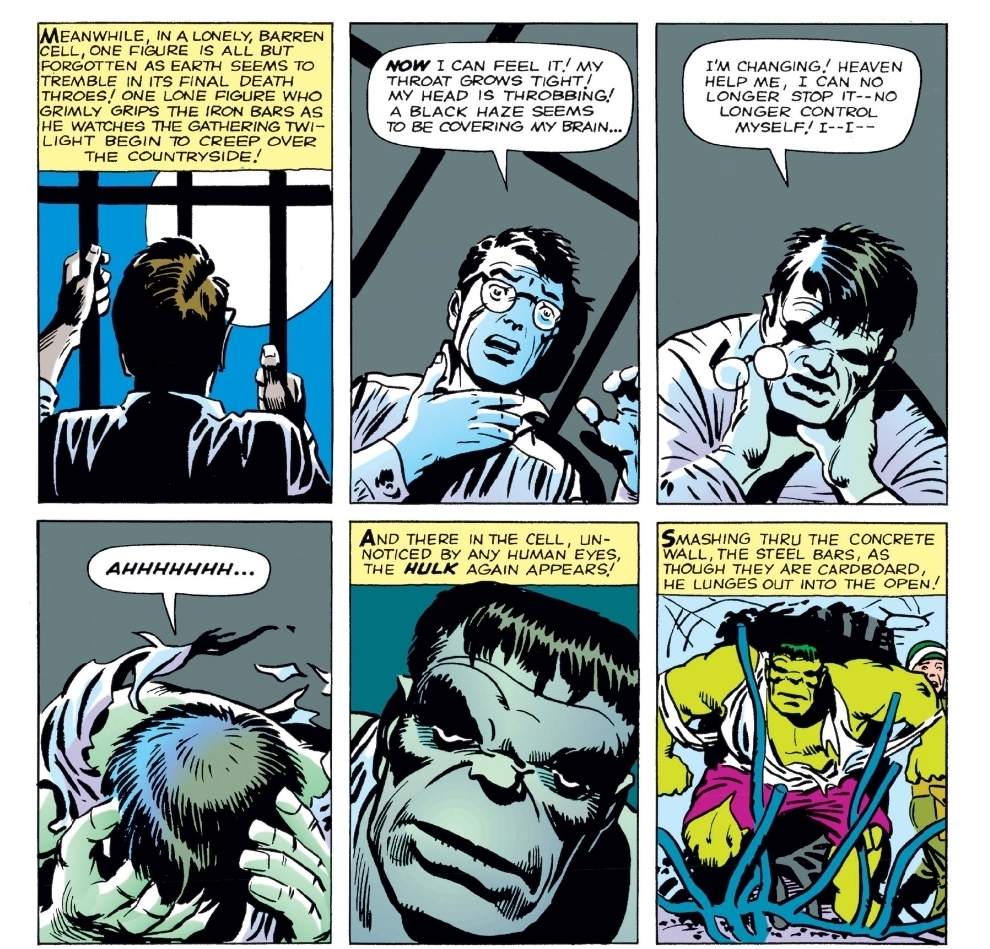
But there is some stuff here that does work. The transformation from Banner to The Hulk still hinges on moonlight, which gives Kirby a chance to slow this book down. He uses multiple panels to let the change breathe. The atmosphere is eerie. There’s something genuinely moody about those night sequences.
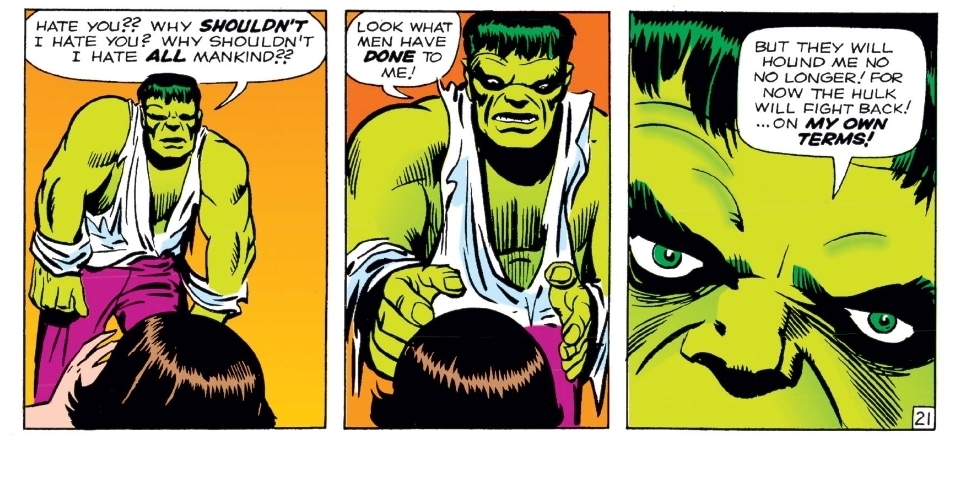
Something else I found interesting is that the Hulk here isn’t dumb.
He speaks clearly. He schemes. He hates mankind. He’s bitter and vindictive — he is closer to Namor in temperament than the childlike Hulk that eventually emerges. There’s a real menace to him. When he goes on one of his rants, you really don’t know if he will go over that edge from anti-hero to villain.
Banner, meanwhile, is arguably the true hero of the book. He’s hunted as a suspected spy, scrambling to stop both the alien invasion and the monster he becomes. The duality is stronger here than in the debut issue. Banner is proactive. The Hulk is reactive.
There’s no real hint yet that this book is part of a larger shared universe. If Fantastic Four is beginning to build continuity, Hulk still feels isolated — like a science horror book running parallel rather than intersecting.
But you can already see Marvel adjusting its emotional blueprint across titles.
Ben Grimm started as the angry monster who wanted to smash everything. The Hulk takes that role and the bitterness and amplifies it. Eventually, that anger will be reshaped into something more tragic.
Right now, though, he’s mean.
He’s green.
He’s radioactive.
And he’s firing ray guns at alien Toad Men.
It’s a messy issue. It’s overloaded. It’s atomic-age sci-fi turned up way too high.
But it’s fascinating to watch Marvel try to figure this out in real time.
They have a Hulk, they just don’t know what to do with him yet.
Marvel in the 60s – Entry #10
 Everything
Leave a comment