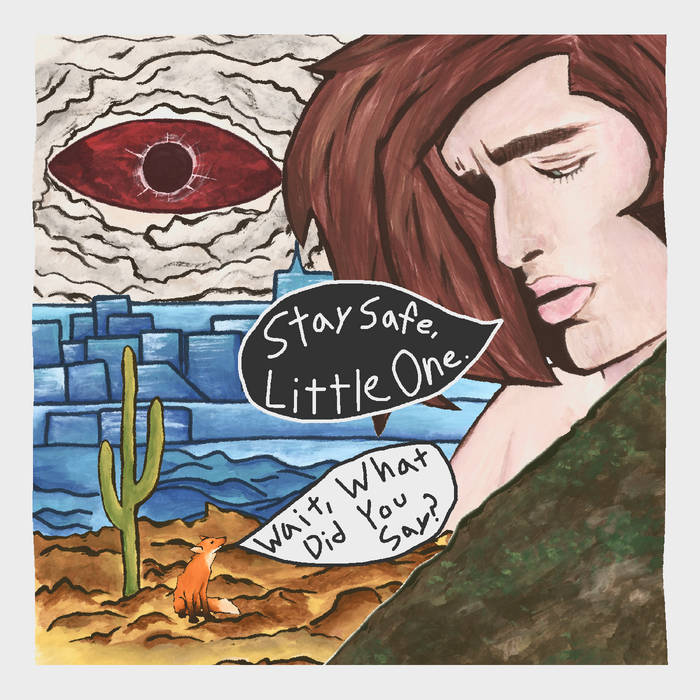
Album by Wait, What Did You Say?
I went into Stay Safe, Little One. mostly taken by how immediately enjoyable it sounds.
Wait, What Did You Say? makes fuzzy, messy indie rock that can suddenly snap into some incredibly catchy power pop. Guitars buzz and distort, vocals sometimes sound like they’re fighting their way through the noise, and songs can move from something small and intimate into these enormous walls of sound.
At different points I thought of bands like Weezer, Silversun Pickups, Radiohead, and even Foo Fighters—not necessarily because the album sounds specifically like any of them, but because it moves around in some of those same spaces.
And for a while, it’s easy to get swept up in that.
But the more I listened to Stay Safe, Little One., the more worried I became about the person at the center of these songs.
There are recurring thoughts about loneliness, isolation and wanting another person to provide some kind of stability. There’s the fear that you’re driving them away. There are moments of recognizing unhealthy behavior and understanding what needs to change, only to retreat back into the same habits because changing is much harder than knowing you should.
I don’t hear it as a clean progression from one emotional state to another. It feels more like a cycle.
“The City” opens with this strange combination of energy and anxiety. The guitars are fuzzy and distorted, the vocals sit inside all of that noise, and yet there’s something immediately catchy about it. Lyrically, the world itself seems almost hostile, with the weather, water and people all becoming things to fear.
“Would It Kill You To Just Be A Little Less Loud???” pushes further into that tension. There’s still a playfulness to the music, but underneath it is the realization that being around someone can bring out a version of yourself you don’t particularly like. You know something needs to change. Actually making that change is considerably harder.
Musically, “Buddy” is warmer and more inviting, and there’s even some self-deprecating humor. But underneath that is a longing for connection tangled up with the recognition that you may not be in a place where reconnecting with someone would actually make anything better.
“Coward.” feels like another part of that cycle. It’s barely more than two minutes, but there’s a blunt desire to be anywhere other than where you are, immediately followed by the inability to actually leave.
“Illiterate (Lol do you get it)” pushes that longing even further. It almost feels less like pining for one particular person than for the idea of finding someone — a best friend, a lover, somebody who might finally fill that space. But when so much of your self-worth depends on whether another person finds you funny, intelligent or desirable, wanting that connection can become its own kind of trap.
By this point, a pattern has emerged. These songs are full of people who seem remarkably capable of recognizing what’s wrong. They know when a relationship is unhealthy. They know when their own behavior is making things worse. They know when they need to leave, let go or change. Knowing what would make you healthier and actually being capable of doing it are two very different things.
While thematically heavy, the album keeps refusing to sound miserable. There are bright riffs, big guitars and moments that verge on straight power pop. It can be melodic and immediately catchy, then fuzzy and distorted, then stripped down and melancholy, sometimes over the course of a single song.
Underneath the haze are incredibly precise melodies, riffs and choruses. They’re polished rock songs deliberately buried beneath fuzz, distortion and noise.
“You Shouldnt Listen To Me” is one of the clearest examples of the album turning back on itself. There’s regret over everything left unsaid and a desire to somehow fix what happened, but even the confession comes with its own defense mechanism. Here are all the things I should have told you. But you probably shouldn’t listen to me anyway.
“Fall” is a tiny break in all of this, built around the changing weather and the hope that maybe it will finally turn cold. There’s something almost comforting about the idea of winter, when isolation can feel natural—an excuse to stay inside and be alone. The music softens as the vocals almost seem to float away.
“I Slept For Twenty-Four Hours” is one of the album’s strangest combinations of accessibility and darkness. Underneath the usual haze and distortion is this bright, melodic power-pop song, with driving guitars and a chorus that keeps rising. But lyrically, it feels like depression swallowing entire stretches of time—sleeping through the day, waking up at strange hours and finding yourself increasingly disconnected from your own life.
“Whats A Song About?” is funny and self-aware, wrestling with the idea of writing a song and whether you can actually make it mean something to someone else. Fittingly, it’s also the catchiest song on the album, with a great riff and a cleaner power-pop sound before the fuzz starts creeping back in.
“721” is seven minutes and 21 seconds long, and it feels like the album’s opus both musically and emotionally.
It begins relatively spare, with electric guitar and an earnest vocal. Then the guitars get bigger and chunkier. The song pulls back. Then it gets loud again. It retreats again. Each time it returns, it feels like there’s more pressure behind it until eventually the entire thing explodes into this fuzzy, hazy, distorted anthem.
“Everythings Worthless! Everythings Worth It.” begins acoustically and, for roughly its first half, stays relatively small. Then, like so many songs on this album, it begins to grow. The music gets larger as the emotion does, and the swell seems to arrive around the song’s most important decision: choosing life.
For a moment, it’s almost triumphant. But the album doesn’t end on that triumph. After the big emotional release, there’s a very short return to the acoustic refrain. Everything shrinks again. It’s almost like the song places a question mark after its own hopeful ending.
And I think that’s why Stay Safe, Little One. ultimately worked so well for me. I spent much of the album worrying about the person I heard at the center of these songs. Wanting someone else to provide stability, recognizing destructive behavior and understanding that something needs to change never means that change actually comes easily. But the ending isn’t hopeless.
We haven’t suddenly arrived at spring. Maybe we’re still in fall, hoping for winter. But for now, after an album filled with reasons why everything might feel worthless, there’s one small positive action that matters enormously.
Choose life.
Verdict: Solid
Explore more from Wait, What Did You Say?


Leave a Reply