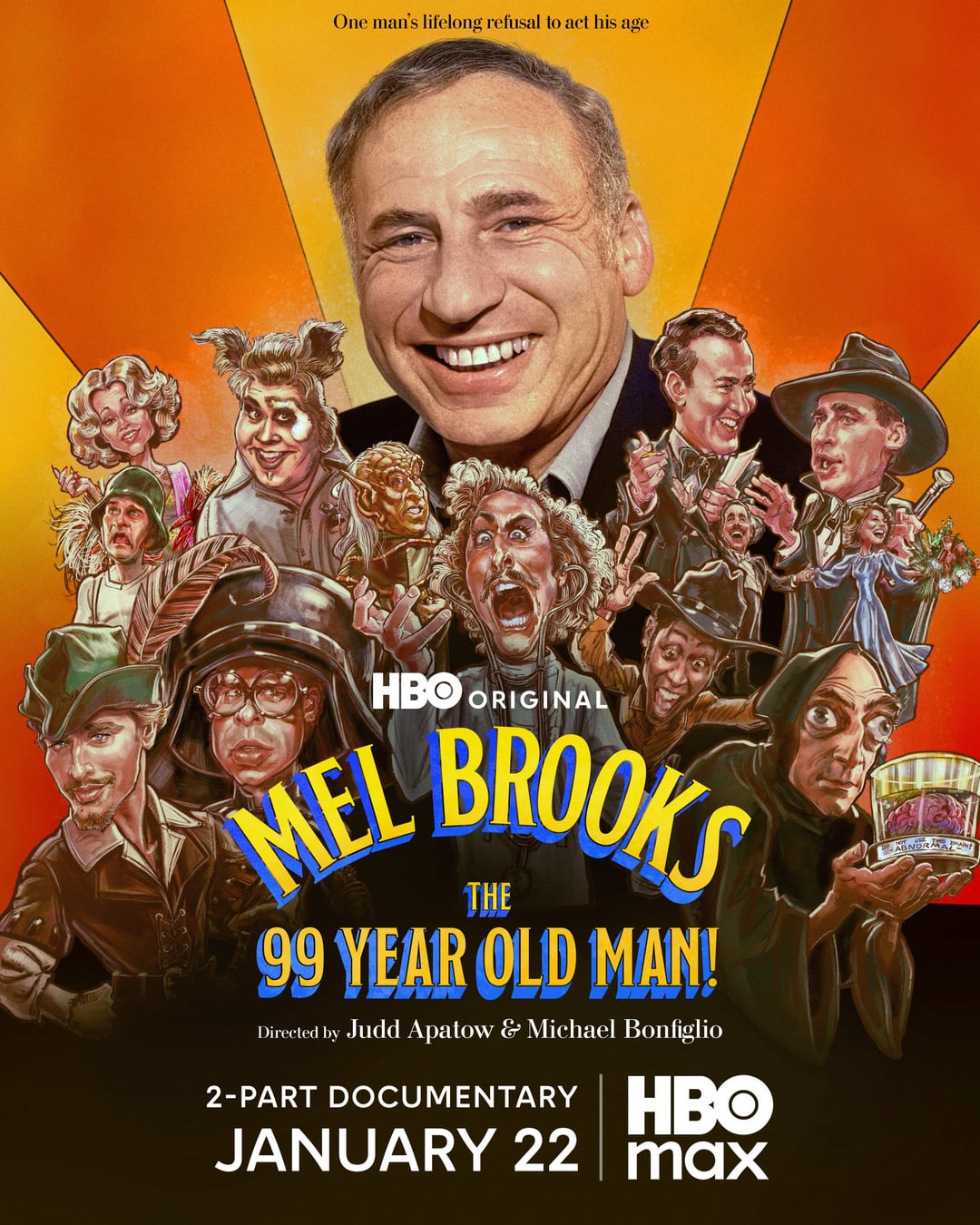
Directed by Judd Apatow and Michael Bonfiglio
I’m a pretty easy audience for a documentary about Mel Brooks.
I grew up with his movies. Young Frankenstein, Blazing Saddles, High Anxiety, History of the World, Part I — these are movies that have been part of my life for as long as I can remember. So a two-part documentary celebrating his life and career is right in my wheelhouse.
And Mel Brooks: The 99 Year Old Man! is very much a celebration. Judd Apatow is clearly a fan, and this isn’t an attempt to tear Brooks apart or dramatically reconsider his legacy. It spends several hours looking back at an extraordinary career, filled with clips, interviews, stories and a ridiculous number of funny people.
But it also doesn’t completely sand down the more complicated parts of his life. Brooks served in the Army during World War II, an experience that clearly stayed with him long after he returned home. The documentary discusses struggles that today might be recognized as PTSD. It also gets into the enormous ambition that drove his career and the toll that sometimes took on his personal life, including his first marriage.
From there, you get the history: television, Your Show of Shows, Carl Reiner and The 2000 Year Old Man, The Producers, and eventually his incredible run of movies, including the more serious films he produced, like The Elephant Man and The Fly.
Looking at all of it together, you realize how unusual Brooks’s comedy really is. This is a man who understood that you could make a fart joke and have something to say about the world at the same time.
His movies can be incredibly stupid and incredibly smart, sometimes within seconds of each other. He uses comedy to go after racism, fascism, religion, politics, wealth, Hollywood and people in power, then happily follows that observation with the dumbest joke imaginable. For Brooks, those things have never been mutually exclusive.
There is also something remarkable about the number of generations Brooks has managed to reach. Someone could have discovered him through The 2000 Year Old Man. Someone else through The Producers or Blazing Saddles. For another generation, it might have been Spaceballs. His career stretches across so much time that Brooks isn’t simply someone whose work survived. His work has been handed from one generation to another.
That’s where this documentary became something more personal for me.
At 99, the number of people Brooks has had to say goodbye to is impossible to ignore. Anne Bancroft. Carl Reiner. Gene Wilder. Friends, collaborators and people he loved.
One of the smartest things Apatow and Michael Bonfiglio do is weave Brooks telling stories for this film with footage of him telling those same stories years or even decades earlier. You see different versions of Brooks overlapping, with the same jokes and the same affection for the people he loves.
We use the phrase “lay someone to rest,” and I started thinking about what that can mean beyond physically saying goodbye. Sometimes after someone dies, the way we talk about them changes. They become someone we commemorate. Someone we miss. Someone we used to know.
Watching Brooks, I started wondering whether I’ve done some of that with my mom, who died a few years ago and, oddly enough, would have celebrated her birthday the same week I watched this documentary.
There are so many parts of me that came from her. My love of eggplant parmesan. Old horror movies. Music. Books. The way I cook. The way I wash and dry dishes.
There are hundreds of pieces of who I am wrapped up in who she was, including a mutual love for Mel Brooks.
Young Frankenstein was one of her favorite movies. I can’t watch it without some part of my brain also seeing my mother sitting on the couch laughing for the hundredth time at “Put the candle back!”
The same thing happens with Blazing Saddles, History of the World and a half dozen other Mel Brooks films that she showed me when I was much too young to understand all of the jokes.
Movies she probably shouldn’t have let me watch at ten years old.
I’m glad she did.
Watching Brooks talk about Bancroft, Reiner and the other people who filled his life made me realize something. He doesn’t just talk about people who died. He tells stories about people he loves.
There is a difference.
The documentary shows Brooks telling some of these stories when those people were alive and telling them again after they’re gone, and the love doesn’t suddenly switch into the past tense. They’re still funny. They’re still important. They’re still part of his story.
Maybe that’s something I can learn from.
I don’t have to talk about my mom only in the context of losing her. I can talk about her the same way I would have if she were still waiting for me to call her on a Sunday night.
The 99 Year Old Man is a funny, affectionate documentary about one of the great comedy careers. There are wonderful stories, a lot of laughs and something genuinely amazing about watching Mel Brooks at 99, still incredibly sharp and still able to make people laugh.
But what stayed with me was something I didn’t expect to find in a Mel Brooks documentary.
Maybe one of the ways we keep the people we love with us is by refusing to lay their stories to rest with them.
We keep telling them.
Over and over.
Even if everybody already knows the punchline.
TV Verdict: All In


Leave a Reply