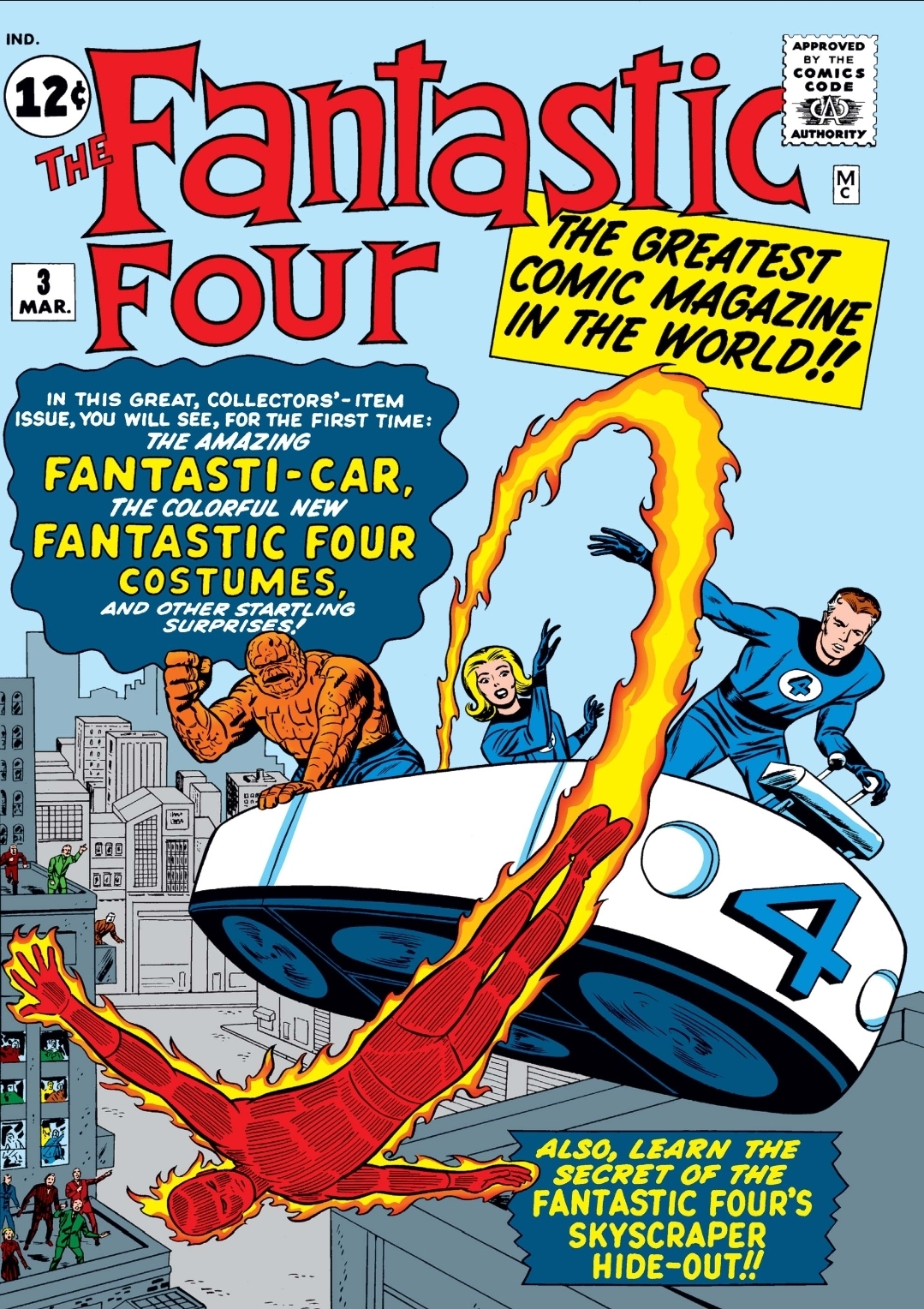
Written by Stan Lee – Penciled by Jack Kirby – Inked by Dick Ayers – Lettered by Art Simek
It’s remarkable how much changes in just a few issues. Barely four months after their debut in November 1961, the Fantastic Four already feel less like a chaotic sci-fi experiment and more like an intentional superhero team.
The street clothes are gone. In their place: the iconic matching blue uniforms with the “4” insignia on the chest — revealed to be Sue’s design, which somehow makes it even better. These costumes don’t just materialize. They’re part of the story. They’re intentional. And for the first time they look like a team instead of four volatile individuals.
That shift is bigger than it seems.
Up through issue two, this book still felt like a 1950s monster and science-fiction comic that happened to feature recurring characters. By issue three, Marvel seems to decide this is something else.

The Fantasticar arrives — modular, slightly absurd, wonderfully kitsch. We even get exploded-view diagrams of their headquarters, packed with labs, gadgets, and branded vehicles like the Pogo Plane and the Fantasti-Copter. Future staples. Lee and Kirby are creating infrastructure. The book isn’t just introducing characters anymore — it’s creating a world.
Reed leans further into being an inventor — less pipe-smoking professorial adventurer, more resident genius building a future out of spare parts and Jack Kirby’s limitless imagination. Johnny’s flame form sharpens into something more iconic. Ben, still lumpy and uneven, now stands in uniform like he’s trying to belong to something.
And Kirby starts getting more inventive with Reed’s powers. Instead of simply stretching, Reed becomes a giant rubber sphere, bouncing and dodging bullets in a way that feels playful and timeless. It’s less horror mutation, more superhero spectacle. The powers are no longer frightening — they’re fantastical.

We also get our third origin recap in three issues. Marvel still isn’t entirely convinced you remember how this happened. But through repetition, the cosmic accident is becoming myth.
And then there’s the romance plotline unique to costumed heroes at the time.
The Reed/Sue/Ben triangle is awkward. It’s uncomfortable. Ben’s jealousy isn’t subtle. It doesn’t always land gracefully, but it does something important. The book allows ugly human emotion into the frame — insecurity, resentment, longing. You can almost see the romance-comic DNA bleeding into the superhero structure.
Johnny’s frustration and departure during the conflict doesn’t just add drama — it’s further proof that this book generates tension through emotional confrontation, not just punching. The team isn’t seamless. It’s combustible. These characters aren’t copies of each other. Square-jawed and stoic. They’re treated like living, breathing individuals full of all the good and bad that being human comes with.
That instinct — to let heroes be messy — becomes one of Marvel’s defining traits.

Miracle Man himself still carries pulp energy: atomic crime, spectacle, Cold War tension. The 1950s atmosphere hasn’t disappeared. The story is still broken into chapters. Kirby’s clothing designs remain sharp and busy. The world feels bright, structured, optimistic. This is still pre-1963 America — there is a sense of confidence without the coming tensions this decade will bring to the real world.
But the horror edge is softening. The science fiction is less about dangerous consequences and more about flying cars. The monsters now wear uniforms.
On the cover, Marvel adds the tagline “The Greatest Comic Magazine in the World.” It’s bold, brash, and self-promoting. But more than that, it signals that something real is shifting here and the book knows it’s building an identity.
By the end of issue three, the Fantastic Four aren’t just a sci-fi curiosity. They’re a team. A headquarters. A vehicle. A mythology. A superhero book with emotional baggage.
The monsters have uniforms.
Marvel in the 60s – Entry #4

Leave a Reply