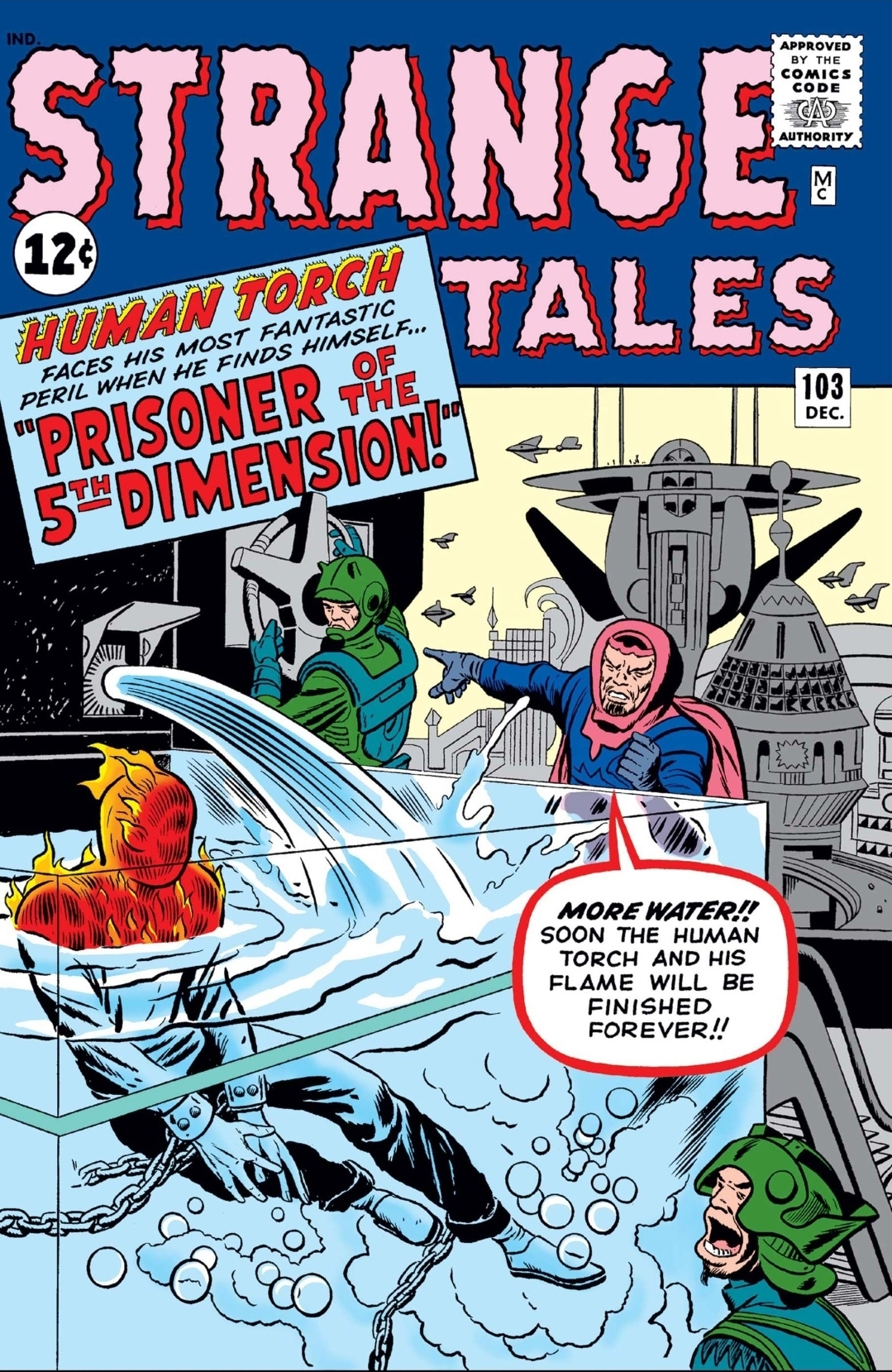
Plot by Stan Lee – Scripted by Larry Leiber-Penciled by Jack Kirby – Inked by Dick Ayers – Lettered by Art Simek
The Human Torch feels pasted into anthology stories.

Johnny Storm continues attending high school like a normal teenager, despite being one of the most recognizable superheroes in the country. The secret identity still doesn’t make any sense, but Marvel keeps insisting on it, and the more they insist, the stranger it becomes.
Still, Kirby keeps evolving.
The Torch looks more dynamic with every appearance. The flying poses are stronger. The action feels faster. There’s a growing confidence to the visuals that the stories themselves still struggle to match.

Because this is pure anthology storytelling.
The plot barely even starts with Johnny. Instead, the issue feels like one of Marvel’s old sci-fi mystery comics — sinkholes, swamp legends, nervous locals, old farmers warning about monsters in the dark. If you removed the Human Torch from this story entirely, the setup would still work almost exactly the same.
There’s even a Reed Richards appearance — the third Fantastic Four cameo in as many issues — where he sends Johnny to investigate.
And that’s where The Torch becomes fully inserted into anthology territory.

The swamp is actually a gateway to another dimension, ruled by strange alien beings and an evil despot named Zemu. Johnny is pulled into this world, and while the story itself is clunky, Kirby gets to cut loose creatively.
Alien architecture. Strange flying ships. Unusual creature designs. Entire cities from another dimension. This is exactly the kind of material Kirby was built for.

The actual plot, unfortunately, is much less convincing.
The “swamp demons” turn out to be interdimensional beings. The old farmer warning the townspeople is revealed to be one of them. Johnny immediately falls in love with a princess from another dimension. A rebellion forms. An authoritarian ruler is overthrown.

By the end, Johnny helps overthrow Zemu, restores the rightful rulers, says goodbye to his alien princess, and returns home in time to get yelled at for daydreaming in class
And while the plot feels a little ridiculous and threatens to collapse under its own weight, you can still see Marvel searching for something.
Because, while not very good, this story reveals an important direction Marvel wants to take with its First Family.
This issue isn’t trying to tell a street-level superhero story. It isn’t trying to build ongoing drama. It’s trying to merge superhero comics with pulp science fiction and planetary adventure — something closer to John Carter of Mars than Fantastic Four in 1962.
And yet, this kind of interdimensional adventure does eventually become a defining feature of the Fantastic Four. Traveling to other planets. Facing off against impossible technology and fantastical alien beings.
They want to merge the two.
They just don’t quite know how to do that yet.
Marvel in the 60s – Entry #25

Leave a Reply