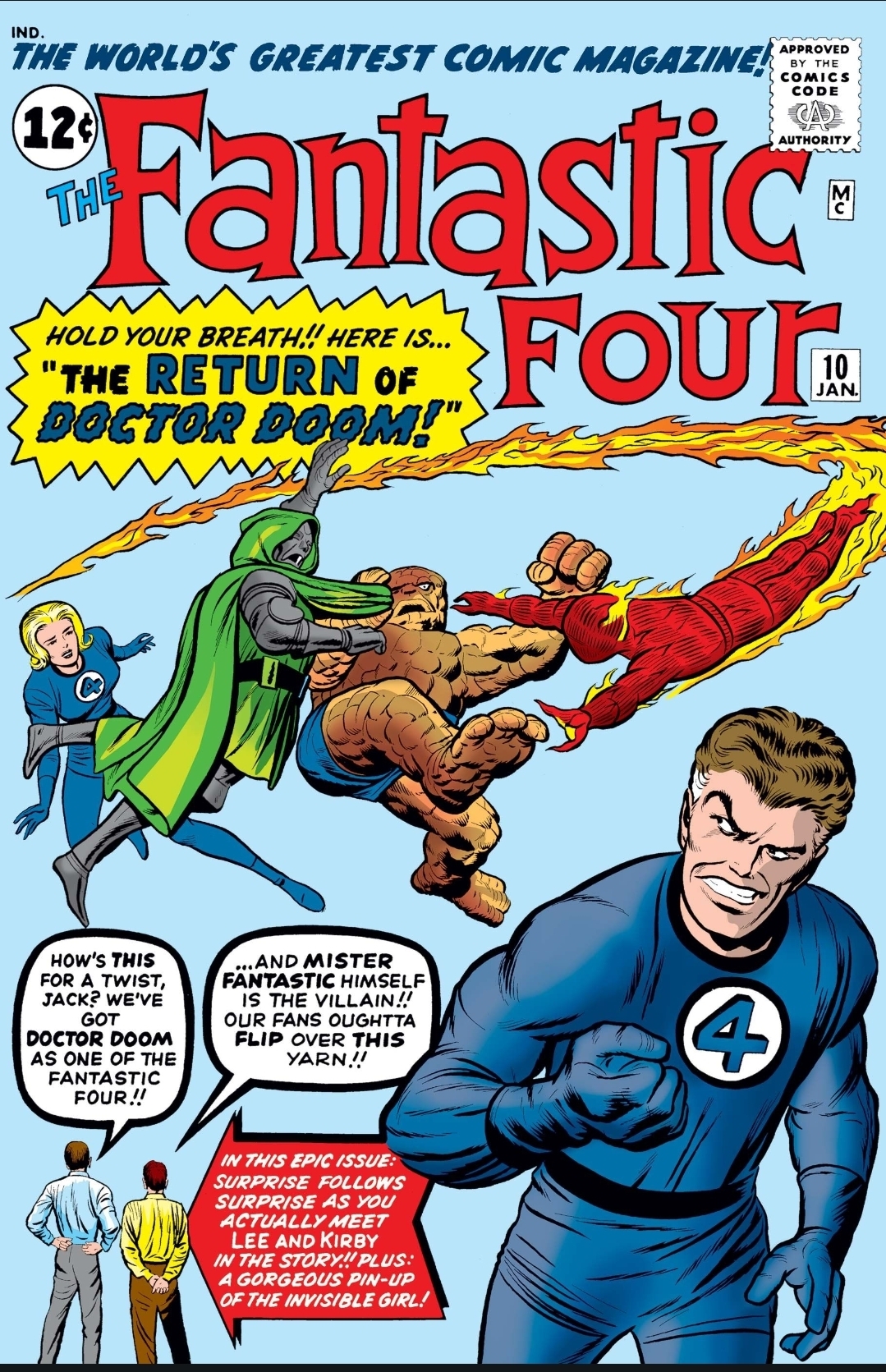
Written by Stan Lee – Penciled by Jack Kirby – Inked by Dick Ayers – Lettered by Art Simek
Fantastic Four #10 feels like Marvel figuring out what kind of franchise this book can become.
Doctor Doom returns.
Again.
At this point, Doom has already “died” a couple of times, but Marvel clearly understands they have something valuable in him. He’s the perfect recurring archvillain. And while he’s still very much in the mustache-twirling phase of the character, you can already see him growing beyond that.
And everything around him is evolving too.

The issue opens in a way that will soon become a staple of Lee and Kirby’s Fantastic Four run: the team hanging around the Baxter Building while Reed experiments with strange technology.
It’s a simple setup, but it immediately reinforces what this book is about — science fiction, superhero spectacle, team dynamics, and Kirby tech everywhere.
Then this issue hits another familiar beat. As the team heads to Alicia Masters’ apartment, everyone gets a moment to display their powers. It almost feels like Marvel has replaced the origin story with recurring demonstrations of what makes each member unique — a way of constantly onboarding new readers without slowing the story down.
And Alicia herself is becoming an important supporting character. Her sculptures of the Fantastic Four’s enemies — despite somehow perfectly recreating villains she’s never actually encountered — become another clever recap device. Through her artwork, the issue quickly reminds readers about Doom, Mole Man, and Namor while also reigniting the growing tension between Reed and Sue over Namor.
Which…
Yikes.
Then the comic fully breaks the fourth wall.

For the first time, Stan Lee and Jack Kirby officially appear in the Marvel Universe. Doom tricks Reed into visiting the Marvel offices under the guise of discussing a new issue of Fantastic Four, blurring the line between creator and character in a way that feels surprisingly modern.
It’s self-serving. It’s silly. And it’s kind of brilliant.
Stan, especially, already feels like a hype man turning Marvel itself into part of the entertainment. You can almost see the mythology of the Marvel Bullpen starting to form in real time.
Doom reveals he survived space by encountering a highly evolved alien race who are capable of transferring consciousness into younger bodies. Naturally, he steals their technology and swaps bodies with Reed Richards.
And from there the issue spirals into full comic-book chaos.

Doom, disguised as Reed, tricks the rest of the Fantastic Four into turning against the real Reed before embedding himself within the Baxter Building. Watching Doom work in Reed’s lab reinforces how similar these two already are — genius minds pointed in completely different directions.
It feels like the moment Doom stops being just an evil genius in armor and becomes Reed Richards’ dark reflection.
Reed escapes. He believes Alicia is the key to breaking through to the rest of the team, but instead he only enrages them further.

Back at the Baxter Building, the Torch eventually uncovers the truth through a clever trick, and Doom’s own invention ultimately shrinks him out of existence.
Or at least… for this month.
While a lot of this story seems absurd at face value — comic creators appearing as characters, alien races casually handing over body-swapping technology, Doom’s exaggerated evil grin while disguised as Reed, a reducing ray capable of shrinking people out of existence — somehow it all pushes the Fantastic Four beyond anthology storytelling and into full superhero mythology.
For the first time, all the chaos is unified instead of competing for attention. The soap opera tension. The comedy. The recurring continuity. The villain. The impossible sci-fi concepts. The celebrity creators. The visual spectacle.
It all feels like it finally clicks.

This might be the most comic-bookish Fantastic Four story yet.
Not perfect. Still occasionally awkward. Still full of Silver Age contrivances.
But Marvel is figuring it out.
At least when it comes to its First Family.
Marvel in the 60s – Entry #28


Leave a Reply