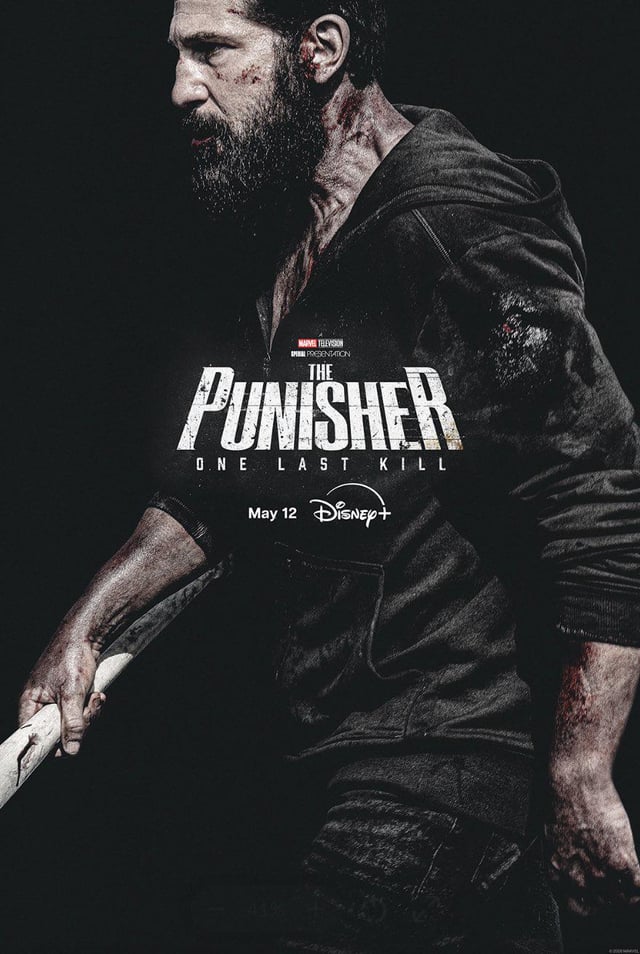
Directed by Reinaldo Marcus Green – Written by Jon Bernthal and Reinaldo Marcus Green – Starring Jon Bernthal
Minor spoilers follow.
The Punisher: One Last Kill opens with a Danzig song, which kind of tells you everything you need to know about the vibe immediately.
The special picks up after Frank Castle has seemingly completed the mission that defined his life — eliminating the final people responsible for the murder of his family. And now that the revenge is over, he doesn’t really know what to do with himself anymore.
Needless to say, when we find Frank, he is deeply unwell.
There have been a lot of versions of the Punisher over the years across comics, animation, film, and television. Soldier. Vigilante. Tactical genius. Antihero. Madman. Walking war crime. One Last Kill feels like it’s trying to pull pieces from all of those interpretations at once.
And it uses those pieces to try and give Frank something close to a character arc — which is ambitious considering this thing is under an hour long and mostly plays like one extended Punisher level from a video game occasionally interrupted by Frank Castle having a psychological breakdown.
It mostly works.
By the end, the violent gauntlet Frank fights through almost feels like a chrysalis for the character.
The first half is slow, strange, and almost mournful. Frank hallucinates dead friends, soldiers, and family members. He talks to people who may or may not actually be there. He drifts through a Manhattan that barely resembles reality anymore — a place that feels less like a city and more like an abandoned war zone.
And because the special filters so much through Frank’s perspective, there’s an interesting question hanging over everything: how much of this is real, and how much is simply how Frank sees the world now?
Because the Punisher is deep in it here. PTSD. Unresolved trauma. Suicidal ideation. It becomes a pretty harrowing examination of a man who has completely lost whatever fragile sense of purpose was keeping him together.
The second half, meanwhile, is pure chaos.
The special basically transforms into a survival-action sequence for the final twenty minutes. Frank gets trapped inside an apartment building filled with killers, innocent bystanders, and increasingly absurd levels of violence.
It’s kinetic. Bloody. Mean.
And seeing Frank move through waves of enemies while trying to keep innocent people alive taps directly into what makes the character work in the first place.
Another thing worth noting: this thing is brutally graphic — more than I ever expected Marvel to allow under the Disney umbrella.
Daredevil: Born Again has been pretty violent, but One Last Kill pushes things even further into the mature-audience corner of the MCU.
Underneath all the violence, though, there’s also a story about identity.
Frank Castle begins this story with his purpose gone. Revenge was the only thing keeping him moving forward, and now he’s forced to confront the possibility that he doesn’t actually know who he is without it.
He’s not interested in being a hero. At least not initially. He doesn’t believe in costumes, symbols, or justice in the same way characters like Daredevil do. Early on, he ignores crimes happening around him entirely. He’s basically a ghost.
But as One Last Kill progresses, something shifts.
The Punisher slowly starts moving from revenge toward protection. Not heroically. But enough that you can feel the character beginning to rediscover purpose through helping people instead of simply avenging the dead.
That’s what makes this feel less like an ending and more like a transition.
Jon Bernthal remains uniquely perfect casting as Frank Castle. He has this exhausting intensity that feels completely authentic, like the character is physically incapable of relaxing or escaping his own head. Bernthal can make Frank feel terrifying, pathetic, sympathetic, and dangerous. Sometimes all within the same scene.
That said, somebody please let this man star in a rom-com one of these days. For his own well-being, he needs to fall in love while running a flower shop.
Not everything here fully works for me.
Structurally, this isn’t much of a story. It’s thin, repetitive in spots, and more interested in mood and violence than narrative momentum. Some viewers are probably going to check out once it becomes that fragmented. And your mileage will absolutely depend on how much graphic violence you can tolerate.
Some of the dialogue is clunky too. At times, it feels like characters are dropping F-bombs simply because the show now has permission to, not because it naturally fits the scene or the character. Occasionally, it makes the dialogue feel more performatively “adult” than authentic.
Overall, I’m still not entirely sure whether I actually liked it.
But I do think it’s interesting.
And more importantly, it points toward a version of the Punisher that can exist inside the MCU while still feeling faithful to the character.
One Last Kill feels like the beginning of something else for the Punisher.
I’m just not entirely sure what that “something else” is yet.
Verdict: Worth Watching

Leave a Reply