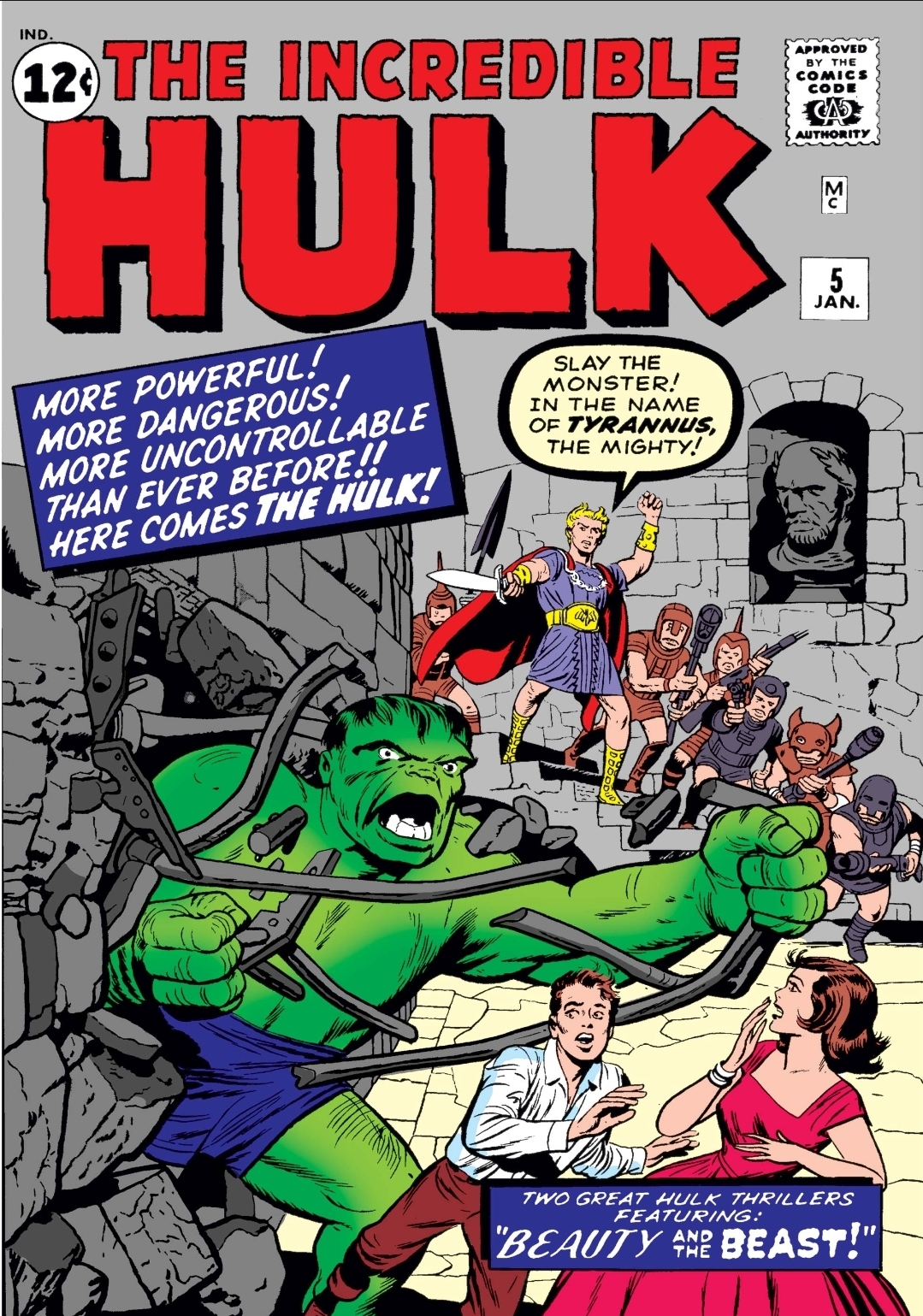
Written by Stan Lee – Penciled by Jack Kirby – Inked by Dick Ayers – Lettered by Art Simek
The Incredible Hulk #5, like the monster himself, feels like two completely different visions of the character fighting for control of the same comic.
And the better half is the one about the underground Roman emperor with the Fountain of Youth.
That’s not a sentence I thought I would ever write.

The issue opens well.
Instead of another clunky origin retelling, we get a series recap framed as General Ross briefing military officials using captured footage of the Hulk. It’s a clever way to catch new readers up while reinforcing Ross’ obsession with the monster.
Bruce is also finally back at the military base, which immediately grounds the series better than the earlier issues that had him hiding in a secret desert lab.
After the exposition, Marvel piles on the melodrama.
Betty spends much of the opening internally agonizing over her feelings for Bruce Banner because early Marvel absolutely loves romances built around people refusing to communicate honestly for twenty straight pages.
But soon enough, we veer fully into comic book territory.

Tyrannus arrives.
And it raises an interesting question: did Marvel even fully know it was building a shared universe yet? Because Tyrannus feels extremely close to Mole Man. Another ruler beneath the Earth. Another hidden civilization. Another Kirby underground kingdom filled with strange technology and armies.
It doesn’t quite feel like intentional world-building yet.It feels more like Marvel repeatedly returning to ideas it knows work.
Still, Tyrannus is interesting in his own right. Unlike Mole Man, who was driven by bitterness and rejection, Tyrannus carries himself like a theatrical Roman emperor. He claims Merlin trapped him underground centuries ago, survives through the Fountain of Youth, and plans to use America’s atomic arsenal to reclaim the surface world.
It’s an incredible mash-up of:
- Cold War paranoia
- ancient mythology
- superhero comics
- pulp science fiction
- atomic-age monster storytelling
Which means it constantly threatens to collapse into complete nonsense. And somehow, it mostly doesn’t.

Tyrannus disguises himself as an archaeologist and recruits Betty to guide him through nearby caves. Banner immediately becomes suspicious, giving us a surprisingly fun “detective Banner” sequence before the story descends into full underground fantasy adventure.
Kirby thrives there. The subterranean kingdom allows him to unleash more “Kirby tech”: spider-like vehicles, fire-breathing robots, bizarre weapons, Roman-inspired armor mixed with futuristic machinery. Visually, the issue is fantastic.
The Hulk himself is also evolving again. Or maybe mutating is the better word.
At this point, it feels like we’ve already seen four different versions of the Hulk in just five issues. Here, Banner still retains partial control, but the Hulk behaves much closer to his original incarnation: crueler, rougher, angrier, constantly resisting Banner’s influence.
Importantly, the comic itself notices this.

The narration openly suggests Banner’s hold over the Hulk is slipping, introducing the idea that Banner and the Hulk are psychologically battling for dominance.
That becomes one of the most important ideas in Hulk history. And you can already see the foundation forming here.
There’s also a strange emotional tension developing between Hulk and Betty. Even at his most monstrous, Hulk refuses to endanger her. The issue leans heavily into Frankenstein and King Kong imagery — the monster with traces of humanity still buried inside.

Eventually the story escalates into gladiator fights, collapsing underground kingdoms, and Betty conveniently developing amnesia because this is still Silver Age Marvel.
But for all its chaos, the first half genuinely feels like a compelling direction for the character.
Then we get to the second part of the book.

And suddenly Hulk is fighting “General Fang” in a Cold War adventure that somehow involves commercial air travel, Tibetan politics, holographic dragons, and the Hulk disguising himself as the Abominable Snowman.
It is absolutely bonkers.
Some of the material is interesting. The conflict feels heavily coded around China and Tibet, hinting at real-world geopolitical tensions in a way Marvel rarely approached directly.
But the story itself collapses into nonsense almost immediately.
Banner decides Hulk must intervene because “General Fang only understands brute force,” which somehow leads to Hulk reading mythology books in Banner’s cave laboratory before disguising himself as a yeti.

Because apparently the Hulk alone isn’t frightening enough.
And yet, even here, there are flashes of what the series could become.
The military pursuing Hulk. Specialized anti-Hulk weaponry. The growing tension between Banner and the monster. Hulk rampaging against armies.
The ingredients are there.
But the book is still undercooked and can’t decide what kind of character Hulk actually is. Monster tragedy? Cold War superhero? Science-fiction adventure? Atomic-age horror? This issue desperately wants to be all of them at once.
And maybe that’s why The Hulk still feels so unstable compared to Marvel’s other books.
Not because the ideas are bad.
But because Marvel still can’t seem to limit itself to the ideas that actually fit the Hulk.
Marvel in the 60s – Entry #32

Leave a Reply