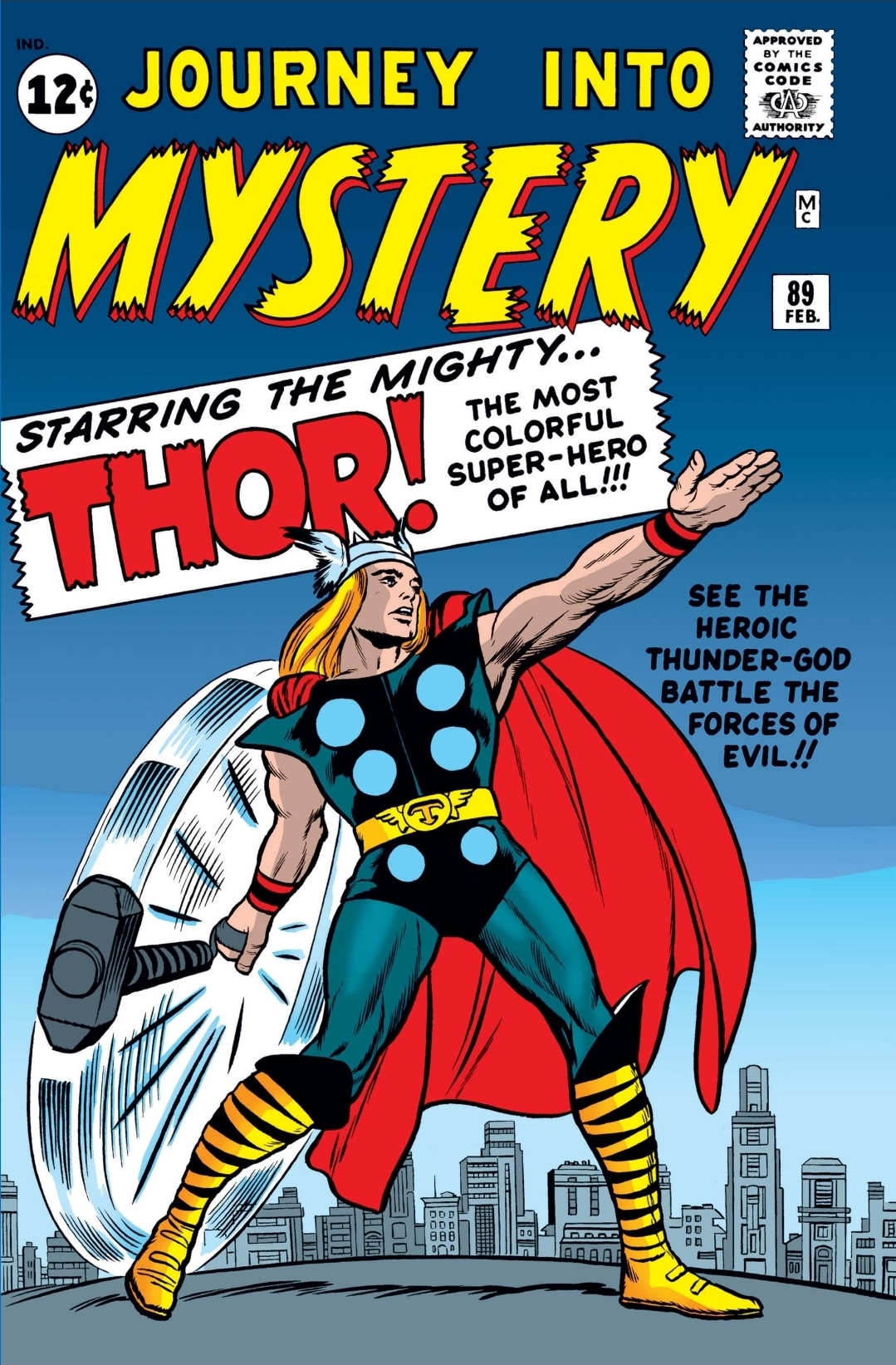
Plot by Stan Lee – Script by Larry Lieber – Pencils by Jack Kirby – Inks by Dick Ayers – Letters by Ray Holloway
After the return of Loki and Asgard in the previous issue, Journey Into Mystery #89 takes an unexpected turn.
Because this isn’t really a Thor story.
It’s a Donald Blake story.

The issue opens with a surprisingly silly sequence as Thor uses a mannequin dressed in one of his costumes to fool onlookers while transforming back into Donald Blake.
It’s goofy, but it highlights something Marvel still seems uncertain about: is Donald Blake merely a disguise for Thor, or is he a character in his own right?
The book continues wrestling with that question throughout the issue.
We also get a retelling of Thor’s origin, now tweaked to include Odin more directly. Marvel continues slowly folding Asgard into the mythology, retroactively adding pieces that weren’t present when the character debuted.
Then we get one of the stranger sequences in the series so far.

The book takes a moment to focus on Jane Foster as she laments Blake’s apparent lack of romantic interest before drifting into a fantasy about domestic life with Thor.
She imagines polishing his hammer. Ironing his cape. Giving him haircuts. Like the Fantastic Four’s Sue Storm, Jane is still largely defined by romance—a recurring weakness in Marvel’s characterization of women at this stage.
The actual villain of the issue is Thug Thatcher, a mob boss who escapes police custody after his gang stages a shootout outside Blake’s office.
It’s a surprising step backward from gods and mythology.But it does allow the comic to spend time with the human side of Thor’s world.
And for much of the issue, Blake is forced to rely entirely on his own intelligence to survive.
When the gangsters burst into his office and take Jane hostage, they force Blake to treat Thatcher’s gunshot wound.
Unable to transform into Thor, Blake suddenly becomes the protagonist in a crime thriller.
And it’s one of the more interesting things the book has done with him. For once, the tension isn’t about whether Thor can win. Of course Thor can win. The tension comes from whether Blake can survive long enough to become Thor.

Eventually the story takes a strange turn when Blake reaches out to Odin telepathically.
Odin responds by magically guiding Blake’s cane back into his hands, allowing him to transform.
It’s also one of the earliest moments that really treats Blake and Thor as the same person rather than two separate identities.
Odin repeatedly refers to Blake as his son, and the distinction between the two feels increasingly blurry.
Once Thor appears, the conflict becomes considerably less balanced.
Thor versus a mob boss is roughly the equivalent of a meteor fighting a chicken.

Thor casually dispatches the gang, demonstrates powers ranging from super-breath to what appears to be super-ventriloquism, and chases Thatcher through a construction site.
After the fight is over, Thor unveils yet another power that feels invented specifically for this issue, erasing Thatcher from his girlfriend’s memory and allowing her to move on with her life.
Which raises approximately a thousand ethical questions the comic has no interest in answering.
The story itself feels slight. The mythology takes a back seat. The villain is forgettable. And yet, the issue still accomplishes something important.
It reinforces that Thor’s world isn’t only about gods and monsters. It’s also about Donald Blake. The mortal man who loves Jane Foster. The doctor who helps people. The vulnerable half of the character.
The humanity provided by Blake remains an important part of the formula.
Even if Marvel still isn’t entirely sure how the two halves fit together.
Marvel in the 60s – Entry #36


Leave a Reply