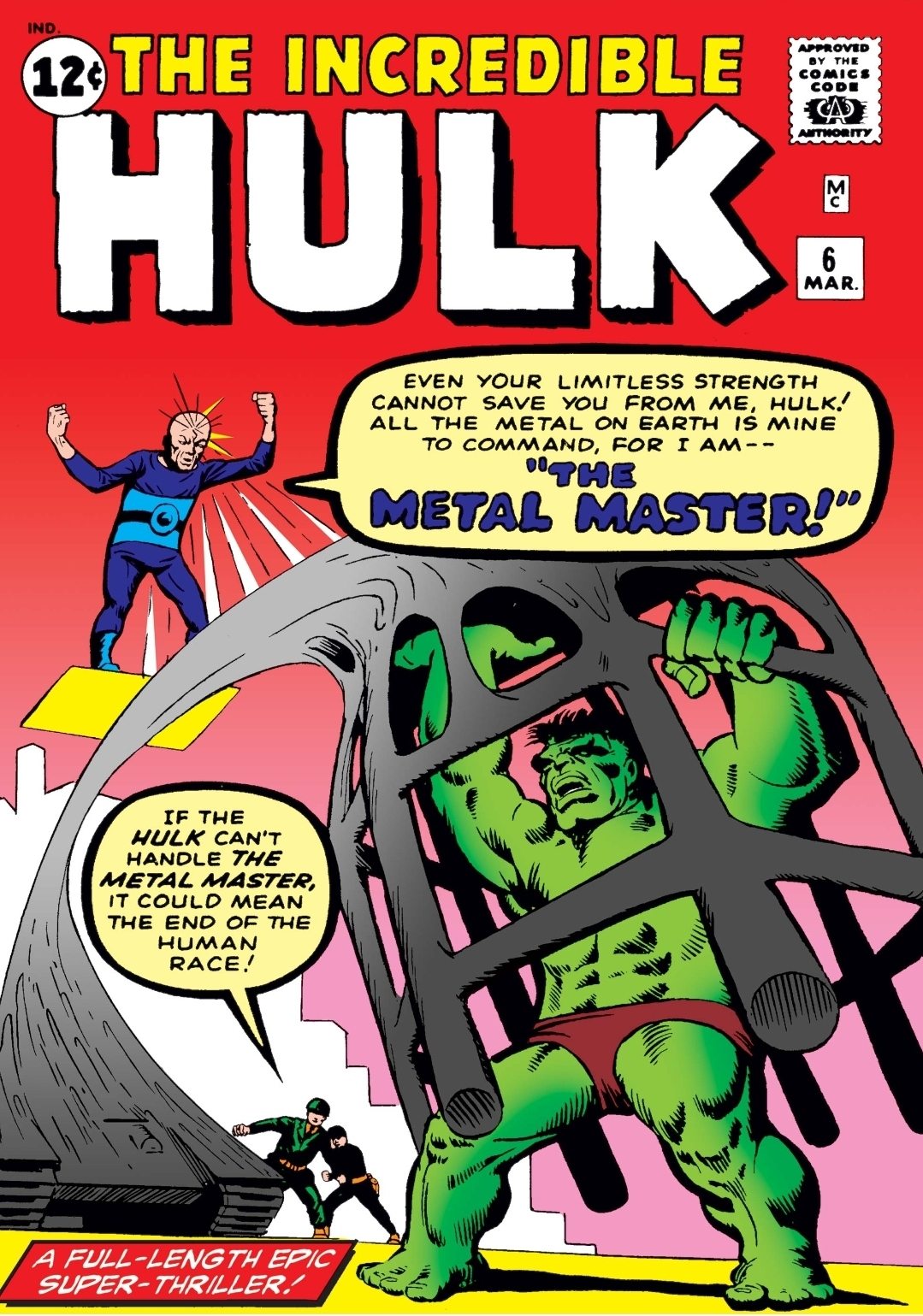
Written by Stan Lee – Art by Steve Ditko – Letters by Art Simek
The final issue of The Incredible Hulk’s original run feels fitting because it spends most of its time doing exactly what the series has been doing since the beginning:
Trying to figure out what the Hulk actually is.
Before we even get to the story itself, the visual change is impossible to miss.

Steve Ditko takes over and immediately gives us a very different Hulk. Kirby’s Hulk looked massive and rounded, a force of nature built from brute strength and raw power. Ditko’s Hulk is leaner. His face feels compressed. His head is squarer. There is something distinctly Boris Karloff about him. Less giant monster and more a Frankenstein creation and body builder combined.
Marvel is still experimenting with the transformations as well.
Bruce Banner remains partially in control of the process, using his gamma equipment to trigger changes at will. In this issue, a mistake gives Banner a muscular physique. This issue playing with the physical connection between Banner and the Hulk.
The villain this time is the Metal Master, an alien from the planet Astra who arrives on Earth with the ability to control metal.
It’s a ridiculous premise but it gives Ditko opportunities to do some genuinely interesting visual work.

The Metal Master’s powers don’t simply move objects around. Metal bends, twists, melts, and reshapes itself into strange, almost horror-inspired forms. Prison bars become grasping tentacles. Military equipment seems to liquefy. Tanks and helmets warp into unsettling shapes. It’s pure Ditko.
Then things get weird. Even by Hulk standards.

Banner transforms into the Hulk, but only his body changes. His head remains Bruce Banner’s. Which leads to one of the strangest images in early Marvel history. A giant Hulk bod with Bruce Banner’s head.
Banner apparently keeps lifelike Hulk masks lying around his laboratory, so problem solved. For now.
.At this point the book feels less like a superhero comic and more like a series of increasingly desperate attempts to define its central character.
The Hulk and Banner are now clearly separate personalities.
The Hulk refers to Banner as if he’s another person entirely. He treats Rick Jones terribly. In many ways, this is the cruelest version of the Hulk we’ve seen so far.
He isn’t heroic.
He isn’t misunderstood.
He’s a bully.

Looking back, it’s fascinating because later writers would explore themes of trauma, abuse, and repressed anger through Banner and the Hulk. Those ideas aren’t fully formed yet, but you can see hints of them emerging.
The Hulk feels less like Banner’s protector and more like the embodiment of his worst impulses.
Meanwhile, Rick Jones launches the Teen Brigade, a nationwide network of teenagers connected by ham radio.It feels almost like Marvel accidentally creating a completely different comic inside the Hulk title. Functioning like a backdoor pilot.
The Hulk eventually defeats the Metal Master using a fake weapon made from cardboard, forcing the alien to abandon Earth. It’s a surprisingly clever solution. It’s also another example of the series changing direction. One moment Hulk is a monster. The next he’s using Banner’s scientific ingenuity.
The issue concludes with what feels like an extended epilogue.

The Hulk eventually finds himself unable to transform back into Bruce Banner, and despite constantly calling Banner a weakling, he reacts with genuine despair.
It’s an interesting twist. Banner isn’t simply imprisoned by the Hulk. In some ways, Banner protects the Hulk as well, providing a place to hide from the military and a way to exist in the world without being hunted.
Weeks go by before the gamma machine exposure finally kicks in and Banner reappears.
As the issue comes to a close, it feels less like an ending than a new beginning.
The Hulk earns a pardon for helping defeat the Metal Master. Bruce returns to the base. Betty is back in his life. General Ross remains furious. Rick worries about what comes next.
The status quo has been reset and the book appears ready to move forward.
And then it doesn’t.
The series simply ends.
Which feels strangely appropriate.
Because after six issues, the Hulk remains one of the least defined characters Marvel has created.
Was he a monster? A superhero? A science-fiction adventurer? A Cold War weapon? A tragic figure? A force of nature? The answer changes from issue to issue.
Even the rules governing his transformations, powers, personality, and relationship with Banner constantly shift.
Spider-Man arrived fully formed. Iron Man debuted with a clear identity. The Hulk never found one.
This feels less like the beginning of one of Marvel’s greatest characters and more like a failed experiment.
Knowing that the Hulk will eventually become one of Marvel’s most enduring icons makes these six issues feel almost impossible to believe.
Because in March of 1963, Marvel doesn’t seem to know what to do with him either.
So, he’s gone.
For now.
But he’ll be back.
Marvel in the 60s – Entry #42
Leave a Reply