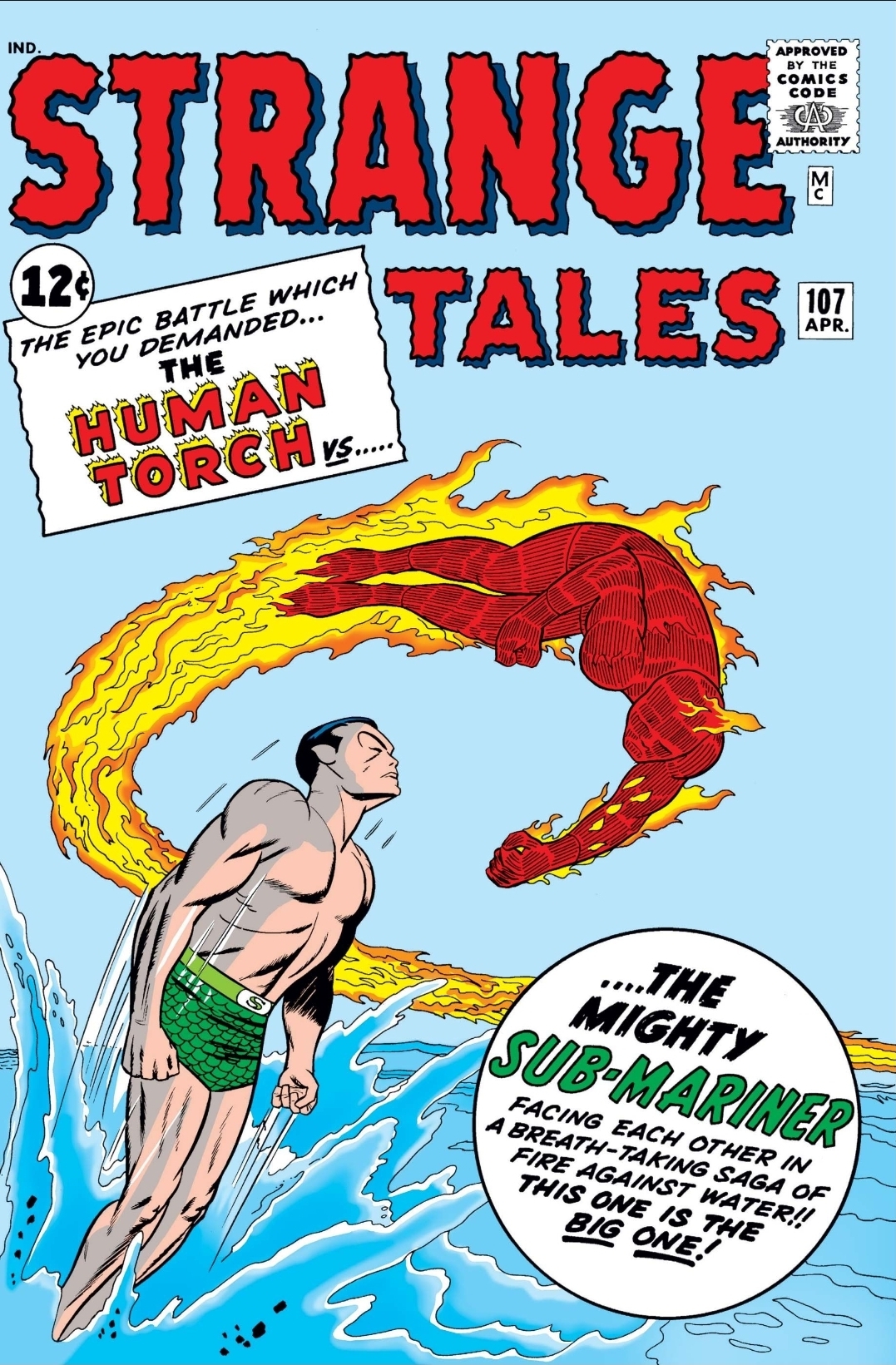
Plot by Stan Lee – Script by Larry Lieber – Art by Dick Ayers – Letters by Art Simek
What a cover.
Jack Kirby delivers one of the strongest Human Torch covers yet, selling the simple idea of the Torch diving headfirst into the ocean to battle the Sub-Mariner. It’s dynamic, colorful, and exactly the kind of image that would stop you in front of a newsstand.
Inside, Strange Tales continues another trend that’s becoming increasingly noticeable across Marvel’s line. Dick Ayers is settling in as the permanent Human Torch artist. And like Don Heck on Ant-Man and Steve Ditko on Spider-Man, Ayers is beginning to give the series its own visual identity.
His approach feels grounded. Johnny Storm looks like a teenager rather than a polished superhero. Reed Richards appears more like a professor than an action hero. The Fantastic Four don’t feel larger than life so much as ordinary people who happen to possess extraordinary abilities.
It’s a subtle shift, but an effective one.

The story itself is little more than an excuse to stage another fight with the Sub-Mariner.
Still frustrated after being tricked into leaving the Fantastic Four last issue, Johnny decides the best way to prove himself is to defeat Namor single-handedly. It’s exactly the sort of impulsive decision you’d expect from a sixteen-year-old.
That’s actually becoming one of the book’s strengths. Unlike many of Marvel’s heroes, Johnny genuinely behaves like a teenager in StrangeTales. He’s impatient. Competitive. Jealous. He desperately wants to prove he’s no longer just the kid on the team.That immaturity gives the series a personality distinct from the Fantastic Four itself.
On the journey across the Atlantic, we’re also reminded that Johnny’s powers are still evolving. His flame burns out before he reaches his destination, forcing him to land aboard a passing ship where he’s mistaken for a stowaway and put to work swabbing the deck. Lee and Lieber injecting a bit of 1960s humor into the story.

Then the fight begins. And it is exactly the sort of Silver Age superhero battle you’d expect. Pages of exposition. Creative power demonstrations. Almost no communication between the two combatants save inaults and threats. Two heroes punching first and asking questions never.
Namor continues accumulating wonderfully bizarre sea-based abilities. At one point he inflates himself like a puffer fish. At another he summons the aid of strange undersea creatures and ancient Atlantean devices. It’s delightfully ridiculous.

The only thing that feels slightly off is Namor himself. His dialogue lacks some of the regal authority that normally defines the Prince of Atlantis. Instead, he sounds oddly like a neighborhood tough, tossing around insults like “match head,” “lame brain,” and screaming “yeow.”
Whether that’s simply Larry Lieber finding his own voice for the character or a side effect of alternating writers, it doesn’t quite sound like the Namor established elsewhere.
Johnny also expands his own power set. He raises his body temperature to extreme levels and, for perhaps the first time, demonstrates an early version of what would eventually become his famous nova flame by maintaining his fiery form underwater.The fight ultimately ends without a clear winner. Which feels appropriate. Because the fight itself isn’t really the point.

This issue exists to establish Strange Tales as a superhero title with recurring characters, familiar villains, and a consistent artistic voice.
The plot is thin. The action is entertaining. But the larger story is Marvel’s continued evolution.
Only a few months ago, many of these books still felt interchangeable. Now Spider-Man, Fantastic Four, Ant-Man, and The Human Torch are each beginning to develop personalities of their own.
Different artists.
Different tones.
Different kinds of heroes.
Marvel’s universe is expanding. Its identity is becoming more focused at the same time.
Marvel in the 60s – Entry #46

Leave a Reply