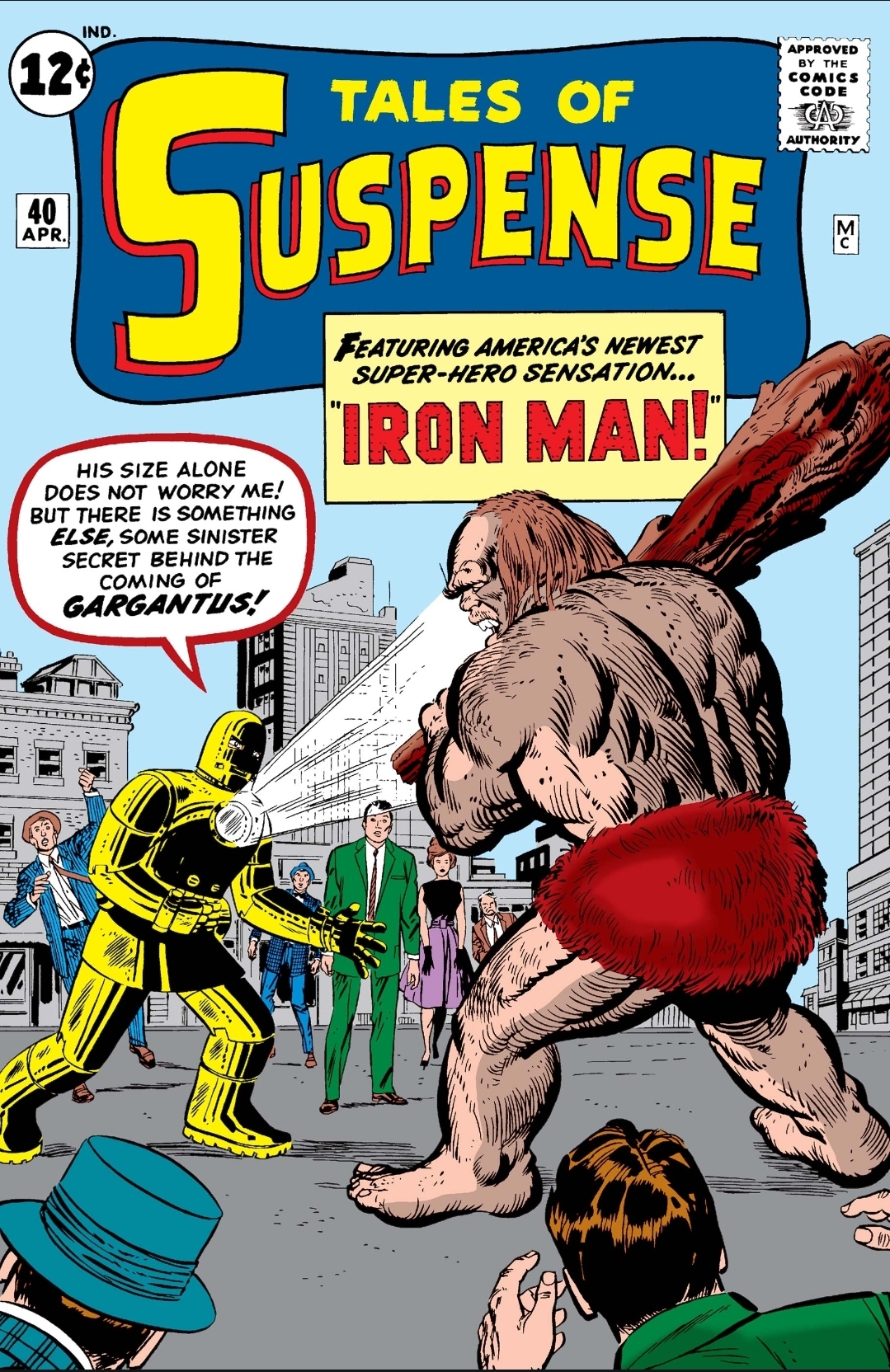
Plot by Stan Lee – Script by R. Berns (Robert Bernstein) – Art by Jack Kirby – Inks by Don Heck – Letters by Duffy (John D’Agostino)
One issue in, Iron Man is already changing.
That’s one of the more fascinating things about reading Marvel chronologically. Characters don’t stay frozen. They evolve almost immediately, often from month to month, as Lee and his collaborators figure out what works.
The creative team itself reflects Marvel’s growth.
“R. Berns” was actually Robert Bernstein, a DC writer using a pseudonym while moonlighting for Marvel. He would go on to script several early Iron Man and Thor stories, eventually helping introduce Happy Hogan and Pepper Potts.
Meanwhile, the lettering is credited to Duffi, another pseudonym used by John D’Agostino, one of the letterers helping establish the distinctive look and rhythm of early Marvel comics.
Jack Kirby also steps in on pencils, creating an interesting collaboration with Don Heck.
Heck helped establish Tony Stark’s polished, Hollywood appearance last issue. Kirby immediately expands the world around him.

The pages are filled with experimental military hardware, bizarre machinery, and the sort of imaginative technology that had already become one of Kirby’s trademarks.
Before the story even begins, readers receive a quick reminder of who Tony Stark is.
Millionaire.
Inventor.
Scientist.
Playboy.
Iron Man.
It’s striking how quickly Marvel cements his place within its universe.

Rather than treating him as a brand-new hero still finding his footing, the narration casually informs us that Iron Man has already spent the time between issues battling gangsters, mad scientists, and even escaped lions and tigers.
The biggest development comes almost immediately. Iron Man abandons the bulky gray armor introduced in his origin and paints it gold after realizing the original design frightens ordinary people.
It’s an amusing explanation for what was almost certainly a creative decision, but it reinforces an important idea.
Iron Man isn’t static. Tony Stark is constantly improving his own inventions. The armor evolves because its creator evolves.
That concept becomes one of the defining characteristics of the character for decades to come.
The armor itself is still wonderfully clumsy. Modern readers are used to sleek nanotechnology. This Iron Man stomps into action like a walking tank.
Many of his weapons are handheld rather than integrated into the suit itself, making him feel closer to a heavily armored engineer than a flying superhero.

Then…
The story happens.
Tony discovers that an entire town has vanished behind enormous walls. Inside, the citizens now worship a mysterious being called Gargantus.
Within days they have apparently built monuments in his honor and surrendered completely to his rule.
It’s…a lot.
The explanation somehow makes even less sense.
Gargantus hypnotizes people using giant reflective eyes.
Except Gargantus isn’t really Gargantus.
He’s an android.
Controlled by tiny green aliens.
Which somehow feels like the most anthology-era twist imaginable.

The entire second half of the comic feels less like an Iron Man story and more like one of Marvel’s old monster and science-fiction tales with Tony Stark inserted into the middle.
It’s exactly the sort of storytelling Marvel has been trying to move away from over the past few months.
Fortunately, the larger developments surrounding Iron Man are far more interesting than the plot itself.
Marvel quietly establishes that Iron Man has already become an active superhero between issues.
The armor receives its first major upgrade.
Tony’s role as an inventor becomes central to the character rather than simply part of his origin.
Those are meaningful steps forward.
Even if they’re buried inside a story about hypnotic alien-controlled robots.
Reading these early Marvel comics has made one thing abundantly clear.
Progress wasn’t seamless.
For every Amazing Spider-Man #1 or Fantastic Four #13, there’s a comic like Tales of Suspense #40 that still carries one foot firmly planted in Marvel’s anthology past.
The story itself is forgettable.
The evolution of Iron Man isn’t.
Marvel in the 60s – Entry #47


Leave a Reply