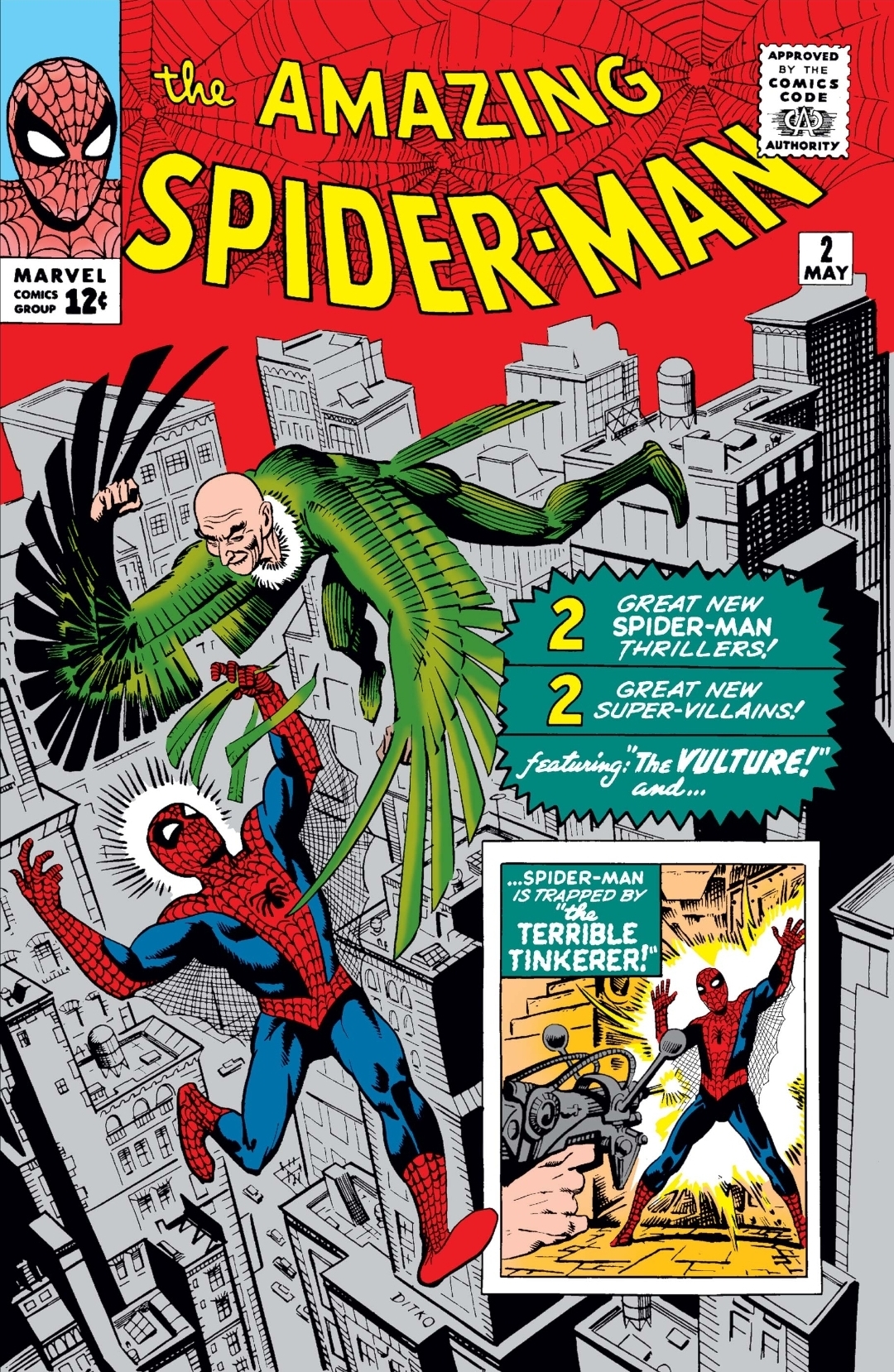
Written by Stan Lee – Art by Steve Ditko – Letters by Art Simek
Only two issues into its run, The Amazing Spider-Man already feels remarkably confident. Not simply because it introduces another classic villain. But because it understands exactly what kind of comic it wants to be.
Most of Marvel’s superhero books are still searching for an identity. Powers change. Supporting casts disappear. Villains come and go. Amazing Spider-Man feels different. Its world has permanence.
The first sign of that is its rogues gallery. Spider-Man’s villains aren’t disposable. The Chameleon debuted last issue. Now comes the Vulture and the Tinkerer.
Unlike many of Marvel’s one-and-done monsters and Cold War villains, these characters don’t simply exist to fill twenty pages. They are part of Spider-Man’s world.
It’s another reminder of just how influential Steve Ditko was as a creator.
Beyond Spider-Man, Ditko would go on to create enduring characters like the Creeper for DC and co-create Captain Atom, the Question, and Blue Beetle for Charlton Comics. Their staying power was such that Alan Moore originally hoped to use them as the cast of Watchmen.
His gift wasn’t simply drawing memorable characters. It was designing characters that felt like they belonged forever.

The Vulture is a perfect example. He’s wonderfully unsettling. An elderly jewel thief gliding silently over New York rooftops, looking more like a predatory bird than a traditional supervillain.
Ditko’s artwork is phenomenal throughout. His action sequences feel almost animated. Spider-Man twists, flips, rebounds, and ricochets through panels with a fluidity unlike anything else Marvel is publishing.
You can practically feel the momentum.

The issue also reinforces one of Spider-Man’s greatest strengths. Peter Parker never stops learning.
After running out of web fluid during his encounter with the Vulture and finding himself trapped inside a water tower, Peter doesn’t simply escape and move on. He improves.
Back home he designs a utility belt with spare web cartridges and a built-in flashlight. It’s a wonderful little moment.
Spider-Man isn’t just strong. He’s an inventor. Every defeat becomes an opportunity to refine his equipment. That scientific curiosity remains just as important as his superpowers.
Outside the costume, Peter’s life continues to feel remarkably grounded. He’s struggling to fit in at school. Trying to earn money. Selling photographs to J. Jonah Jameson, whose Now Magazine has not yet evolved into the Daily Bugle.
Those everyday concerns remain just as important as fighting crime.
Spider-Man effortlessly blends superhero comics, teen drama, romance comics, and slice-of-life storytelling into something that feels uniquely its own.

Even the ending is refreshingly optimistic. Peter defeats the Vulture. Gets paid. Helps Aunt May.
For once, everything actually goes right for Peter Parker.
The second story heads in a much stranger direction.

Peter takes a job assisting Professor Cobbwell and stumbles into the orbit of another future Marvel staple, the Tinkerer.
What begins as a simple errand quickly spirals into one of Marvel’s classic science-fiction plots.
The Tinkerer is secretly working alongside aliens, hiding surveillance devices inside ordinary household electronics.
It’s ridiculous but Ditko elevates the entire sequence.

His use of shadow gives the repair shop an almost noir atmosphere.
The famous half-Peter, half-Spider-Man panel remains one of the visual highlights of early Marvel, perfectly capturing Peter’s growing suspicion before the reader fully understands why.
Once the action begins, Ditko is completely in his element.
Spider-Man darts through crowds of enemies, bouncing between walls, ceilings, and machinery with a sense of movement few artists could match.

The aliens eventually retreat. The Tinkerer escapes. Another future recurring villain survives to fight another day.
Amazing Spider-Man #2 reinforces something that already seems unique among Marvel’s superhero books.
Every issue expands Peter Parker’s world. New villains. New supporting characters. New gadgets. New problems. Almost all of them are still part of Spider-Man’s world more than sixty years later.
Marvel is still figuring out most of its heroes.
Spider-Man already knows exactly who he is.
Marvel in the 60s – Entry #50


Leave a Reply