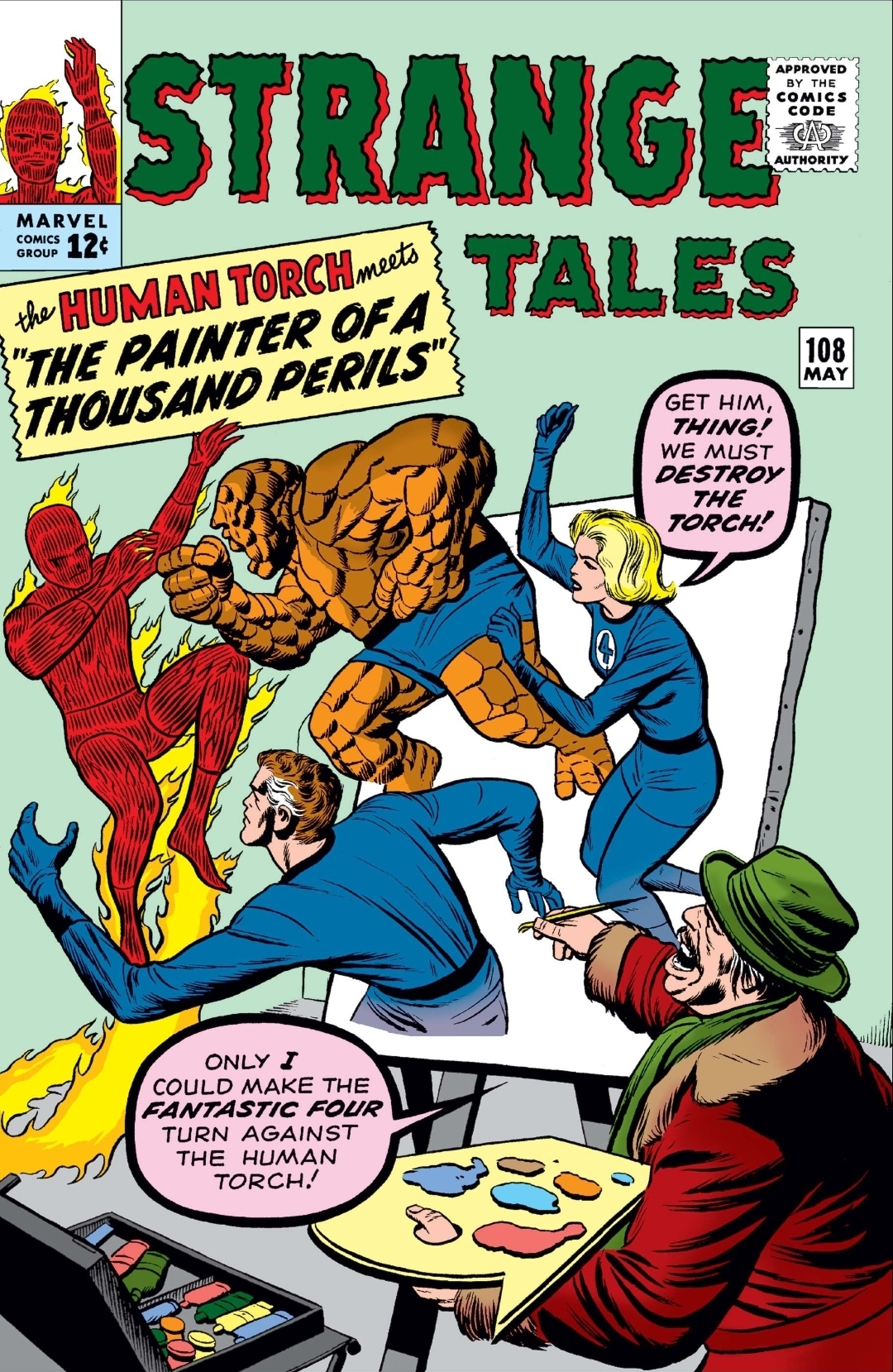
Written by Stan Lee – Script by Robert Bernstein – Art by Jack Kirby – Inks by Dick Ayers – Letters by Terry Szenics
Just when it feels like Marvel’s superhero line has finally left its anthology roots behind Strange Tales reminds us there is still plenty of old DNA left in the system.
Marvel is also continuing to experiment with how it catches new readers up. Rather than relying solely on captions, this issue opens with a brief Human Torch crime-fighting montage that showcases Johnny’s powers while naturally recapping the events of the past few issues. It’s another small storytelling technique that Marvel is steadily refining.
Johnny Storm is gradually growing into a more mature hero rather than simply the Fantastic Four’s kid brother. He’s also continuing to develop new powers at an astonishing rate.
Smoke rings capable of restraining criminals. Flames shaped into scissors. At this point, Johnny’s abilities seem to expand whenever the plot requires them.

Then comes one of the most wonderfully ridiculous Marvel names yet.
Wilhelm Van Vile.
If ever there were a man destined to become a supervillain, it was someone named Wilhelm Van Vile.
Kirby wastes no time giving him an equally absurd premise. Anything he paints comes to life.
It’s exactly the sort of concept that would have fit perfectly in one of Marvel’s monster or fantasy anthologies only a year earlier.
The real joy in this issue though is watching Kirby cut loose. Three-headed gorillas. Ancient cannons. Magic carpets. Dinosaurs. Every few pages introduce another excuse for Kirby to draw something outrageous.
Van Vile himself has a surprisingly amusing criminal career. He begins as an art forger. Moves into counterfeiting. Gets caught trying to pass off phony bills by Johnny while he’s working his civilian job.
Then discovers—because this is 1963 Marvel—a magical alien paint set buried beneath a prison floor.
Sometimes it’s best not to ask too many questions.

The resulting crime spree becomes little more than an excuse for Kirby’s imagination to run wild.
Eventually Johnny realizes every painted creation contains a small imperfection.
Using that weakness, he paints a duplicate Human Torch to distract Van Vile while destroying the enchanted paints themselves.
Problem solved.

The story does feel like a step backward. The villain could easily have appeared in one of Marvel’s anthology books. Even the resolution relies on the sort of ironic twist those stories loved.
And yet…
The comic never becomes completely disposable. Johnny himself continues to mature. He’s more confident. More resourceful. More capable of carrying a story on his own than he was just a few months earlier.
That’s ultimately what saves the issue.
The plot belongs to Marvel’s past.
The Human Torch belongs to its future.
Marvel in the 60s – Entry #52


Leave a Reply