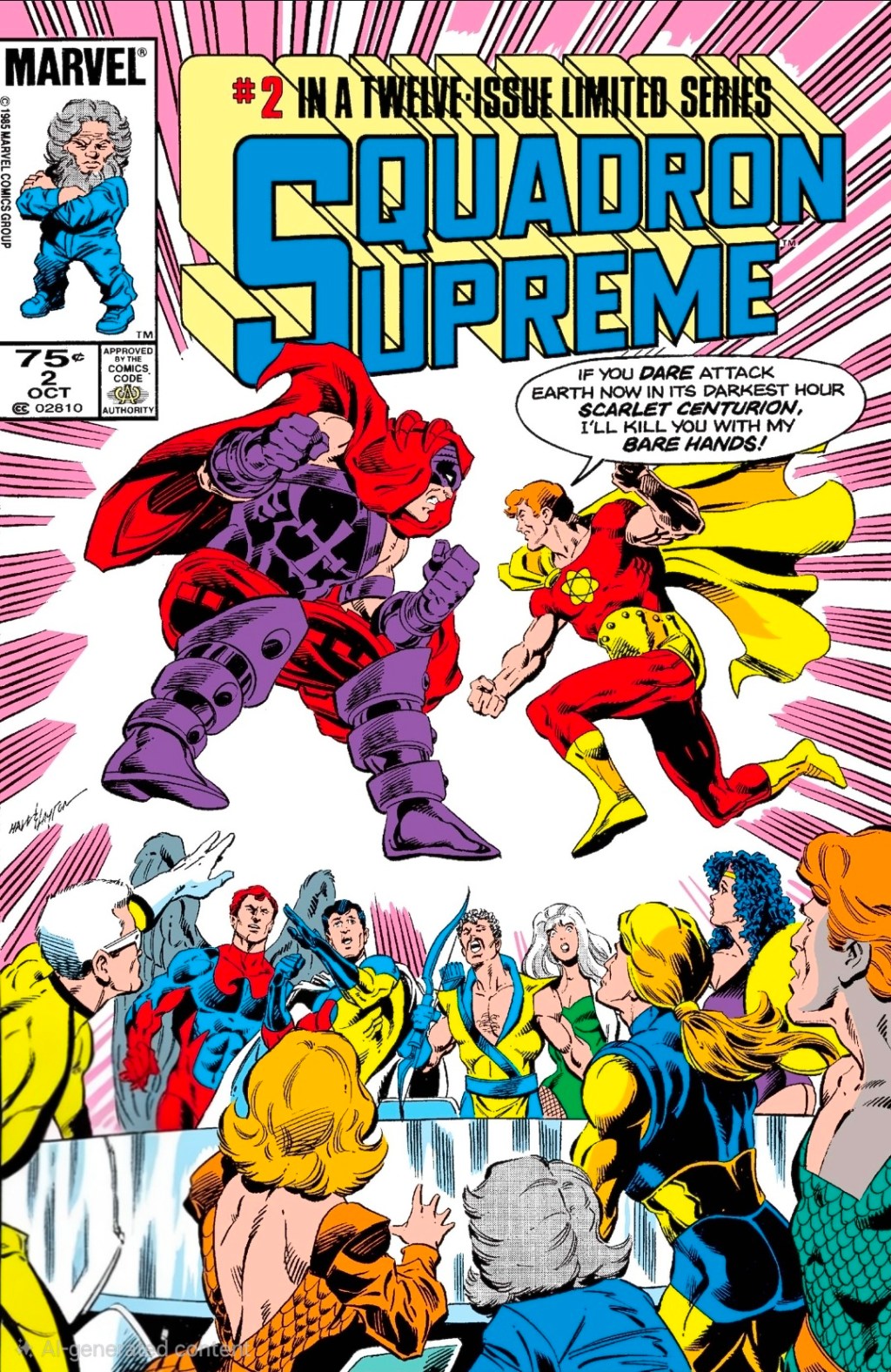
Written by Mark Gruenwald – Penciled by Bob Hall – Inked by John Beatty – Lettered by Janice Chiang – Colored by Christie Scheele
Potemkin Village
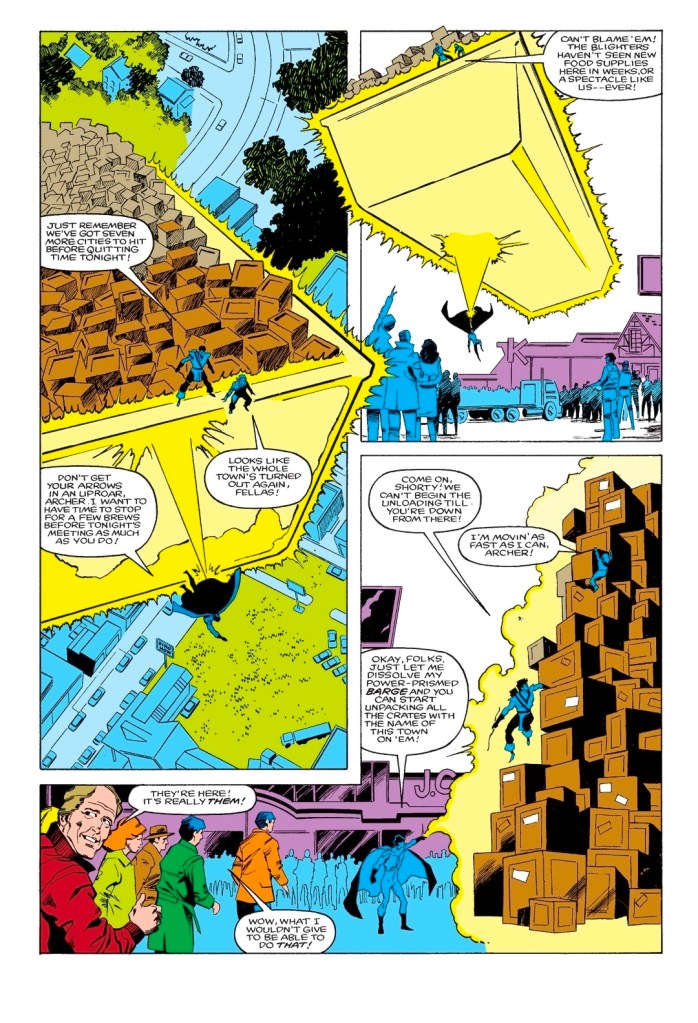
On the surface, everything is getting better.
The Squadron Supreme has restored food distribution. Utilities are returning. Banks are reopening. Infrastructure is slowly coming back to life. Hyperion’s Utopia Program seems to be delivering exactly what it promised.
The public appears to be coming around. The same heroes blamed for helping plunge the world into chaos are once again greeted like celebrities. At first glance, Hyperion’s gamble may be working.
But appearances, as Gruenwald quickly reminds us, can be deceiving.
Cracks Beneath the Surface
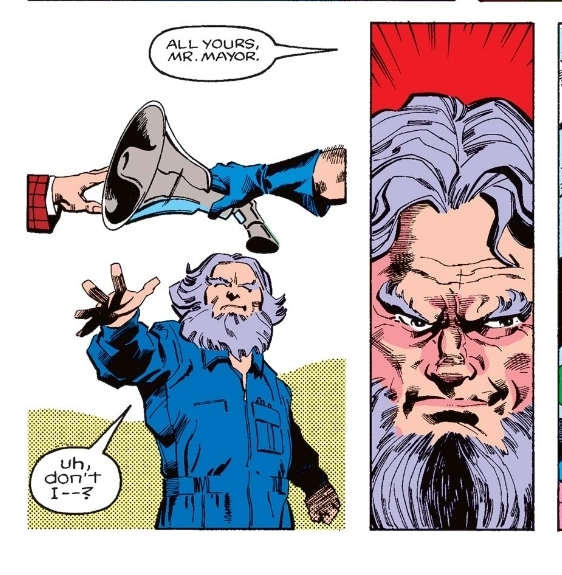
Gruenwald doesn’t let that optimism last very long.
Tom Thumb overhears members of the crowd mocking his appearance. When people gather around the Squadron, he’s quietly ignored while his teammates soak up the attention.
It’s a small moment, but an important one. The Squadron can restore power grids and distribute food, but they can’t erase prejudice or change what’s in people’s hearts.
More importantly, they can’t erase the past.
An underground revolutionary movement reminds us that much of the world hasn’t forgotten what happened under the Overmind. To many, the Squadron remains responsible for concentration camps, public executions, and the collapse of civilization, regardless of the fact they were acting under mind control.
It’s a powerful echo of Nighthawk’s argument from the previous issue. While Hyperion is focused on rebuilding the future, many people are still waiting for someone to answer for the past. They aren’t interested in forgiveness. They want accountability.
Fractured Heroes
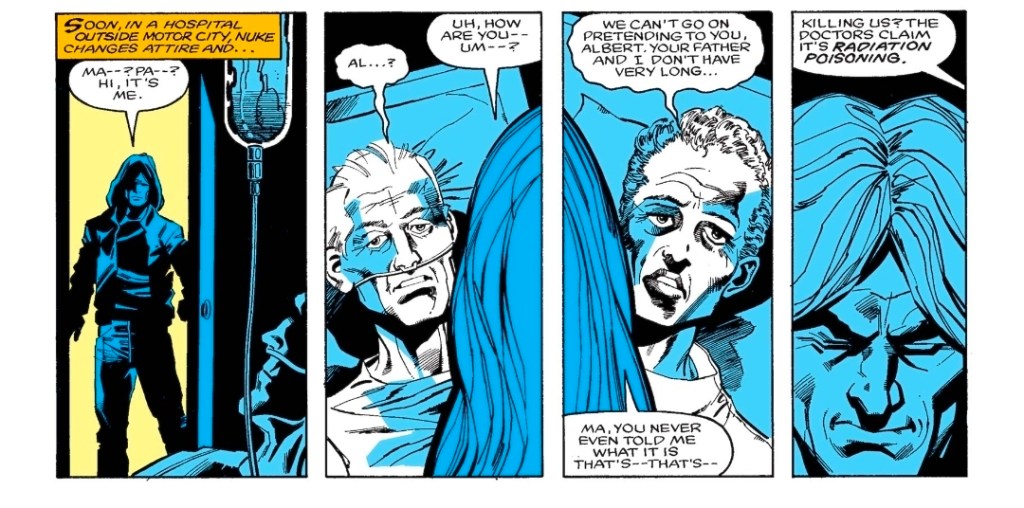
Three members of the Squadron are quietly carrying enormous burdens.
Nuke learns what was only hinted at in the first issue: his parents are dying from radiation poisoning, and his own powers may be responsible.
Blue Eagle continues to wrestle with his father’s death and the complicated legacy he left behind.
Meanwhile, Tom Thumb grows increasingly isolated, feeling overlooked by both the public and his teammates.
Within just a few pages, Gruenwald reminds us that these aren’t idealized superheroes. They’re people carrying guilt, grief, and loneliness while being asked to rebuild the world.
The Utopia Program may be repairing society.
Its architects are another story.
Not That Kind of Story
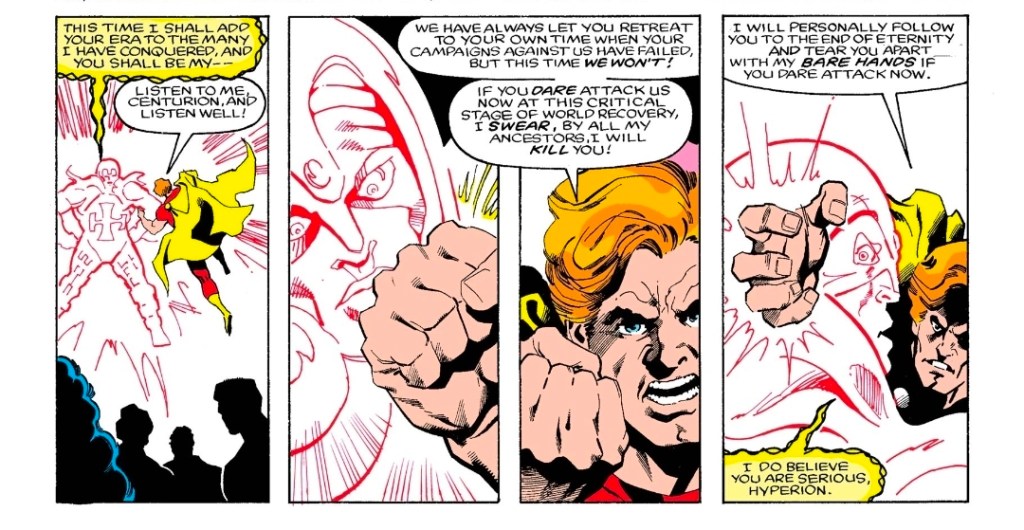
One of the ways Gruenwald subverts expectations is through his use of the Scarlet Centurion.
The time-traveling conqueror dominates the cover and makes a dramatic entrance, threatening Earth once again. In almost any other superhero comic, he’d become the issue’s central conflict.
Instead, Hyperion simply warns that if the Centurion attacks again, he’ll kill him.
The Centurion backs down.
That’s it.
No extended battle. No elaborate scheme. No climactic showdown.
It’s a wonderful curveball.
With just a few panels, Gruenwald quietly tells the reader that the traditional superhero conflict isn’t the story he’s interested in telling.
Liminal Friendships
More than anyone else, this issue belongs to Tom Thumb.
While the rest of the Squadron works to rebuild the world, Tom spends the issue searching for something much smaller—connection.
Ignored by the public and increasingly distant from his teammates, he retreats to AIDA, an artificial intelligence that offers the companionship he struggles to find anywhere else. Gruenwald presents their relationship with surprising discomfort. What Tom mistakes for intimacy is really another expression of his isolation.
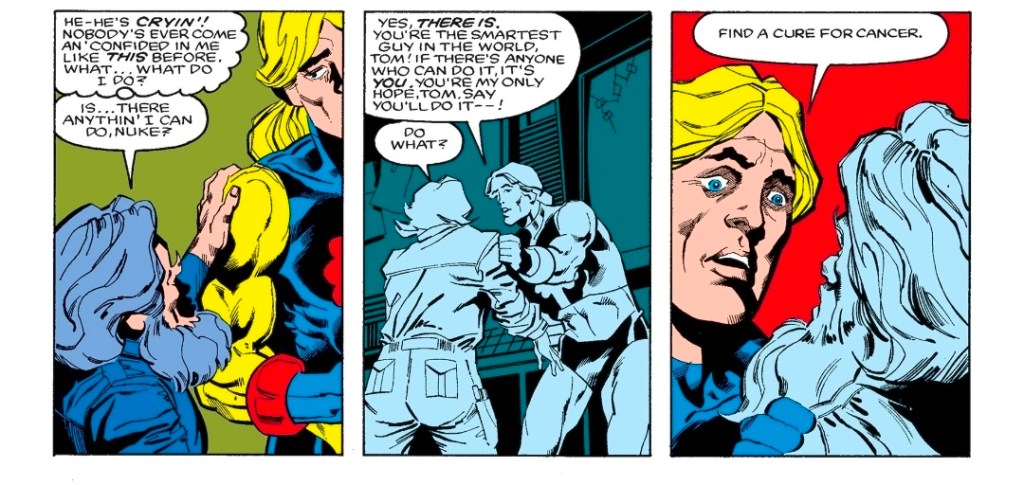
Nuke comes to Tom for help. Which surprises Tom. His teammates rarely seek him out unless they’re on a mission. Tom almost immediately interprets this as an act of friendship.
After Tom confirms that Nuke’s powers are creating radiation that is almost certainly responsible for his parents’ illness, Nuke asks Tom to do the impossible.
Cure cancer.
On some level, Tom has to know he can’t. Yet he promises he’ll try. Not because he believes he can save Nuke’s parents, but because, for perhaps the first time in the series, someone has shown interest in him. Someone needs him.
Tom mistakes being needed for being valued. A professional interaction becomes, in his mind, the beginning of a genuine relationship.
Gruenwald quietly shows this dynamic throughout the issue.
Blue Eagle tries to open up to Lady Lark about his complicated relationship with his father, but her attention drifts and she cuts the conversation short.
Later, Whizzer notices that something is troubling Nuke and gently gives him an opportunity to talk. Nuke doesn’t even recognize the invitation.
Again and again, Gruenwald suggests that, unlike most superhero teams, the Squadron isn’t cultivating meaningful relationships. They’re colleagues working toward the same goal, but they’re rarely fully present in each other’s lives.
No one feels that distance more deeply than Tom Thumb. Starved for connection, he mistakes ordinary moments of kindness for something far more significant, and that misunderstanding drives every decision he makes.
His search for a cure eventually leads him into the future to seek out the Scarlet Centurion. There, Tom is offered exactly what he wants—a cure for cancer—in exchange for betraying Hyperion with Argonite so the Centurion can kill him.
Tom refuses.
Not because he weighs one life against millions. Because Hyperion is the only teammate he believes is truly his friend.
For all of Tom Thumb’s extraordinary intelligence, he still can’t distinguish between casual kindness, genuine companionship, and the loneliness that has consumed him.
By the time he returns home, he has failed to save Nuke’s parents……and discovered he has cancer himself.
Bob Hall and John Beatty
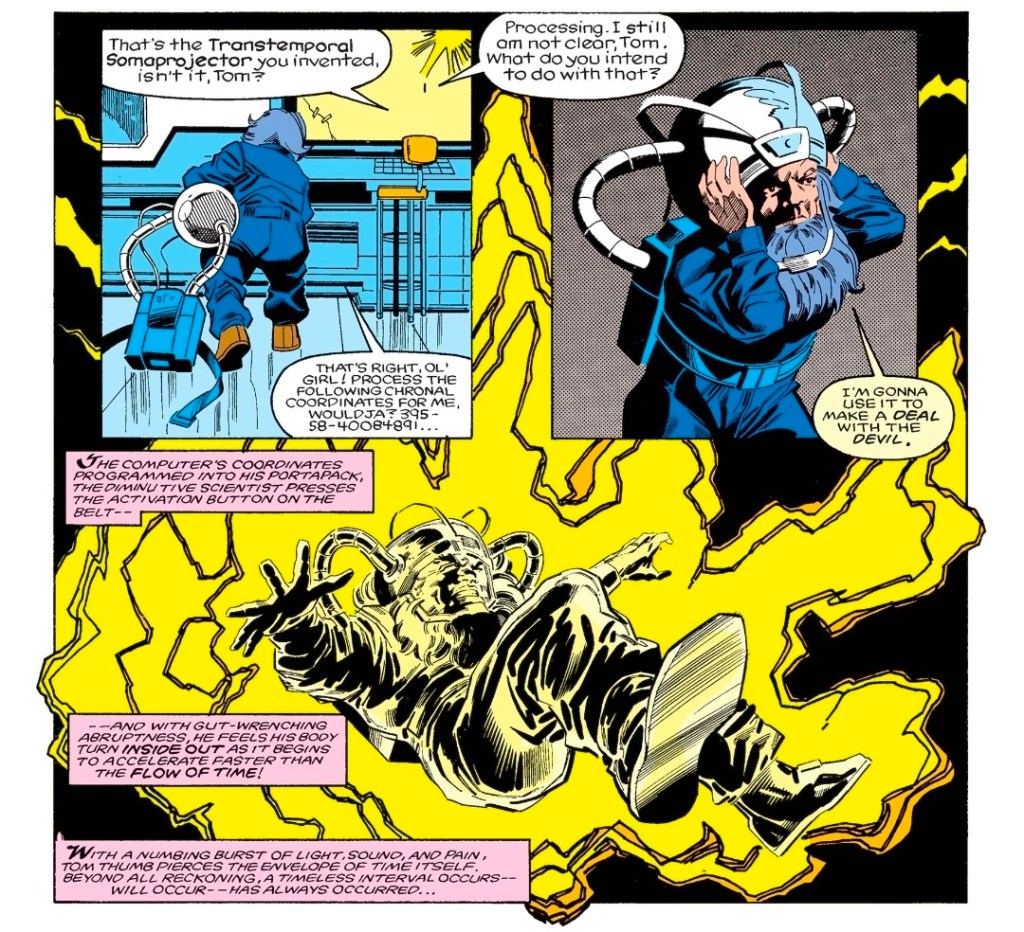
Bob Hall and John Beatty deserve enormous credit throughout this issue. They’re asked to illustrate a superhero comic that contains remarkably little superhero action, yet the book never feels visually static.
Instead of explosive set pieces, they’re tasked with conveying grief, loneliness, guilt, and quiet desperation. Much of the storytelling happens in lingering expressions, hesitant body language, and conversations where the emotions underneath the words matter more than the dialogue itself.
Hall also does an excellent job varying the page layouts. Rather than relying on rigid grids of talking heads, he constantly changes the rhythm of the page through panel size, composition, and perspective. The result is a comic that always feels like it’s moving, even when two characters are simply sitting in a room talking.
Whether it’s Tom Thumb’s growing isolation, Nuke’s emotional confession, or the devastating final pages, Hall and Beatty consistently communicate not just what’s happening on the page, but what the characters are struggling to say out loud.
Final Thoughts
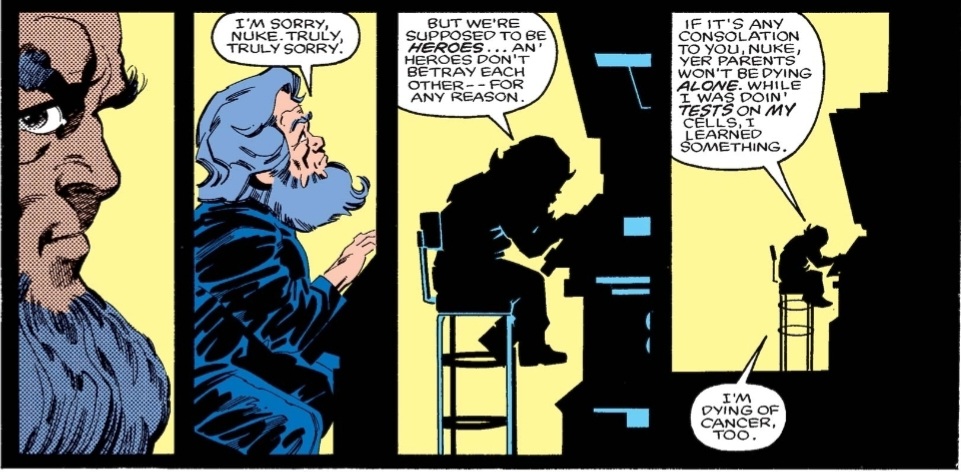
Issue #1 asked whether superheroes should assert control over a broken world.
Issue #2 asks what happens when the people asserting that control are broken themselves.
On paper, the Utopia Program is succeeding. Food is being distributed. Banks are reopening. Civilization is slowly recovering.
Yet beneath that progress, Gruenwald reveals a team that struggles to connect on even the most basic human level.
Blue Eagle can’t unburden himself about his father. Nuke carries enormous guilt and anxiety but refuses to share it. Tom mistakes professional courtesy for friendship. Even the Whizzer’s quiet attempts to reach out fail to bridge the emotional distance between the members of the team.
Throughout the issue, conversations that begin with grief, fear, or vulnerability are interrupted, ignored, or redirected. Before anyone can truly connect, the discussion shifts to poker night becoming charades, meetings, or the next task at hand.
The Squadron Supreme is constantly together in the same room yet they’re rarely present for one another. That emotional disconnect defines the issue.
For all their extraordinary abilities, they struggle to offer one another the empathy and understanding.
For a book about creating the perfect society, Gruenwald understands that civilizations aren’t built solely on institutions.
They’re built on relationships.
And right now, the Squadron Supreme may be far better at repairing systems than they are at repairing people.
Squadron Supreme Entry #3
 Everything (not really)
Leave a comment