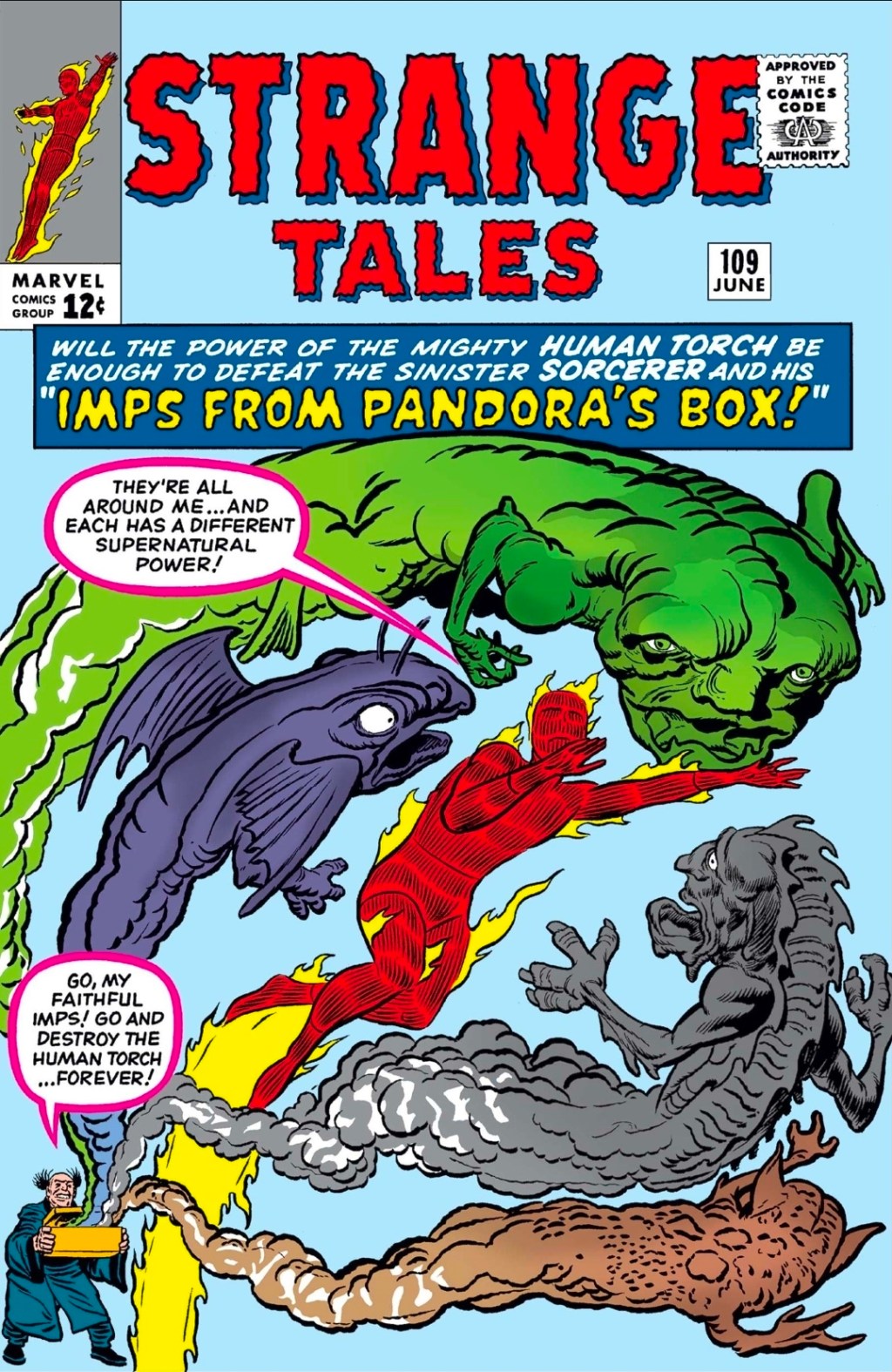
Plot by Stan Lee – Script by Robert Bernstein – Art by Jack Kirby – Inks by Dick Ayers – Letters by Martin Epp
If Fantastic Four #15 showed Marvel leaving its anthology roots behind, Strange Tales #109 is a reminder that the transition wasn’t happening everywhere at once.
That’s the story of Marvel in 1963. Two steps forward. One step back.
The plot itself could have come straight from one of Marvel’s pre-superhero fantasy comics. Ironically, that’s also what makes it interesting.
Instead of another inventor or mad scientist, Lee and Bernstein build the story around black magic, Pandora’s Box, and Greek mythology.
Thor had already opened the door to mythology through Asgard, but outside those pages Marvel still preferred scientific explanations for its villains. The Sorcerer is one of the company’s earliest attempts to let supernatural magic exist in the everyday Marvel Universe.
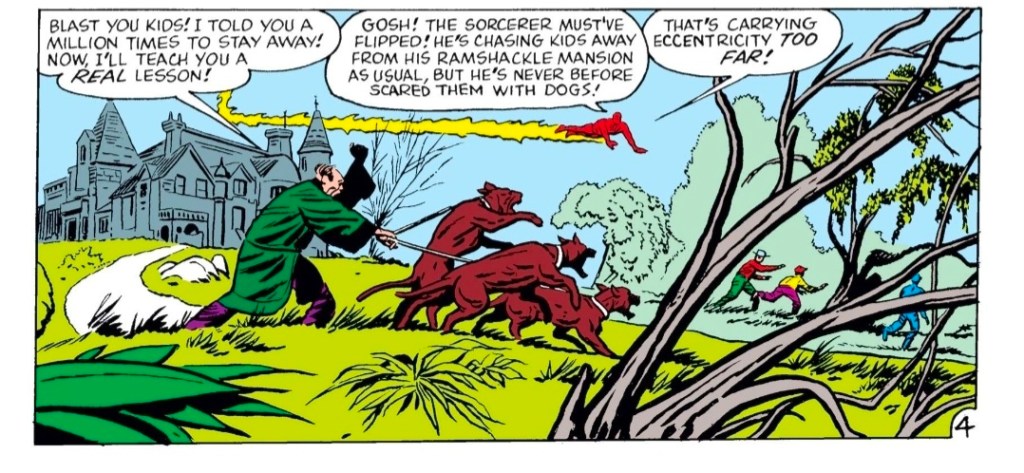
The issue begins with the familiar hijinks around the Baxter Building before reminding readers that Johnny Storm is still just a teenager trying to balance superheroics with high school.
Unlike Peter Parker, Johnny doesn’t really have a supporting cast to ground these stories, so the comic occasionally has to remind us that he has a life outside being the Human Torch.
After stopping an altercation between a bunch of kids and an eccentric old hermit, Johnny unknowingly crosses paths with the mysterious Sorcerer. Before long, Pandora’s Box has been opened, releasing magical imps that spread fear, anger, and destruction throughout the city while their master embarks on a crime spree.
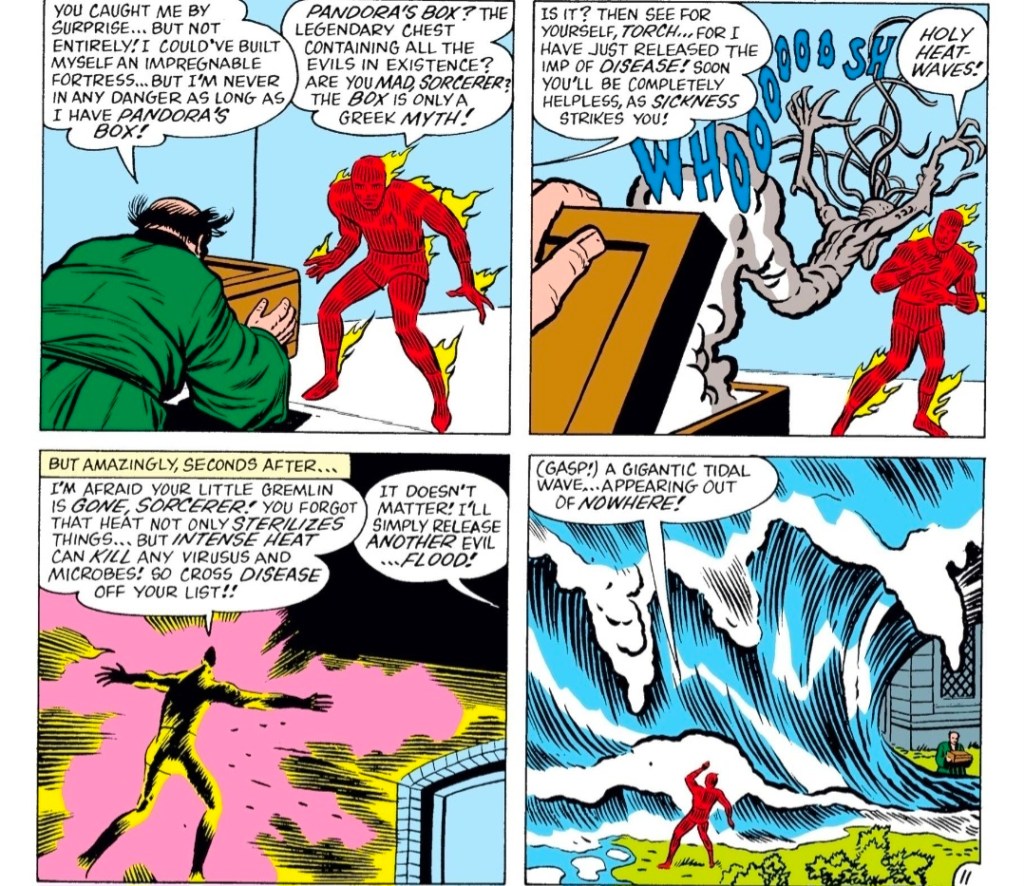
Fortunately, Jack Kirby never treats the material as routine. A story built around Greek mythology gives him an excuse to draw grotesque imps, giant waves, magical effects, panicked crowds, and a flashback involving Circe and Pandora’s Box. Even when the plotting feels familiar, Kirby fills nearly every page with movement and energy.
Unfortunately, the ending exposes the story’s anthology roots. Johnny somehow identifies each imp’s magical ability and immediately knows exactly how to defeat it. The resolution feels less like clever problem-solving and more like the comic inventing rules as it goes to reach the finish line.
Strange Tales #109 isn’t a bad comic, but it does highlight how uneven Marvel’s evolution has been. While books like Fantastic Four were becoming increasingly character-driven, the Human Torch was still battling disposable villains in stories that could have comfortably appeared a year earlier with only a few cosmetic changes.
Strange Tales #109 ultimately succeeds because Jack Kirby’s dynamic artwork and Marvel’s willingness to experiment with magic and mythology compensate for the familiar plot.
Two steps forward.
One step back.
Marvel in the 60s – Entry #58


 Everything (not really)
Leave a comment