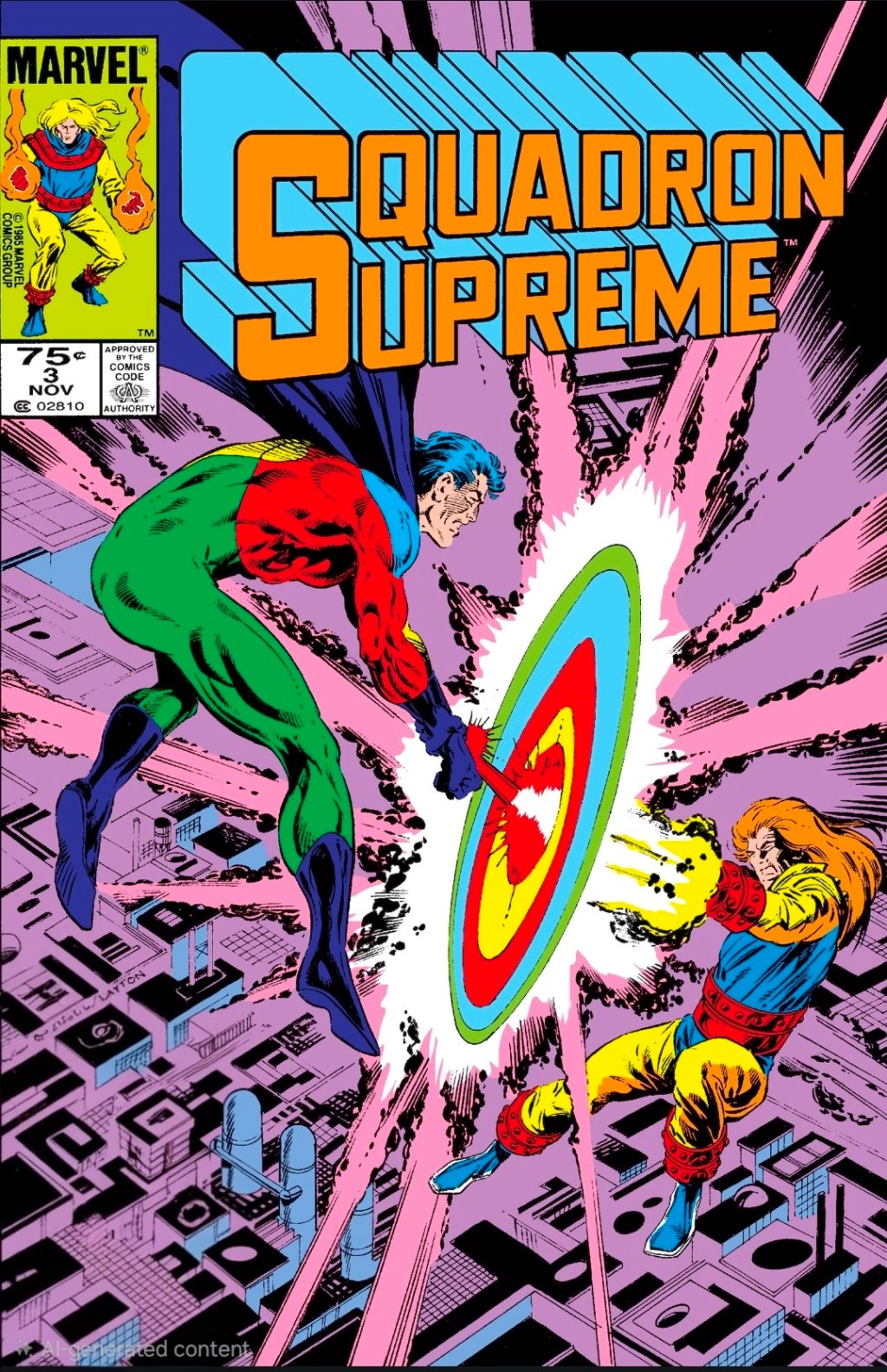
Written by Mark Gruenwald – Penciled by Bob Hall – Inked by John Beatty – Lettered by Janice Chiang – Colored by Christie Scheele
Governing the Future
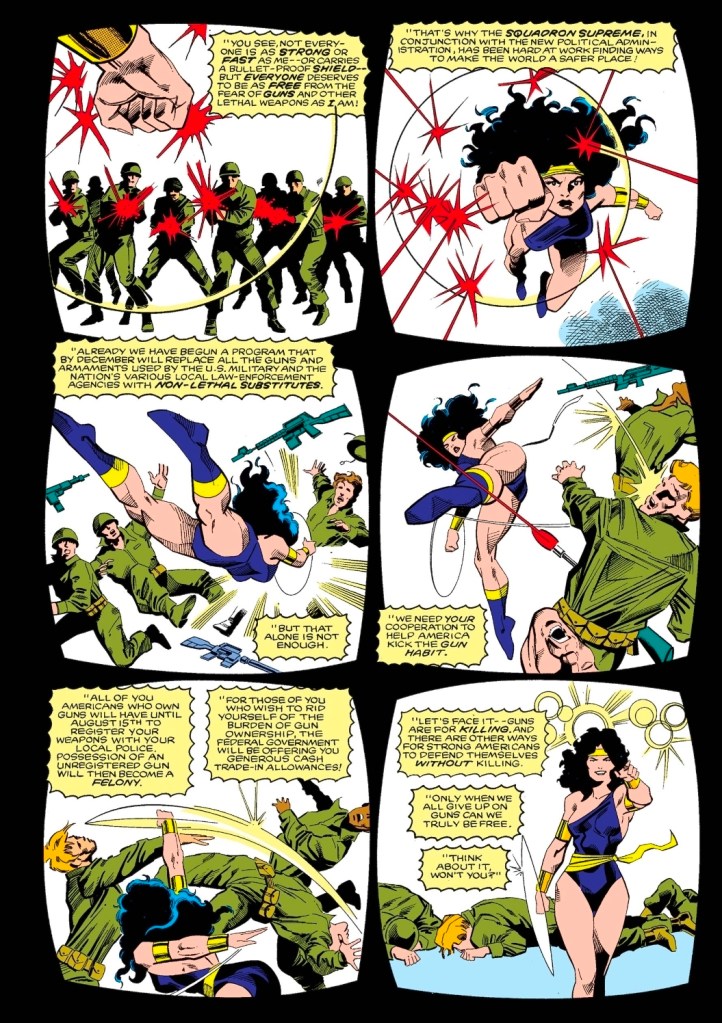
Issue #3 opens with Power Princess filming a public service announcement explaining the Squadron’s latest initiative: the elimination of firearms. Gruenwald wisely avoids turning the scene into a debate over gun control itself. That decision has already been made.The interesting question isn’t whether the policy is right, but what it looks like when superheroes stop acting as heroes and begin acting as statesmen.
Public appearances become part of the job. Lady Lark’s celebrity is used to promote the program. The Squadron’s image becomes almost as important as its policies.
Hyperion’s revolution has moved from philosophy to an administration.
An Institution, Not a Community
Gruenwald continues to reveal how differently the members of the Squadron relate to one another.
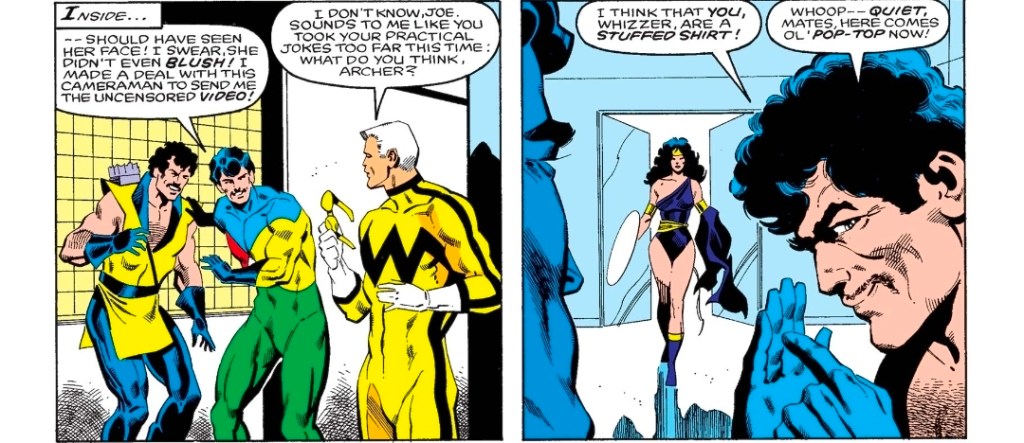
During Power Princess’s public service announcement, Dr. Spectrum decides to “liven things up” by using his Power Prism to pull down her top. Later, when he brags about it to a few teammates, Golden Archer laughs it off as harmless fun. The Whizzer quietly objects. Spectrum dismisses the criticism, and the moment quickly becomes another joke.
It’s an early reminder that this team isn’t built on particularly strong personal relationships. They share the same headquarters and work toward the same mission, yet they often approach one another from fundamentally different emotional and moral perspectives.
That idea continues throughout the issue.
Nuke has gone AWOL, missing twenty-seven meetings before anyone decides to look for him. Tom Thumb hides what he knows out of fear his teammates will think less of him. Spectrum openly admits he doesn’t particularly enjoy spending time with Nuke, comparing him to an annoying younger brother.
Individually, they’re small moments. Together, they paint a picture of a team that knows how to coordinate missions far better than it knows one another.
By the time it’s revealed that Nuke is in desperate need of help, no one on the team has built a relationship strong enough to reach him.
Gruenwald suggests that having the power to save the world doesn’t necessarily prepare you to recognize—or reach—someone in crisis.
Grounded Not Grim
One of my favorite aspects of Squadron Supreme so far is Gruenwald’s refusal to turn superheroes into caricatures.
Stories that place superheroes in the “real world” often push toward extremes. Powers become either wish fulfillment or unbearable curses. Heroes become saints or monsters.
Gruenwald takes a far more restrained approach.
His heroes contain multitudes. They’re immature. They’re compassionate. They’re selfish. They’re generous. Sometimes they’re all of those things within the span of a single issue.
Gruenwald extends that same philosophy to their powers.
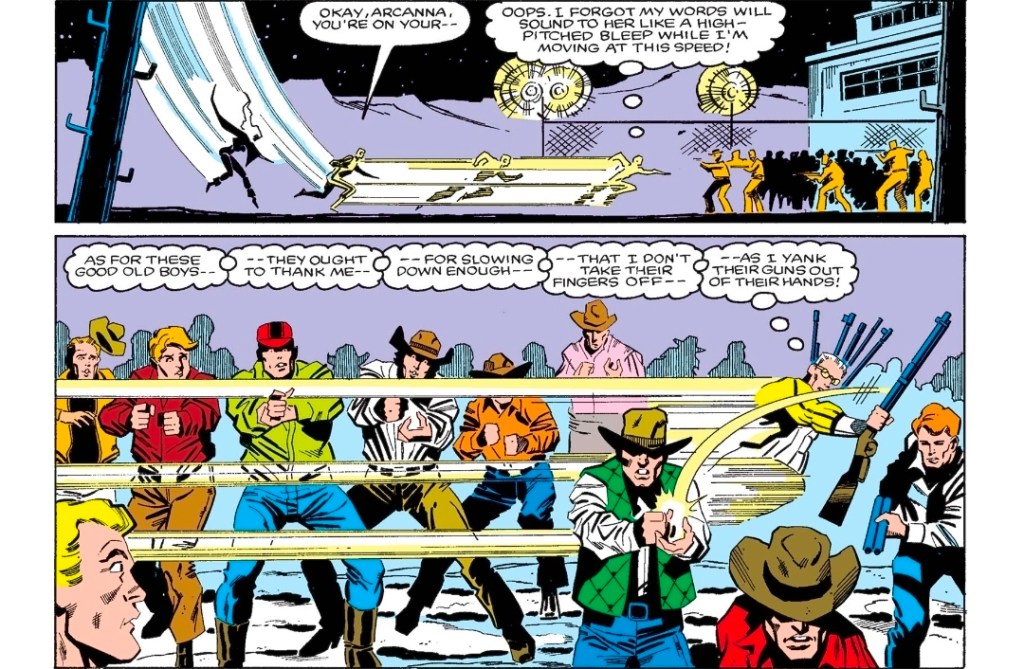
The Squadron’s abilities create practical complications without overwhelming the story. The Whizzer has to slow down while disarming criminals so he doesn’t tear fingers from hands. His voice becomes little more than a squeak while running at super speed. Dr. Spectrum casually realizes flying at incredible speeds requires some way of protecting himself from the wind.
They’re small touches, but they make extraordinary abilities feel surprisingly grounded.
Dr. Spectrum
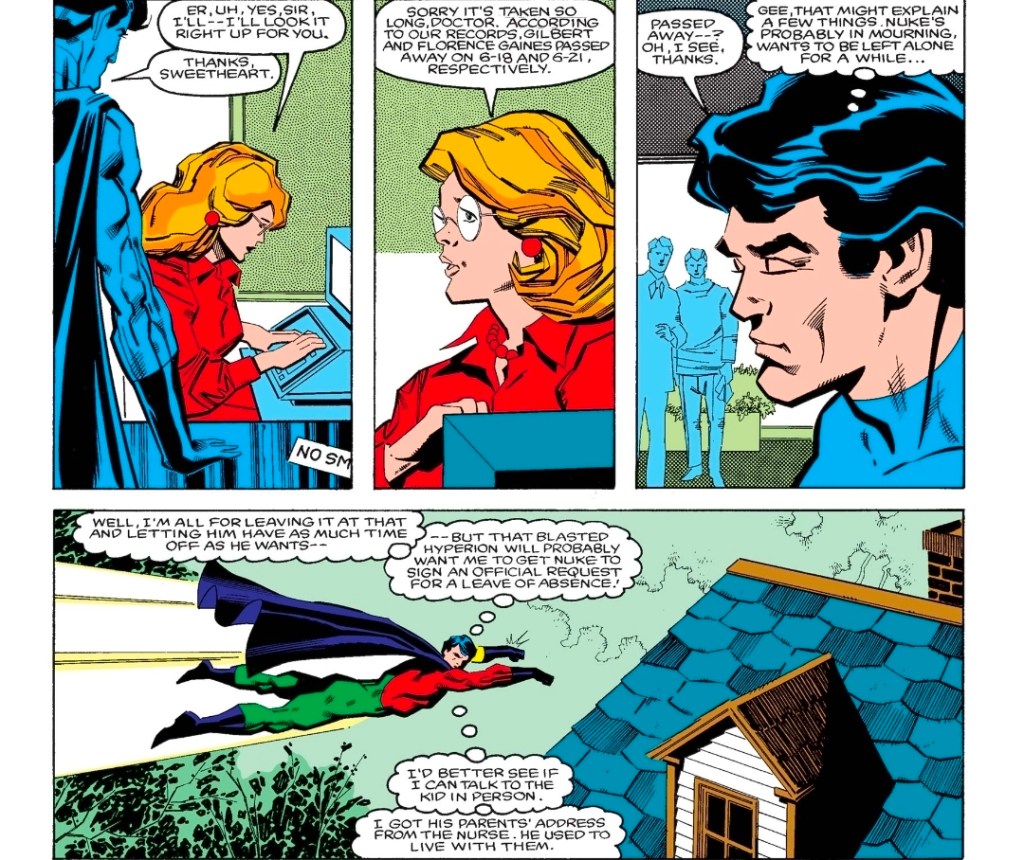
Dr. Spectrum is perhaps the clearest example.
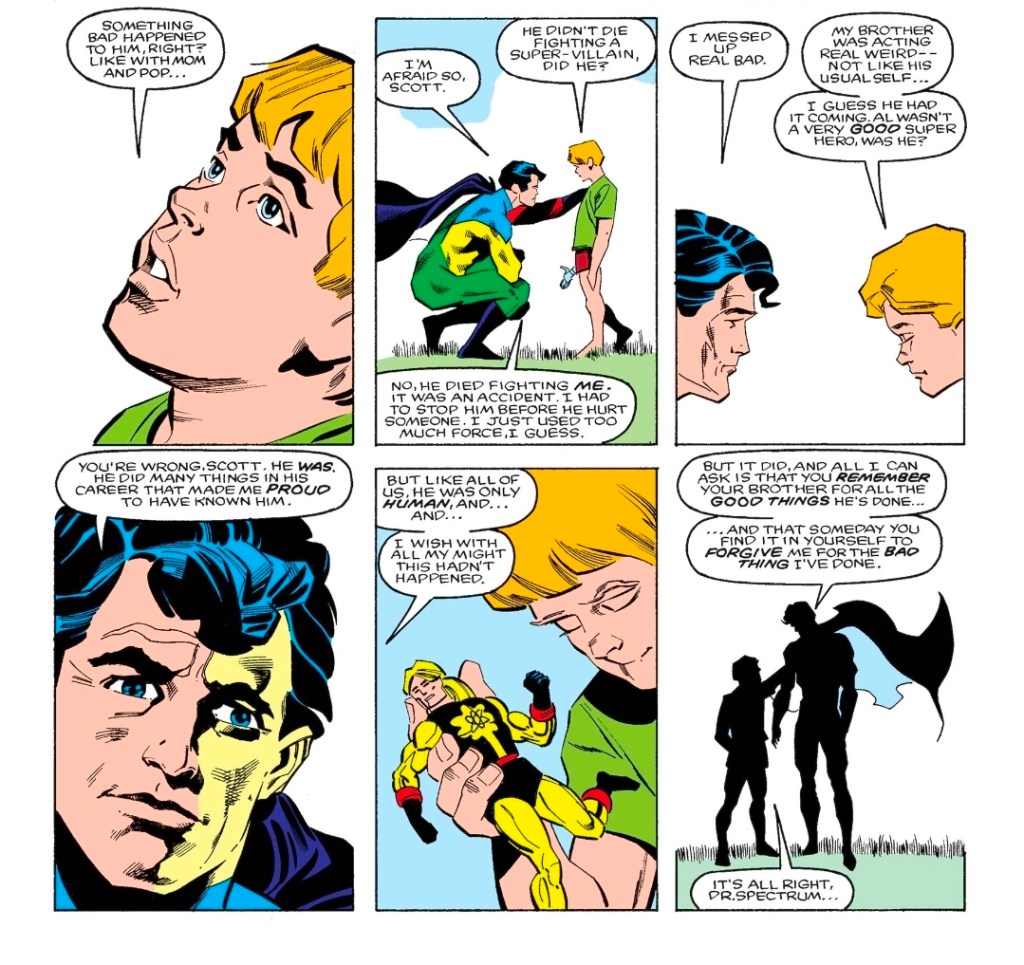
Spectrum begins the issue immature, insensitive, and more than a little obnoxious. Yet he also shows genuine empathy when he learns of Nuke’s parents’ deaths, tries to comfort Nuke before their confrontation, shields Nuke’s younger brother from painful truths, and is ultimately devastated by the consequences of his own actions.
Gruenwald refuses to flatten him into either a hero or a villain. Like the rest of the Squadron, he’s simply human.
The Breaking Point
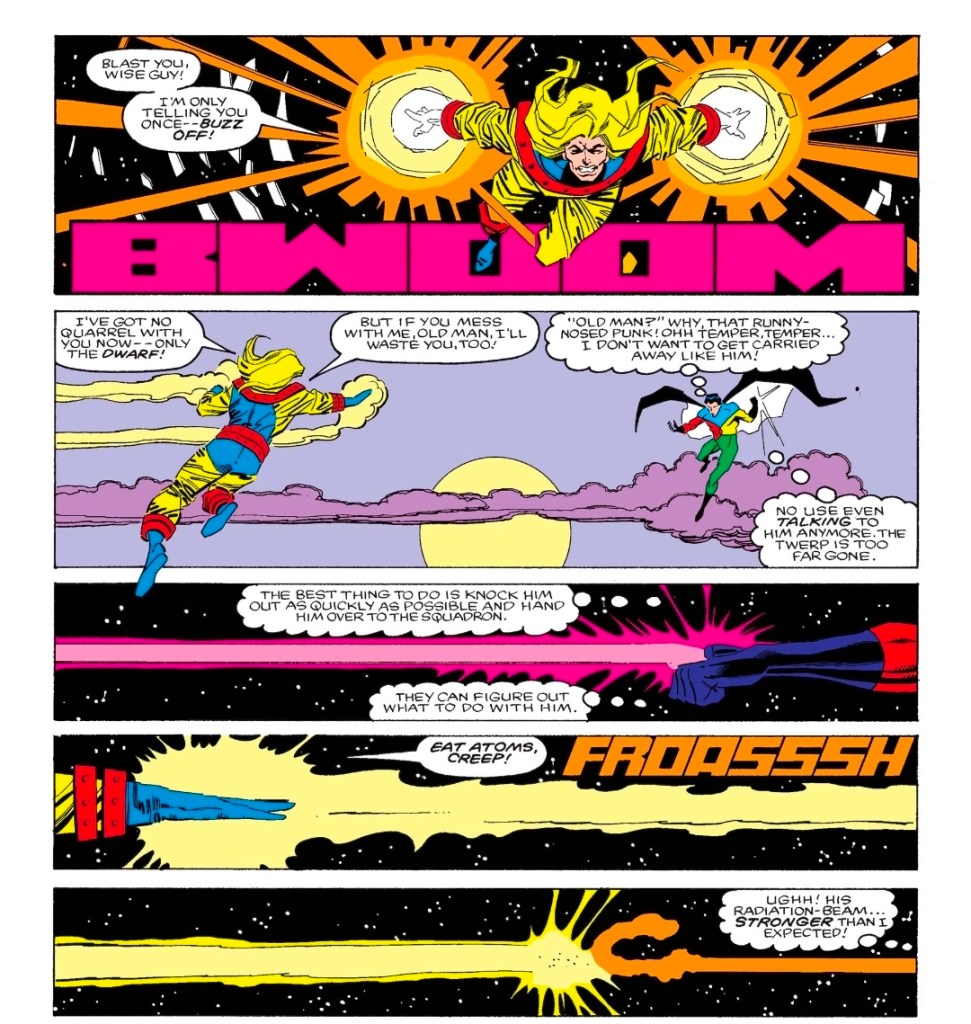
For the first time since the series began, Gruenwald delivers a true superhero battle.
Because he’s waited three issues, the confrontation carries enormous weight.
By the time Spectrum finds Nuke mourning at his parents’ graves, every emotional thread laid throughout the series has converged.
Nuke blames Tom Thumb. He resents the Squadron. He’s consumed by grief, guilt, and rage.
Spectrum genuinely tries to reach him. The problem is that he’s trying to build trust in the middle of a crisis.
That relationship needed to exist before this confrontation began.
The fight itself isn’t the tragedy. The tragedy is that the Squadron mistakes proximity for connection. They work together, live together, and fight together, but they never build the kind of relationships that allow people to recognize when someone needs help before they ask for it.
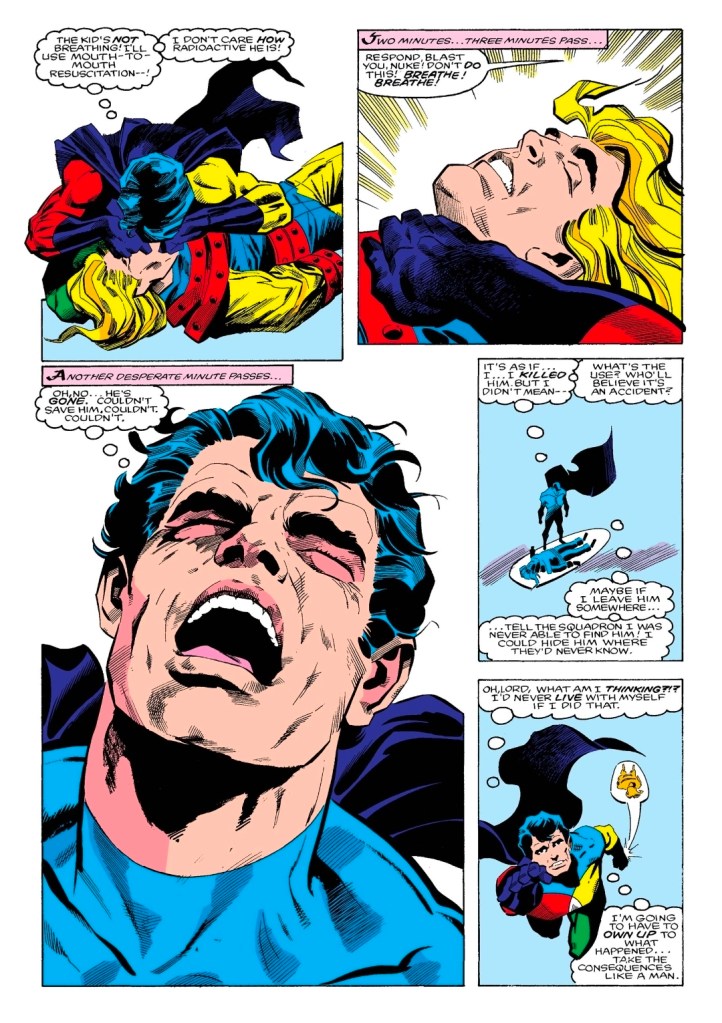
Spectrum improvises, trapping Nuke inside an energy sphere. He succeeds in containing his teammate’s powers.
He also traps his oxygen.
Nuke suffocates as a result.
It’s a horrifying accident, but it doesn’t feel random.
It feels like the inevitable outcome of every missed conversation, every neglected relationship, and every missed opportunity to notice that one of their own was quietly falling apart.
Bob Hall and John Beatty
Bob Hall and John Beatty continue to do exceptional work throughout the series.
Much of Squadron Supreme asks them to illustrate conversations rather than combat, yet the comic never feels visually static. Through expressive faces, subtle body language, and varied panel layouts, they give every exchange energy and emotional weight.
When the action finally arrives, it lands with far greater impact because Gruenwald has largely withheld it until now.
Three issues of character-driven storytelling make the first true superhero battle feel genuinely dangerous. Hall and Beatty never allow the spectacle to overshadow the human drama at its center. Every blow carries the emotional weight that has been building since the series began.
The final pages are especially effective. Spectrum’s desperate attempts to save Nuke, followed by his quiet conversation with Nuke’s younger brother, abandon superhero spectacle almost entirely, instead relying on facial expressions, body language, and silence to communicate grief. It’s some of the strongest visual storytelling the series has delivered so far.
Final Thoughts
Issue #1 asked whether superheroes should assert control over a broken world.
Issue #2 asked what happens when the people asserting that control are broken themselves.
Issue #3 asks what happens when heroes fail to take the time to understand the people they’re trying to save.
On the surface, the Utopia Program continues to succeed. Policies are implemented. Local governments cooperate. The machinery of society keeps moving forward.
Yet beneath that progress, Gruenwald repeatedly reveals the cost of relationships left undeveloped.
The public resists the Squadron because trust can’t be legislated. It has to be earned.
Nuke withdraws because no one recognizes his pain until it has become a crisis. By the time Spectrum finally reaches him with genuine empathy, understanding arrives too late.
For a series about building a better society, Gruenwald quietly argues that institutions, policies, and even superheroes can only accomplish so much.
Trust between people isn’t built through authority. It’s built through empathy, understanding, and relationships cultivated before they’re needed.
The Squadron Supreme may be creating a more efficient world.
That doesn’t necessarily mean they’re building a better one.
Squadron Supreme Entry #4

 Everything (not really)
Leave a comment