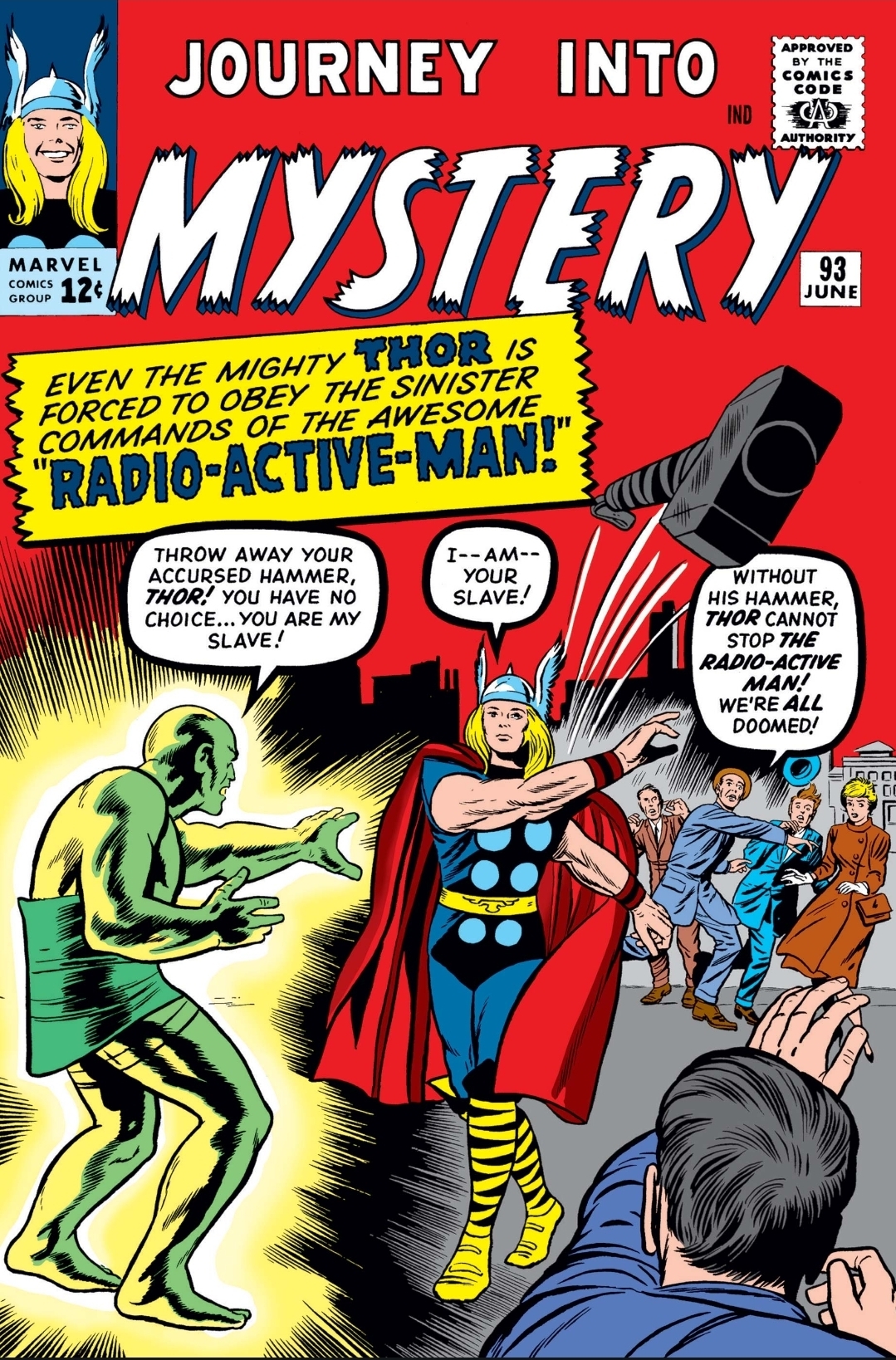
Plot by Stan Lee – Script by Robert Bernstein – Art by Jack Kirby – Inks byDick Ayers – Letters by Raymond Holloway
Journey into Mystery #93 introduces Chen Lu, the Radioactive Man, one of the first original villains created specifically for Thor. After months of battling Communists, gangsters, monsters, and Loki, the God of Thunder finally begins assembling a rogues’ gallery of his own.
The issue opens during the Sino-Indian border conflict, where Don Blake is serving as a doctor in a military hospital. When Chinese forces attack, Thor enters the battlefield.
Kirby wastes no time reminding readers that Thor isn’t just another superhero.

Thor catches artillery shells in one hand, tears apart mountainsides, hurls entire rows of tanks through the air, and summons devastating storms. Every issue seems to make his powers a little grander, pushing him further away from the street-level heroes beginning to populate the Marvel Universe. Kirby wants Thor to feel less like a superhero than a force of nature.
Unfortunately, the sequence also reflects one of Marvel’s recurring weaknesses during this period.
The Chinese characters are presented almost entirely as Cold War caricatures. Their exaggerated features, coloring, dialogue, and motivations reduce them to propaganda rather than characters. It’s uncomfortable to revisit today, and it dates the comic far more than any of its science fiction.

After their defeat, Chinese scientist Chen Lu is ordered to create a weapon capable of defeating Thor. Rather than serving his country, however, Lu decides to make himself the ultimate power, bombarding his own body with radiation until he transforms into the Radioactive Man.
It’s a wonderfully comic-book origin.
Kirby clearly enjoys designing a villain who practically glows off the page. Radioactive Man leaves burning footprints, melts bullets before they reach him, survives fire, emits deadly radiation, hypnotizes Thor, and even claims striking him would unleash the force of a hydrogen bomb.

Whether all of these abilities survive future appearances is another question, but in his debut he feels genuinely overwhelming.
That makes the ending all the more abrupt.
After escaping Radioactive Man’s hypnosis as Don Blake, Blake somehow invents an electronic tracking device capable of locating Mjolnir at the bottom of the ocean, complete with a live video monitor. (How exactly did he get a camera down there?) It’s a wonderfully absurd reminder that early Marvel heroes often possessed whatever expertise the plot happened to need.
Moments later, Thor returns, creates a tornado, and sends Radioactive Man flying back to China, where the strain of his own powers destroys him.

It’s a surprisingly quick conclusion after spending so much time establishing him as nearly unstoppable.
Journey into Mystery #93 represents another important step in Thor’s evolution. Radioactive Man gives the series one of its first memorable original villains, while Kirby continues expanding Thor into a hero whose battles feel appropriately mythic.
The politics and stereotypes still belong to the past.
The storytelling is beginning to reach for the future.
Marvel in the 60s Entry #60



Leave a Reply