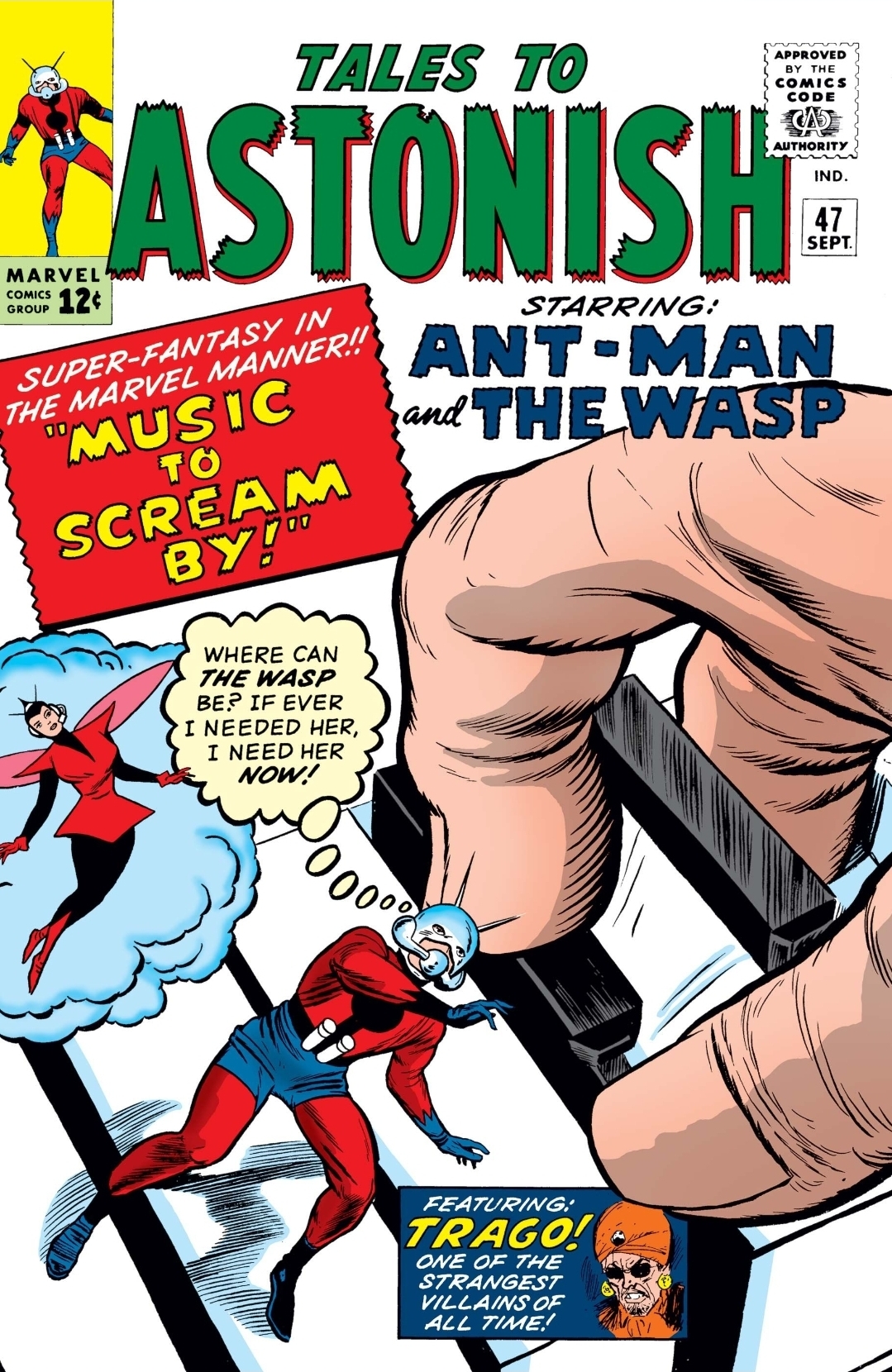
Plot by Stan Lee – Script by H.E. Huntley – Art by Don Heck
Marvel is about to have a pretty significant month. The Avengers and X-Men will debut, expanding a superhero universe that seems to be growing almost every week.
Ant-Man, meanwhile, is fighting a trumpet player from India who can hypnotize people with his magic notes.
Tales to Astonish #47 gets off to a particularly rough start when Ant-Man and the Wasp stop a group of jewel thieves. Janet becomes distracted by the diamonds, giving Hank an opportunity for some casual sexism, before the Indian owner of the jewelry store helpfully explains that his people are known for being exotic and mystical.
Sexism and racial stereotypes right off the bat. We’re off to a good start.

One thing that does immediately stand out is Don Heck’s artwork. His work has been changing since the earliest Ant-Man stories. The smoother faces that sometimes reflected his background in romance comics are giving way to heavier shadows, sharper features, and more angular figures. Some of these pages barely look like the Heck artwork from only a year earlier and remind me of artists I grew up with, like Bill Sienkiewicz and Denys Cowan.
Hank and Janet eventually take a night off to visit a jazz club—Janet apparently being quite the jazz aficionado—but naturally stumble into another crime. A musician named Trago attacks someone and steals money from the club, only to have no memory of why he did it. The owner takes pity on him but sends him back home to India.
There, Trago finds Ghazandi, who teaches him to play a magical horn capable of hypnotizing snakes. Naturally, Trago has a thought. Why stop at snakes?
Months later he returns to America, now sporting a turban and beard, and begins using the horn to hypnotize people. After robbing the patrons of a jazz club, he gets considerably more ambitious and decides to put all of Manhattan into a trance.
For all the recurring villains Marvel has begun developing elsewhere, Ant-Man still spends surprisingly little time fighting actual supervillains.
Trago feels much closer to the strange one-off threats that populated Tales to Astonish before Hank Pym ever put on a costume.

Eventually Hank and Janet fall under Trago’s spell themselves, leaving the ants to drag them underground in an attempt to break the hypnosis.
And then things get weird.
While underground, they’re attacked by a snake. Korr, the winged ant Hank has begun using for transportation, sacrifices himself to save Ant-Man and the Wasp.
Korr dies a hero.
Korr conveniently has a brother named Foss, who can now become his new flying ant.
This is something that actually happens.

Ant-Man and the Wasp eventually track down Trago. Hank bends his magical horn, causing Trago to accidentally play the forbidden notes Ghazandi warned him never to play.
How Hank knows exactly how to accomplish this is best left unexplored.
The notes erase Trago’s memories along with his powers, returning him to his previous life as an ordinary jazz musician. Hank and Janet leave the club early because Hank is still grieving Korr.
And thus ends the tragic story of Korr the winged ant.
There are small signs of evolution here. Hank flying around on an ant finally replaces the increasingly ridiculous catapult he once used to launch himself across town. Janet continues taking an active role in the action. Heck’s artwork is becoming more visually interesting. But the stories themselves remain stuck.
Two issues ago, the return of Egghead, the development of the Wasp, and the ongoing relationship between Hank and Janet suggested Tales to Astonish was becoming a more conventional superhero series. Since then we’ve gotten alien brain scanners, a giant robot Cyclops, and now a magical hypnotic trumpet player.
That’s particularly noticeable as Marvel enters September 1963. The Fantastic Four have Doctor Doom. Spider-Man has Doctor Octopus. Thor has Loki. Doctor Strange has already met Nightmare and Baron Mordo.
Ant-Man has Trago.
I really hope they figure this out.
Marvel in the 60s – Entry #73


Leave a Reply