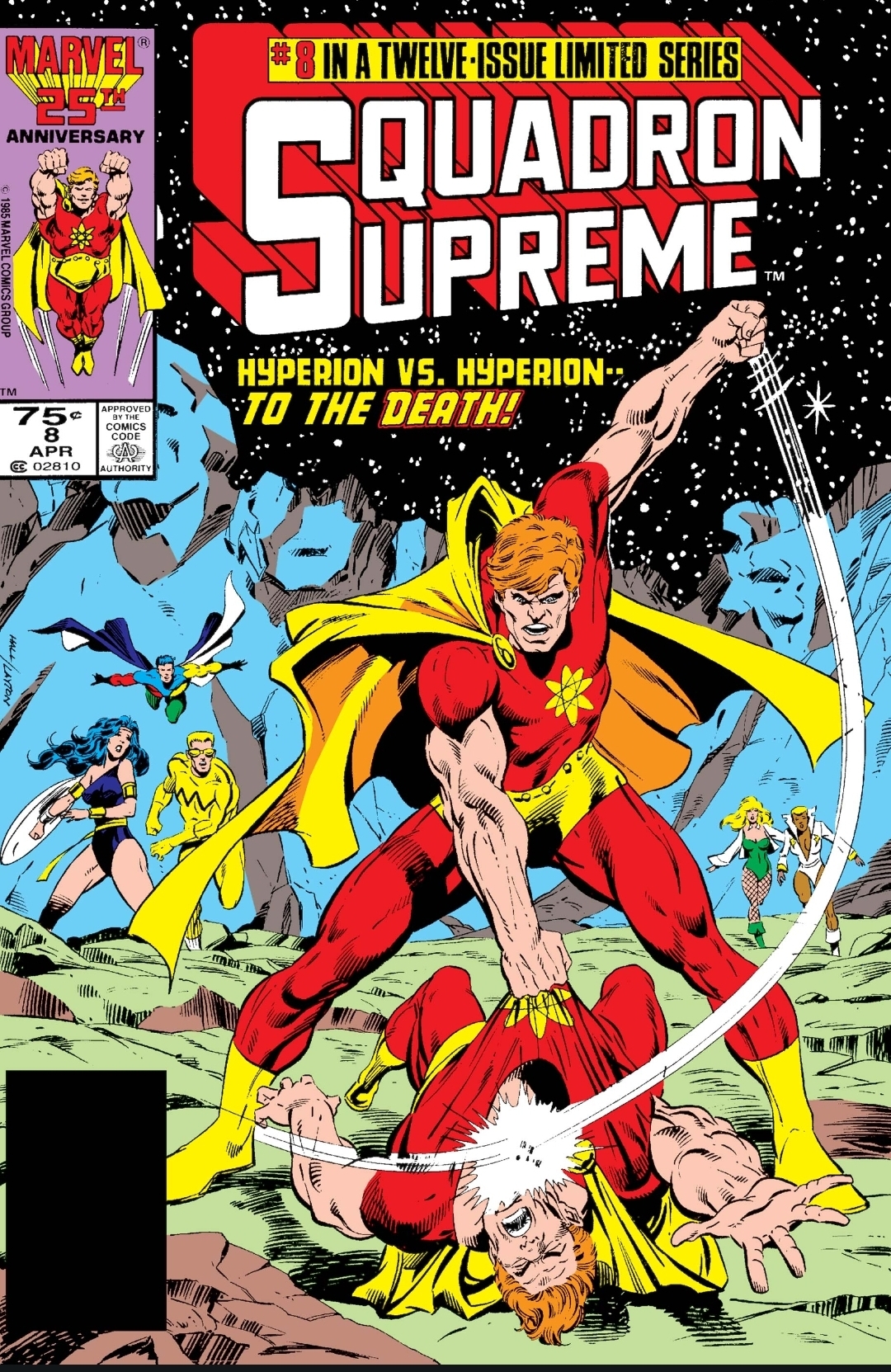
Written by Mark Gruenwald – Pencils by Bob Hall – Inks by Sam De La Rosa – Lettered by Rick Parker – Colored by “Max” Scheele
The Good Old Days

Issue #8 opens with the Whizzer out for a run when he stumbles across a crime in progress.
For a few pages, it almost feels like we’ve stepped back into the world before the Utopia Program. There are costumed bad guys, a superhero shows up, and a fight breaks out.
Except the Utopia Program has changed this world even here. The criminals are wearing the same force-field belts the Squadron introduced as an alternative to guns. Now they’ve discovered another use for them: the fields also protect them from the Behavior Modification machines.
It isn’t a permanent solution. Eventually they’ll have to come out. Still, it’s another complication the Squadron didn’t anticipate.
Whizzer tells Tom Thumb, and he immediately wants to keep the loophole quiet.
So even this brief return to the old days doesn’t last long. The Squadron is once again deciding that there are things people are better off not knowing.
The Trouble With Brainwashing

Elsewhere, another piece of the Utopia Program is producing much more troubling results.
Blue Eagle and Quagmire are part of a team working at a chemical plant that has been converted to manufacture “gumdrops,” the tranquilizers invented by Ape-X for use by law enforcement.
Quagmire hits on one of the female workers, and Blue Eagle responds by berating him. He tells Quagmire that his behavior reflects badly on the Squadron and eventually strikes him.
Quagmire can’t defend himself.
Behavior Modification won’t allow it.
It’s an ugly demonstration of a power imbalance the Squadron has created. Quagmire has been conditioned against taking any action against a member of the Squadron Supreme. If one of them decides to abuse him, he has no way to fight back.
Blue Eagle takes off to cool down, seemingly more troubled by his feelings for Lady Lark than by the abuse of power he just demonstrated.
When he returns, there’s been an accident at the plant. Blue Eagle finds Quagmire unconscious after saving thirty people and taking a potentially lethal dose of gumdrops in the process.
It’s unquestionably a heroic act. But after what we’ve just seen, there’s an uncomfortable question attached to it.
How much choice did Quagmire have?
Behavior Modification has removed his ability to act in certain ways. Now we’re left wondering whether it can also override something as fundamental as self-preservation. Does his directive to protect people mean he can’t stop, even if continuing might kill him?
The Squadron wanted to turn criminals into better people, so they implanted rules in their minds that they cannot override.
Quagmire can’t defend himself against someone abusing him. He may not even be able to protect himself from dying while trying to save someone else.
The rules don’t understand context. Or consequences.
The Double Bind

Gruenwald finds other ways to explore the same problem.
Arcanna visits Dr. Decibel, who has concerns about the way she’s managing her pregnancy. But she has instructed him not to worry about her or tell the rest of the Squadron, and his Behavior Modification prevents him from going against her wishes.
This time nobody is abusing the system intentionally. Arcanna isn’t Blue Eagle. Dr. Decibel isn’t being threatened or mistreated. But the result is still potentially dangerous because his ability to exercise his own judgment about her medical condition has been removed.
Lamprey contends with his own limitations of free will on the way back from a crisis intervention with Hyperion and Doctor Spectrum.
Hyperion speeds ahead of the others, and Doctor Spectrum notices that something about his behavior seems strange. Lamprey notices something even more significant. The energy he detects from Hyperion isn’t quite right.
He has information that could expose the impostor. He just can’t say it. Behavior Modification prevents Lamprey from voicing his suspicions about a member of the Squadron.
Foxfire runs into a similar problem when she discovers the replacement Hyperion with Power Princess. She knows something is wrong, but Hyperion also knows she can’t tell anyone what she saw.
The Squadron designed Behavior Modification around the idea that there are choices people shouldn’t be allowed to make.
They didn’t consider all the situations where not being able to make a choice could be just as dangerous.
The Enemy of My Enemy is Still Probably My Enemy

The real Hyperion, meanwhile, remains trapped in the strange dimensional space where Master Menace banished him. He’s been able to watch what the impostor has been doing in his place, but has been powerless to interfere.
He eventually discovers that Menace is trapped there too, leaving the two enemies dependent on one another to escape.
Master Menace only agrees to work with Hyperion if he promises not to use the Behavior Modification Machine on him when they return. Hyperion initially refuses, and Menace walks away, apparently preferring exile to brainwashing.
Eventually Hyperion relents, but with a condition of his own: Menace has to promise not to interfere with the Utopia Program. The two make their pact, although Menace’s reaction doesn’t exactly inspire confidence that he’ll honor his side of the bargain.
Once they escape, Hyperion lets Master Menace fall from the sky. He claims that saving him would interfere with Menace’s freedom.
It’s funny, but it’s also petty.
And maybe that’s important before Hyperion returns home. The impostor may be the villain here, but Gruenwald has never presented the real Hyperion as a saint. We’ve watched him lie, push Behavior Modification on others, ignore warning signs within his own team and help cover up what Golden Archer did to Lady Lark.
Dropping Master Menace may be a relatively harmless way to indulge a grudge, but we’re about to see what happens when Hyperion has a much more personal reason to be angry.
Hyperion Unleashed

Hyperion crashes into the Squadron’s meeting room in one of the most dynamic images the series has given us and immediately calls out his replacement.
The two Hyperions take off, and what follows is some of the biggest pure superhero action Squadron Supreme has delivered.
These guys are enormously powerful, and Gruenwald and the art team let us experience what that actually means. Their fight tears through everything around them. When their atomic vision collides, the resulting explosion looks like a bomb going off.
It’s awesome comic-book stuff.
But the real revelation isn’t how powerful Hyperion is. It’s how his image of benevolence slips.
For most of the series, Hyperion has been remarkably restrained. Even as his decisions have become more troubling, his power has largely been exercised through meetings, policies and the Utopia Program. He’s lied, covered things up and supported brainwashing people, but always with the conviction that what he was doing would make the world better.
And he’s presented himself as the nicest guy in the room while doing it. Patient, polite, non-confrontational. Calling people “buddy.” There’s almost a Mayberry quality to Hyperion even as he helps take control of the world.
Here he’s filled with rage and a desire for retribution. He has every reason to be furious. The impostor stole his identity, deceived Power Princess and murdered her husband Howard.
But once Hyperion gains the upper hand, the fight stops looking like a fight. He begins beating his counterpart to death, acting as judge, jury and executioner.
Power Princess begs him to stop. Doctor Spectrum manages to hold him off briefly, but the impostor ultimately confesses to murdering Howard and dies in Power Princess’s arms.
The two Hyperions aren’t the same. Gruenwald hasn’t suddenly erased the enormous difference between them. But there’s something unsettling about finally seeing the anger and capacity for violence underneath the real Hyperion’s friendly exterior.
For eight issues, we’ve watched this incredibly powerful man decide what’s best for everyone else while smiling and calling them “buddy.”
Now we know what he looks like when he stops smiling.
Final Thoughts

Issue #8 spends a lot of time showing us the unintended consequences of the Squadron’s solutions.
Force-field belts meant to replace guns become a temporary defense against Behavior Modification. Quagmire’s conditioning leaves him defenseless against Blue Eagle and raises questions about whether his heroism is even voluntary. Dr. Decibel can’t act on his medical concerns. Lamprey can’t voice a suspicion that could expose an impostor. Foxfire is forced to keep a secret.
Even the impostor Hyperion is, in a roundabout way, another consequence. Rebellion against the Utopia Program led to putting an incredibly powerful murderer inside the Squadron.
These aren’t hypothetical concerns anymore.
People are adapting to the Squadron’s rules, exploiting them, rebelling against them and getting trapped by them.
The Utopia Program is starting to feel like a series of cascading solutions. The Squadron identifies a problem and creates something to control it. That solution creates another problem, which requires another solution, another rule, another attempt at control.
And there may be no end to that cycle. Or to the escalation.
The people who still have free will can find loopholes, abuse the system, rebel against it or simply make bad choices. The people subjected to Behavior Modification have the opposite problem. They can’t exercise their own judgment when the rules implanted in their minds don’t fit the situation in front of them.
Every limitation leads to another response. Every rebellion leads to another attempt at control. And each attempt at control seems to raise the stakes.
The Squadron wanted to eliminate violence, crime, suffering and death by bringing more and more of human behavior under their control.
By the end of this issue, that escalation has become lethal.
Hyperion sees the impostor as a threat that needs to be eliminated, and once again, he takes it upon himself to decide what should be done. Only this time the solution isn’t a new program, machine or law.
It’s an execution.
Squadron Supreme Entry #10


Leave a Reply