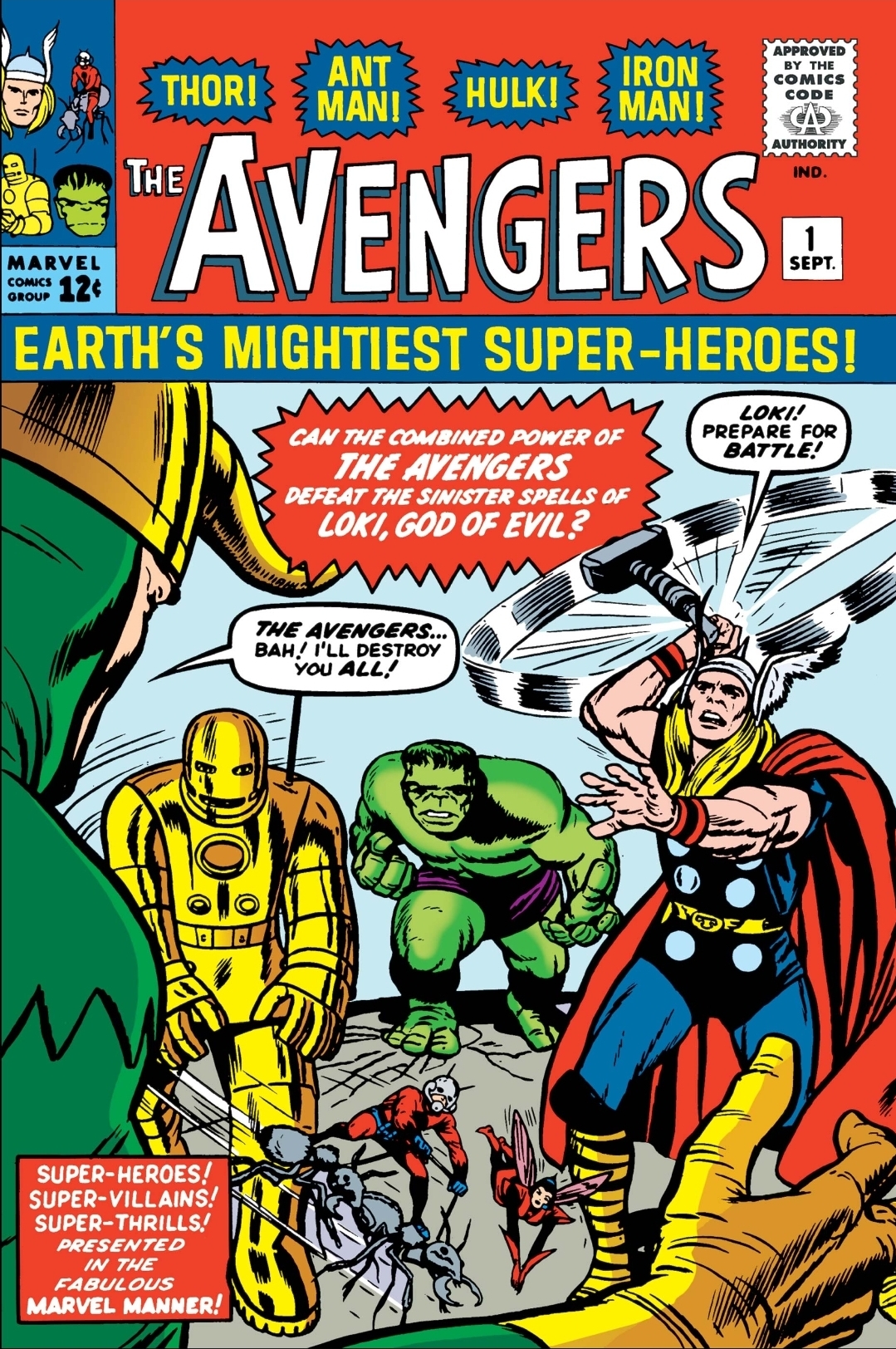
Written by Stan Lee – Pencils by Jack Kirby – Inks by Dick Ayers – Letters by Sam Rosen
Well, they did it.
After nearly two years of building a superhero universe one character at a time, Stan Lee and Jack Kirby finally put a bunch of them in the same comic book.

The first thing that struck me reading Avengers #1 again is how good these characters look together. Kirby has drawn all of them before, but seeing them side by side emphasizes how differently he approaches each one.
The Hulk is enormous, with the physique of a 1960s bodybuilder. Thor is thick and imposing in a way he hasn’t always been in Journey into Mystery. Ant-Man and the Wasp are much more conventionally athletic. Iron Man doesn’t look like a man wearing a superhero costume. He looks like armor.
They already feel like completely different kinds of superheroes sharing the same world.

Loki is searching Earth for another way to defeat Thor when he comes across the Hulk. He frames him for a train accident, hoping the resulting trouble will somehow draw Thor into the situation.
Rick Jones and his Teen Brigade send out a radio message asking the Fantastic Four for help, but the message also reaches Iron Man, Ant-Man, the Wasp, and Thor.
The Fantastic Four are busy, but everyone else shows up. Including the Wasp, who takes one look at Thor and immediately starts swooning.

A false image of the Hulk lures Thor away from the others, and he almost immediately concludes that Loki must be responsible.
So he takes off for Asgard.
That leaves Iron Man, Ant-Man, and the Wasp to find the Hulk, who has chosen an ingenious way to hide from everyone looking for a gigantic green man.
He joins a circus.

Once the Hulk is discovered, Kirby gets to cut loose.
This may be my favorite Hulk artwork of the series so far. Kirby makes him huge without turning him into a mindless monster. Lee also returns to the more cunning Hulk we saw earlier in his own series.
Iron Man takes him on directly. It’s exactly the kind of superhero collision this book promises, and Kirby squeezes perfection out of every panel.

Meanwhile, Thor is having an entirely different comic-book adventure.
He returns to Asgard, confronts Odin, and travels through a landscape of dangerous seas and strange creatures in search of Loki. The scale suddenly becomes mythological, and Kirby seems completely at home.
When Thor finally reaches Loki, we get one of their best confrontations yet.

What makes Avengers #1 so much fun is that it doesn’t immediately flatten these characters into a single kind of superhero.
Thor can disappear into a mythological adventure while Iron Man battles the Hulk on Earth. Ant-Man can solve problems using his size and ants. The Wasp darts around the action. The Hulk is a physical force unlike anyone else in the book.
Eventually Thor returns to Earth with Loki and reveals what’s actually been happening. The heroes turn their attention toward Loki, and once again everyone gets something to do.
In the end, it isn’t Thor or Iron Man who defeats him. Ant-Man traps Loki inside a lead-lined tank.

Once the crisis is over and everyone is preparing to leave, Ant-Man and the Wasp decide they should all form a permanent team.
The Wasp suggests the Avengers as their name and, just like that, Marvel history is made.
We’ve spent over 80 issues of comic books watching Marvel build toward something like this without necessarily knowing it was building toward anything at all.
The Fantastic Four created the foundation. Then came the Hulk, Thor, Ant-Man, the Wasp, Iron Man, and Spider-Man. Characters started wandering into each other’s books. Villains returned. Stories referenced things that happened months earlier.
All these separate comics started becoming part of one world.
Avengers #1 takes advantage of all of it.
Loki can cause trouble for the Hulk. Rick Jones can call for the Fantastic Four and reach Iron Man, Ant-Man, the Wasp, and Thor instead. And Thor can disappear for a side quest in Asgard.
Five heroes from separate features can come together without Marvel having to build any of them from scratch.
Marvel has spent almost two years building a universe.
Now they get to play in it.
Marvel in the 60s – Entry #79



Leave a Reply