
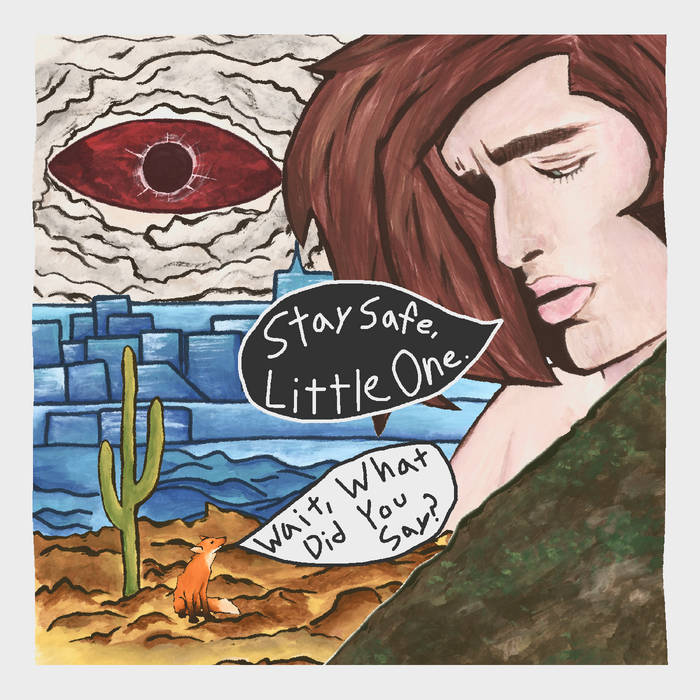
Album by Mon Rovia
Bloodline is an album that takes us along on a personal journey of identity. Mon Rovia explores family, heritage, religion, grief, race, and history as he tries to understand where he came from and what that means for the person he is now. And it’s all wrapped in some truly gorgeous music.
“Black Cauldron” begins gently with acoustic guitar and Mon Rovia’s voice, but it doesn’t stay that way. Piano, mandolin, synths, and strings gradually pile up until this small folk song has become something much larger.
The memories work the same way. This isn’t someone sitting down and telling us the story of his childhood from beginning to end. They’re fragments. Images. Trauma mixed with innocence. Things remembered firsthand sit alongside things he may only understand now. As the sounds accumulate, so do the pieces of his past.
“Pray the Devil Back to Hell” begins with what sounds like a news report about the Liberian Civil War. The song moves through images of war, child soldiers, and buried family members.
But it doesn’t stay in that darkness. Like so many songs here, it starts small and keeps opening up. By the end, voices have gathered around Mon Rovia until they sound almost like a heavenly choir. A song that begins with war ends with people singing that love knows no sides. A fitting tribute to the Women of Liberia Mass Action for Peace.
“Day at the Soccer Field” is heartbreaking. A soccer field should be a place where children play and experience joy. Here, there are children with guns who have become so accustomed to violence that the horror barely seems to register anymore. Mon Rovia sounds fragile against the sparse music, and everything builds toward his hope that they’ll make it back alive.
“A Foreshadowing” slows down into a piano-led ballad, looking back at memories that seem to reveal different things with distance. “Little by Little” gets even smaller, mostly Mon Rovia and acoustic guitar with a mournful violin occasionally appearing around him. There’s grief here, but also an increasing awareness of mortality and the need to notice where you are while you’re still here.
“Whose Face Am I?” gets directly at one of the questions sitting underneath the entire album. Mon Rovia looks toward his mother, his father, their families, and the place he came from while trying to see where he fits among them. If you’ve been separated from so much of your family’s past, how do you understand your place in it? Whose face do you see when you look at your own? The song matches that yearning with this tender, aching music.
“Running Boy” moves with more drive and urgency, conveying a sense of self-preservation and escape, while “Field Song” feels like a respite. Layered vocals make it sound like a whole group has joined in, and suddenly we’re at a barn party.
“Somewhere Down in Georgia” turns toward the American South, using the landscape to reckon with the racism and slavery embedded in its history. “Oh Wide World” has an upbeat drum and some beautiful guitar playing, but underneath it I hear someone afraid to actually go somewhere. “Code of Many Colors” returns to something more haunting. Ethereal backing vocals give it the feeling of slowly waking from a dream, or maybe a nightmare.
“Heavy Foot” comes crashing in like a hit single. It starts quietly before the beat kicks in and turns into this infectious country-folk stomp with a huge chorus. It’s classic protest-song stuff, taking aim at the systems that divide people, but Mon Rovia packages it inside something so ridiculously catchy that the politics can almost sneak up on you.
“Infinite Pines” sounds like someone beginning to move forward. After spending so much of the album digging through the past, there’s a great melody and rhythm carrying Mon Rovia toward whatever comes next.
“Where the Mountain Meets the Sea” brings everything down to a gentle acoustic arrangement with keys and cello. It doesn’t sound like Mon Rovia has solved all the questions he’s spent the album asking. I’m not sure those questions can be solved.
Instead, he seems to arrive somewhere closer to peace: “ But life is short, made long through love.”
What I love about Bloodline is that Mon Rovia doesn’t present his life as a clean story. He couldn’t. His earliest memories come from a country at war. Parts of his family history were taken away from him. His life continued in another country with another complicated history. So he gathers the pieces that are scattered around him.
A memory. A parent. A road. A soccer field. Liberia. Tennessee. Georgia. Racism. Grief. Love.
The music seems to gather itself the same way. A voice and acoustic guitar become piano, strings, mandolin, percussion, synths, and choirs. Small songs grow larger as more pieces are added.
Bloodline doesn’t wrap everything up in a neat bow. It doesn’t reveal one true answer to all of Mon Rovia’s questions.
But maybe knowing yourself isn’t about finding one answer. Maybe the act of discovery isn’t so much in completing the puzzle.
It’s in the gathering of the pieces.
Verdict: Great
Explore more from Mon Rovia


Leave a Reply