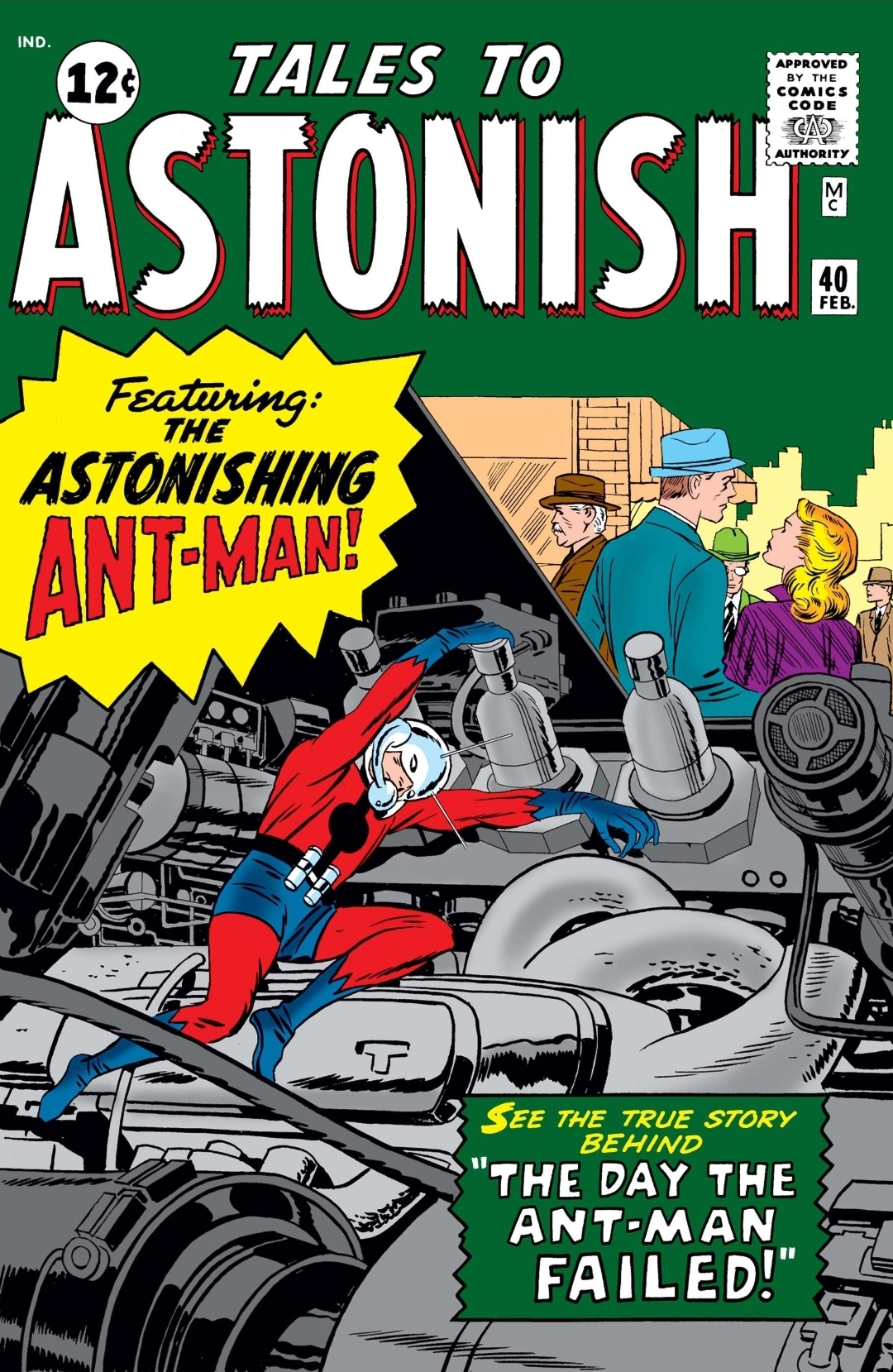
Plot by Stan Lee – Script by Larry Lieber – Pencils by Jack Kirby – Inks by Sol Brodsky – Letters by Art Simek
Tales to Astonish #40 feels like Marvel still trying to figure out exactly what Hank Pym is supposed to be.
The issue opens with a small but interesting detail: Hank mentions unstable molecules, a term that will become heavily associated with Reed Richards and the Fantastic Four.
It’s one of the first moments that hints at Marvel’s books operating in similar scientific territory, although there still isn’t much evidence that anyone is consciously building a shared universe yet.

More importantly, it reinforces something that keeps changing from issue to issue:
Hank Pym is apparently everything. A biochemist. An inventor. A government contractor. A detective. A superhero. And depending on the story, sometimes all of them at once.
This month the plot returns to familiar territory. A criminal known as the Hijacker has been targeting an armored car company, and Hank learns about the crimes through his ant network.
Ant-Man still travels by catapult. Flung through the city and then landing on an ant pile. Which remains one of the funniest recurring ideas in early Marvel.
The mystery itself is fairly simple, but it gives Kirby plenty of opportunities to play with scale and perspective.

Ant-Man rides ants up buildings. Giant office supplies become obstacles. Conversations are framed from ground level, making ordinary people feel enormous. At this point, the shrinking visuals remain the book’s greatest strength.
The actual plot takes a strange turn when Hank develops appendicitis while preparing to catch the Hijacker.
Or does he?
Because this being an Ant-Man comic, the medical emergency turns out to be part of a larger scheme.
The whole thing eventually involves model airplanes, hidden traps, armored cars, and enough twists to feel like a Silver Age detective serial.

The standout sequence comes when Ant-Man hides inside the ignition system of a truck.
When the Hijacker repeatedly blasts the horn, the sound becomes overwhelming at Ant-Man’s size, creating one of the more inventive uses of shrinking powers the series has produced so far.
The payoff works especially well because it ties back to the issue’s opening, where Hank develops a new gas mask made from unstable molecules.
Then comes the reveal. The Hijacker is actually the owner of the armored car company himself. It’s a very Scooby-Doo ending. The logic is a little shaky and Hank’s deduction is a little dubious. But it does reinforce what Marvel seems to want Hank Pym to be: someone who solves problems through intelligence rather than brute force.

The problem is that Marvel still can’t decide what kind of intelligence that is. Scientific genius? Inventor? Detective? Government researcher? Crime fighter? All of the above?
Unlike the Fantastic Four, whose identity becomes clearer every month, Ant-Man still feels like Marvel experimenting in public.
By this point, Hank Pym feels less like a fully defined character and more like a collection of useful traits that can be rearranged to fit whatever story Marvel wants to tell that month.
The issue is enjoyable enough. Kirby’s visuals remain strong. The mystery is serviceable.
But more than anything, it feels like Marvel is beginning to outgrow its own cast. The ideas are getting bigger, stranger, and more varied than its current heroes can contain.
Marvel in the 60s – Entry #35


Leave a Reply