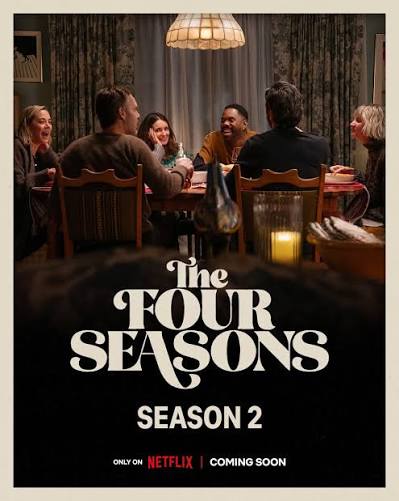
Created by Tina Fey, Lang Fisher, and Tracey Wigfield – Starring Tina Fey, Will Forte, Colman Domingo, Marco Calvani, Kerri Kenney-Silver, and Erika Henningsen
Let’s get this out of the way: I’m probably biased.
Before I watched a minute of the first season of The Four Seasons, the cast had already done most of the heavy lifting to win me over. Tina Fey. Will Forte. Steve Carell. Colman Domingo. Kerri Kenney-Silver. That’s basically a list of performers I’ve spent years enjoying in one project or another.
At that point, watching The Four Seasons felt less like trying a new restaurant and more like being invited somewhere that already serves all of my favorite foods.
And thankfully, the show has largely lived up to that goodwill.
I really enjoyed the first season, and these first two episodes suggest season two understands exactly what made it work.
What I enjoy most about this series is how it takes relatively small, human problems and gives them room to matter. Divorce. Death. Marriage. Friendship. Growing older. Feeling left behind. Wondering if you’ve become the person you thought you’d be. These aren’t high stakes by television standards, but they are the kinds of things that keep people awake at night.
That makes the show surprisingly relatable. There’s comfort in watching characters struggle with problems that feel recognizable. The situations are heightened for comedy and drama, but the emotions underneath them feel real. Most of us will never solve a murder or save the world. Most of us, however, will have to navigate loss, friendship, change, and the occasional awkward conversation we’d rather avoid.
That’s where The Four Seasons finds its stories.
Season one was largely about how a friend group survives a divorce.
Season two appears to be asking how a friend group survives a death.
Both are major life transitions. Both force people to reevaluate relationships they may have taken for granted. And both create difficult conversations that nobody particularly wants to have.
Which is where this group excels.
And by “excels”, I mean avoids completely.
The first two episodes revolve around the group gathering to spread Nick’s ashes, and almost nothing goes according to plan. They’re grieving. They’re trying to honor their friend. They’re trying to support Anne. They’re trying to figure out what Ginny’s place in all of this is.
Most importantly, they’re trying very hard not to say what they’re actually thinking.
That tension is where so much of the show’s humor and drama comes from.
These people love each other. They support each other. They worry about each other. They gossip about each other endlessly.
But when it’s time to have a genuinely difficult conversation, they suddenly become masters of avoidance.
That’s where The Four Seasons finds its sweet spot.
It’s smart.
It’s funny.
It’s heartfelt.
And every so often it becomes delightfully absurd.
The dialogue is sharp, the observations about relationships feel lived-in, and then someone does something completely ridiculous and the show suddenly shifts gears without ever feeling like it’s losing its identity.
Most comedies lean heavily toward one style.
The Four Seasons somehow manages to juggle all of them.
The cast helps tremendously.
Will Forte as Jack remains one of my favorite parts of the show. Most of his career has been built around playing lovable weirdos, and The Four Seasons finds an interesting middle ground for him. Jack is awkward, optimistic, and operating on a slightly different wavelength than everyone else, but he’s also one of the emotional anchors of the group.
Tina Fey as Kate and Colman Domingo as Danny continue to excel as the friends who always seem slightly cooler and more put together than everyone else, even when they clearly aren’t. Marco Calvani brings a romantic earnestness to Claude that keeps him from becoming a caricature. And the tension between Anne (Kerri Kenney-Silver) and Ginny (Erika Henningsen) feels like it’s laying the groundwork for much bigger conversations later in the season.
Another thing the show does remarkably well is making these characters likable despite all of their flaws.
On paper, many of them are kind of terrible.
They gossip. They judge people. They can be selfish, dismissive, and occasionally mean. They ridicule things they don’t understand and sometimes treat the people closest to them poorly.
And yet, somehow, they’re still endearing.
Because beneath all those rough edges is genuine affection. Even when they’re driving each other crazy, you believe they love each other.
That’s harder to pull off than it sounds.
These first two episodes mostly feel like the show laying track for the rest of the season. People are contemplating life-changing decisions. Old tensions are resurfacing. New conflicts are emerging. Everyone is trying to figure out how to move forward after losing someone who was such a central part of the group’s identity.
It’s messy, uncomfortable, and deeply human — which is exactly where this show tends to do its best work.
And I’m more than happy to spend another season with these people.
Verdict: Really Into This
 Everything (not really)
Leave a comment