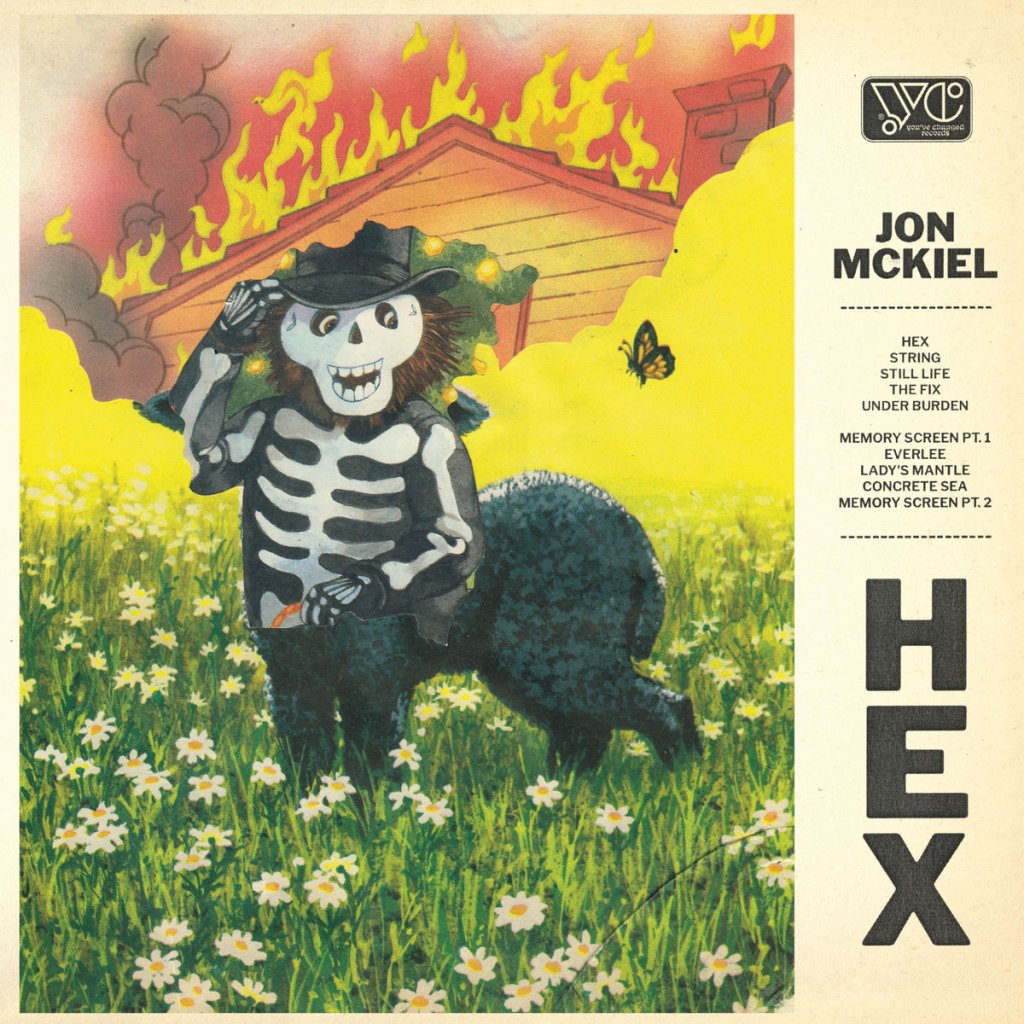
Album by Jon McKiel
I have no idea what genre to call this.
At various points Hex sounds like bedroom soul, indie folk, psychedelic pop, jazz, ambient music, and 70s singer-songwriter fare. If someone told me to imagine the patient exploration of a Grateful Dead jam, the grounded songwriting instincts of Paul Simon, and the warmth of late-70s soul all occupying the same space, I’d at least know where to start.
These songs often drift into hypnotic grooves, abstract lyrics, and dreamlike textures, yet they always seem to maintain some melodic or emotional thread that keeps them grounded. The result is an album that feels unique and occasionally strange without ever losing the listener completely.
The title track immediately demonstrates that balance. “Hex” rides a smooth groove while blending together many of the album’s competing influences. By the time the layered vocals and repeated phrases begin to accumulate near the end, the song genuinely feels like it’s trying to cast a spell.
“String” continues that feeling. The guitars drift and flutter around the arrangement while the rhythm settles into a trance-like pulse. It’s the kind of song that encourages active listening but also rewards simply closing your eyes and letting the music wash over you.
“Still Life” was one of the album’s biggest highlights for me. The soulful groove arrives immediately and feels so good that I almost forgot vocals were coming. McKiel lets the song breathe for nearly two minutes before introducing them, trusting the atmosphere to carry the listener. It’s a decision that pays off beautifully.
“The Fix” pushes further into the album’s psychedelic side. There’s a dreamy quality throughout that occasionally reminded me of Brian Wilson at his most experimental, while still maintaining the warmth that runs through the entire record.
“Under Burden” may be the album’s best example of how strange these songs can become while remaining surprisingly inviting. The repetitive rhythm, unusual textures, and gradual build should feel disorienting. Instead, they become hypnotic.
“Everlee” stands out because it’s one of the album’s most direct and immediately beautiful songs. The melody feels rooted in 60s and 70s pop traditions, and at times it even reminded me of Donovan. Beneath that beauty, though, I found myself hearing a quiet grief—not simply for a person, but for a world that feels increasingly disconnected from nature and increasingly shaped by our own excesses.
That idea becomes even clearer on “Concrete Sea.” Led by acoustic guitar and a wonderful vocal performance, the song feels like a lament for disappearing natural spaces and the endless expansion of development. It brought to mind the more subdued moments of Freedy Johnston while fitting naturally into the album’s larger atmosphere.
“Lady’s Mantle” pulls things back into the album’s hazier territory, blending distorted textures, soulful melodies, and inventive percussion into another immersive listening experience.
The closing track, “Memory Screen Pt. 2,” serves as a fitting conclusion. It begins gently before gradually dissolving into waves of effects, distortion, and ambient textures. The song feels less like an ending than a slow fade into a dream.
I still don’t know exactly how to describe Hex. The lyrics often feel abstract enough that trying to pin down a single meaning can become a losing battle. The music frequently wanders into unexpected territory. Yet somehow everything works.
Maybe that’s because the album never experiments for the sake of being difficult. Beneath all the strange turns and stylistic detours are strong songs, memorable grooves, and an emotional warmth that keeps everything connected.
It’s an odd record. A unique one. And it completely hit my sweet spot.
Verdict: Great
Explore more from Jon Mckiel
 Everything (not really)
Leave a comment