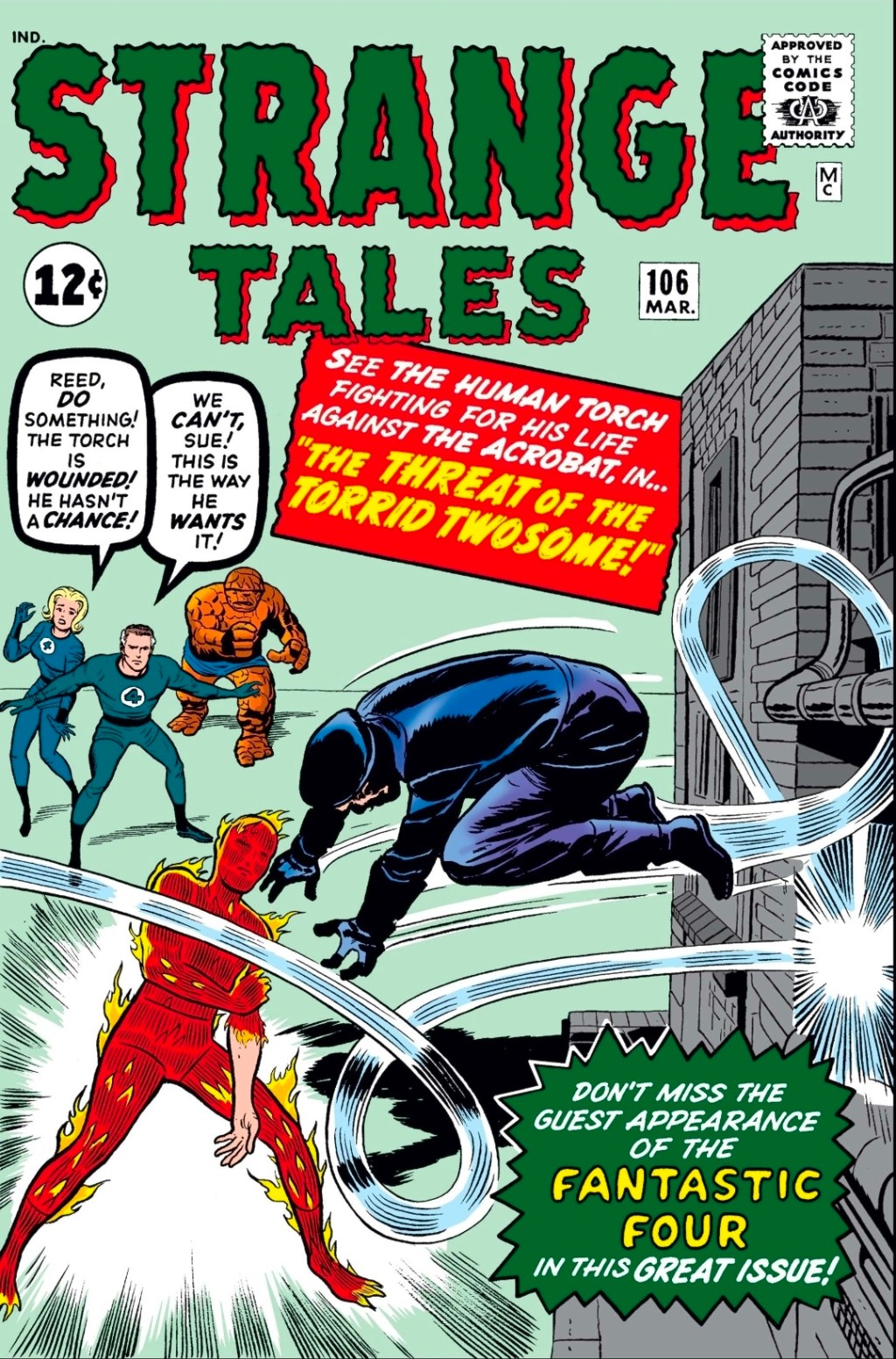
Plot by Stan Lee – Script by Larry Lieber – Art by Dick Ayers – Letters by John Duffy
The biggest change in Strange Tales #106 isn’t the villain.
It’s the absence of Jack Kirby.
For the first time, the Human Torch feature is handed over entirely to Dick Ayers, who now does both pencils and inks.
The difference is immediately noticeable.
Where Kirby’s pages often felt ready to burst apart with strange machinery, impossible architecture, and explosive action, Ayers is a more restrained storyteller. His worlds feel more ordinary. His backgrounds are more grounded. The emphasis is less on visual spectacle and more on clearly guiding the reader through the story.
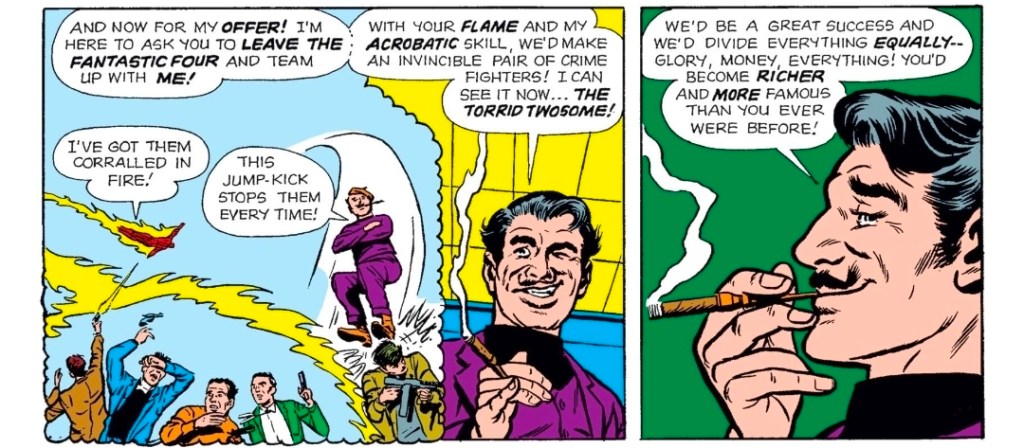
The issue also quietly resolves one of the strangest ongoing elements in the series. Johnny’s secret identity.
The explanation is wonderfully simple: everyone already knew. They were just too polite to bring it up. Which means all of Johnny’s elaborate efforts to protect his secret identity were completely unnecessary. More importantly, it frees the series from a premise that never really worked and allows Johnny to operate openly as a superhero.
With that out of the way, the plot introduces Carl Zante, supposedly the world’s greatest acrobat and a character who feels suspiciously close to a rough draft of Batroc the Leaper.
Zante convinces Johnny that the Fantastic Four doesn’t appreciate him. Why split the spotlight with Reed Richards and company when the two of them could become partners?
The “Torrid Twosome.”
The premise is silly. But it also provides a blueprint for the future. New villains.
Not communists. Not aliens. Not anthology monsters.
Just colorful weirdos with gimmicks.
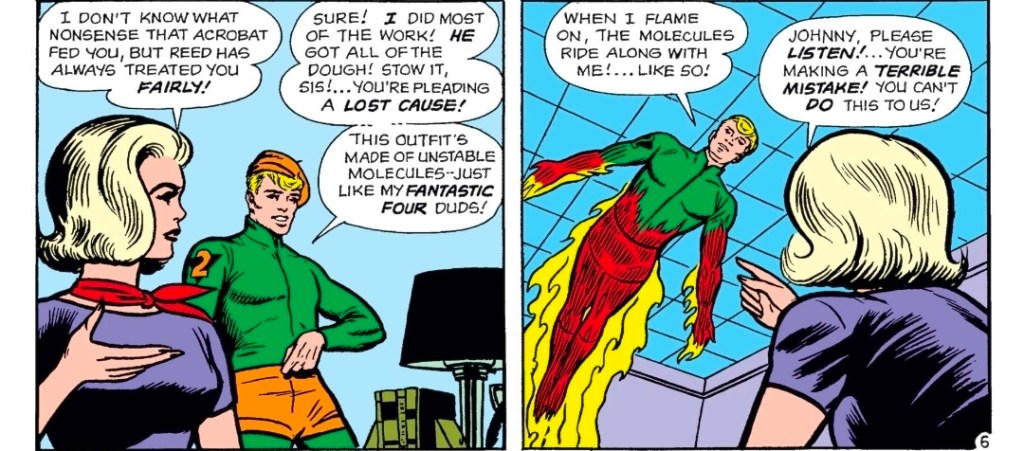
The Fantastic Four themselves make several appearances throughout the issue, each member getting a brief interaction with Johnny. Their presence helps reinforce something Marvel is becoming increasingly good at: making its books feel connected.
Most importantly, we get another mention of unstable molecules, one of the first truly recurring scientific concepts in Marvel’s growing universe.
For the first time, it feels like ideas are beginning to travel between books.
Johnny eventually quits the Fantastic Four, gets himself a flashy new costume, and joins Zante.
The partnership lasts approximately as long as you’d expect. Zante tricks Johnny into helping rob a bank, turns on him, shoots him, and leaves him behind.
Which is surprisingly dark for a Human Torch story.
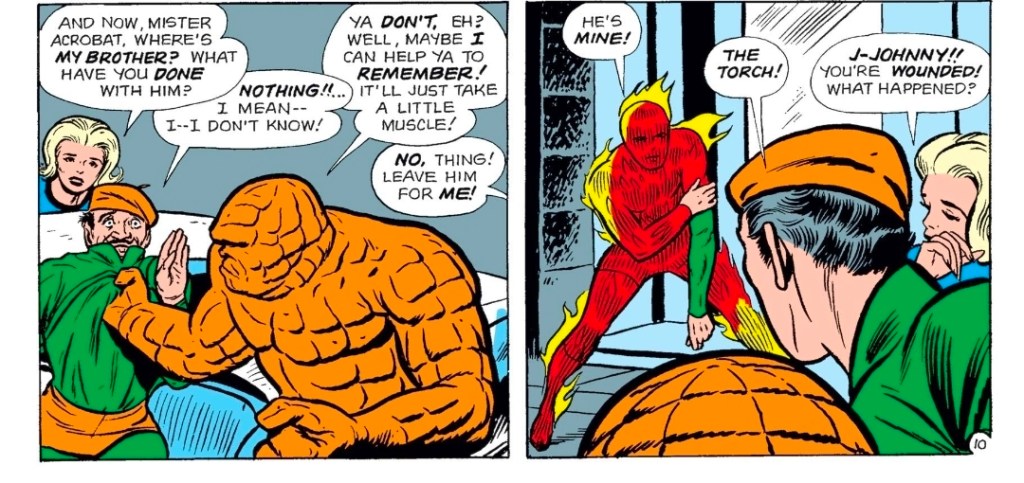
The rest of the Fantastic Four eventually enter the picture, but Johnny ultimately confronts Zante himself.
Afterward, Johnny claims he knew Zante was a crook the entire time and was only pretending to go along with the scheme. The problem is that we’ve spent the entire issue inside Johnny’s head. So let’s just say that explanation feels a little questionable.
The story itself isn’t particularly memorable. Carl Zante never becomes an important villain. The plot is predictable.And Johnny spends most of the issue making bad decisions.
But the issue still feels important.
Because for perhaps the first time, the Human Torch feature no longer feels like a superhero awkwardly trapped inside an anthology comic.
The formula is finally in place.
A recurring hero.
Colorful villains.
A supporting cast.
A shared universe.
A superhero problem.
A superhero solution.
Marvel in the 60s – Entry #38
 Everything (not really)
Leave a comment