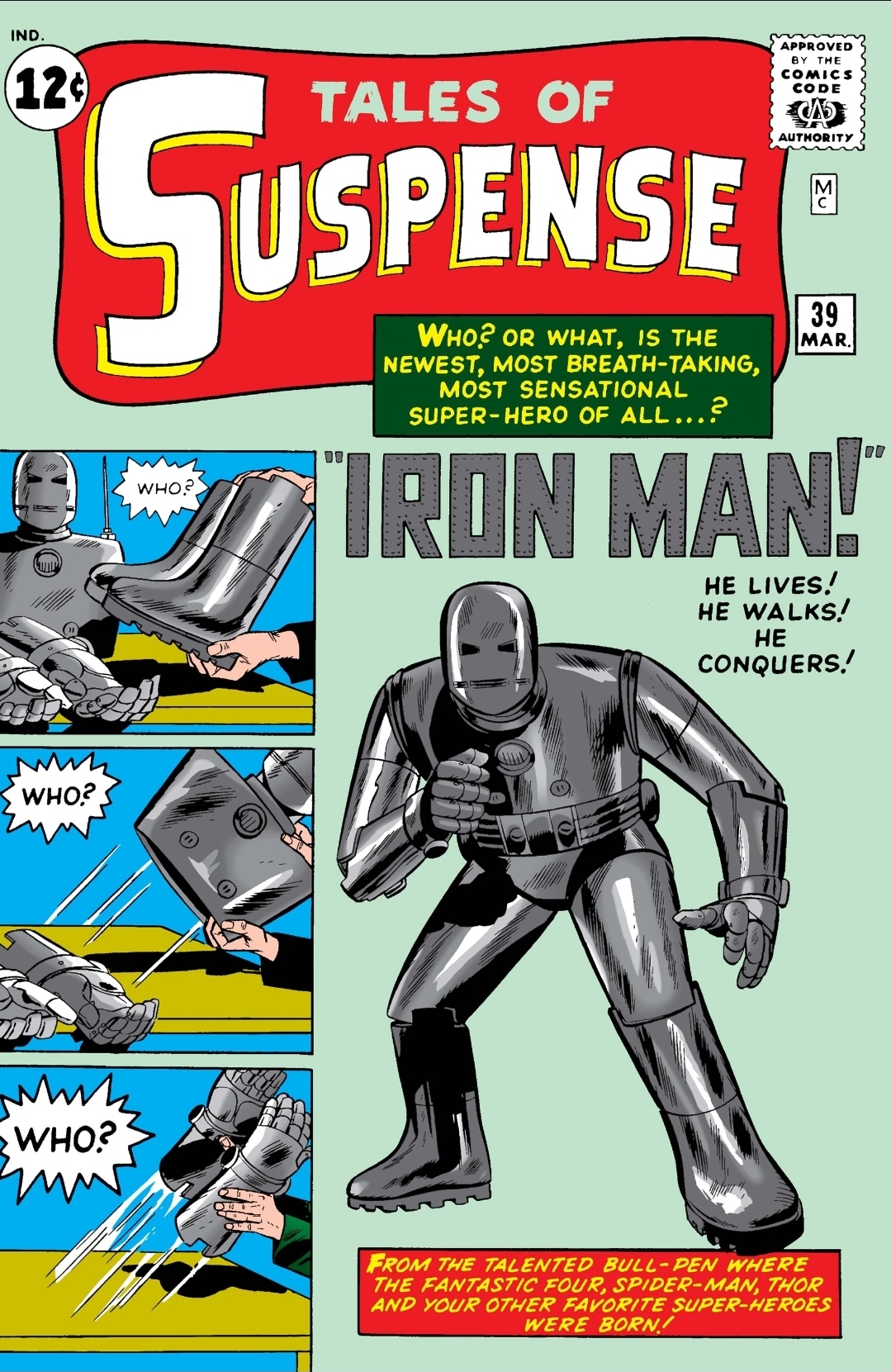
Plot by Stan Lee – Script by Larry Lieber – Art by Don Heck – Letters by Art Simek
Another month.
Another milestone.
With Amazing Spider-Man #1, Marvel introduced one of its most important heroes. Now, just weeks later, it introduces another.
Iron Man arrives.
And the world of Iron Man is very different from Marvel’s other heroes.
Thor draws from ancient myths. The Hulk reflects atomic age anxieties. The Fantastic Four lean heavily into science fiction. Ant-Man often feels like he’s wandered out of a detective story from the 50s. Spider-Man is rooted in everyday adolescence.
Iron Man feels like 1963.

Tony Stark’s world is one of celebrity, wealth, technology, military contracts, and Cold War politics. He feels less like a comic book character and more like someone pulled from the pages of a contemporary magazine.
No Marvel comic so far has felt more connected to the world outside the window.
Don Heck is the perfect artist to introduce him.
This is Heck’s second appearance after Tales to Astonish #41, and his strengths are immediately apparent. If Kirby excels at monsters, gods, and impossible machines, Heck excels at people.
Tony Stark arrives looking like a movie star.
There’s an old Hollywood quality to him. If Howard Hughes served as part of the inspiration for Stark, Heck’s artwork makes that connection feel obvious.
Tony Stark is already fully formed: wealthy, brilliant, charismatic, arrogant, and completely comfortable in his own world.

The issue opens with Stark demonstrating a new weapons system, showcasing the technological genius that made him a millionaire.
In hindsight, it’s also perfect foreshadowing. Because before long, those same ideas about miniaturized electronics, transistors, and magnetic technology will become the only thing keeping him alive.
After introducing Stark’s glamorous lifestyle, the comic takes a sharp turn.
We move to Vietnam. And unfortunately, this section of the story has aged poorly. The depiction of the Vietnamese people, the coloring choices, and the characterization of Wong-Chu and his forces all feel rooted in the broad stereotypes and Cold War attitudes of the era. Even by early Marvel standards, parts of it are uncomfortable to revisit.
Still, the setting itself is significant.
Marvel isn’t inventing a fictional country. It isn’t creating an imaginary conflict. For perhaps the first time, a Marvel superhero origin is directly tied to an ongoing real-world event.
While visiting the region to test weapons, Stark triggers a booby trap, suffers a serious injury, and is captured by Wong-Chu’s forces.
The origin from this point forward is iconic.
Shrapnel is lodged dangerously close to Stark’s heart. Wong-Chu demands that he build weapons. And Stark meets Ho Yinsen, a scientist who becomes the true emotional center of the story.
Yinsen is easy to overlook because Iron Man eventually becomes such a massive character, but the origin doesn’t work without him.
Stark supplies the engineering brilliance. Yinsen supplies the humanity. Together they secretly construct a suit of armor designed both to keep Stark alive and help them escape.

It’s a fascinating twist on the superhero formula. Thor gains power. Spider-Man gains power. The Hulk becomes power. Tony Stark builds a machine because otherwise he will die.
The armor isn’t a costume. It’s life support.
When Yinsen sacrifices himself to buy Stark time, Iron Man is born.
I have a soft spot for the original gray armor. It’s bulky. Awkward. Industrial. Less superhero costume than walking machine shop.
Modern Iron Man is sleek and elegant. This version looks like it was assembled from whatever happened to be lying around the workshop. Which, of course, is exactly what happened.
The early armor is also surprisingly versatile. Flamethrowers. Magnets. Saws. The suit feels less like a flying tank and more like a Swiss Army knife with legs.
In fact, Iron Man is still so primitive that a falling file cabinet gives him trouble during the escape.
The power set hasn’t fully developed yet. But that’s part of the charm.

The climax sees Stark turn Wong-Chu’s own prisoners against him before ultimately defeating the warlord with a blast of fire. It’s a surprisingly brutal ending by early Marvel standards.
Like many Marvel first appearances, Tales of Suspense #39 still contains traces of the anthology era. You can feel the monster comics. The science-fiction stories. The Cold War adventures. All of them blending together.
But unlike many of Marvel’s earlier heroes, Iron Man arrives with a remarkably clear identity. Not just as a superhero. As a concept.
In the span of a single month, Marvel introduces one hero worried about homework and another who builds weapons for governments.
Spider-Man made Marvel feel more personal. Iron Man makes Marvel feel larger.
Marvel isn’t simply adding heroes anymore.
It’s expanding the kinds of stories its universe can tell.
Marvel in the 60s – Entry #41

Leave a Reply