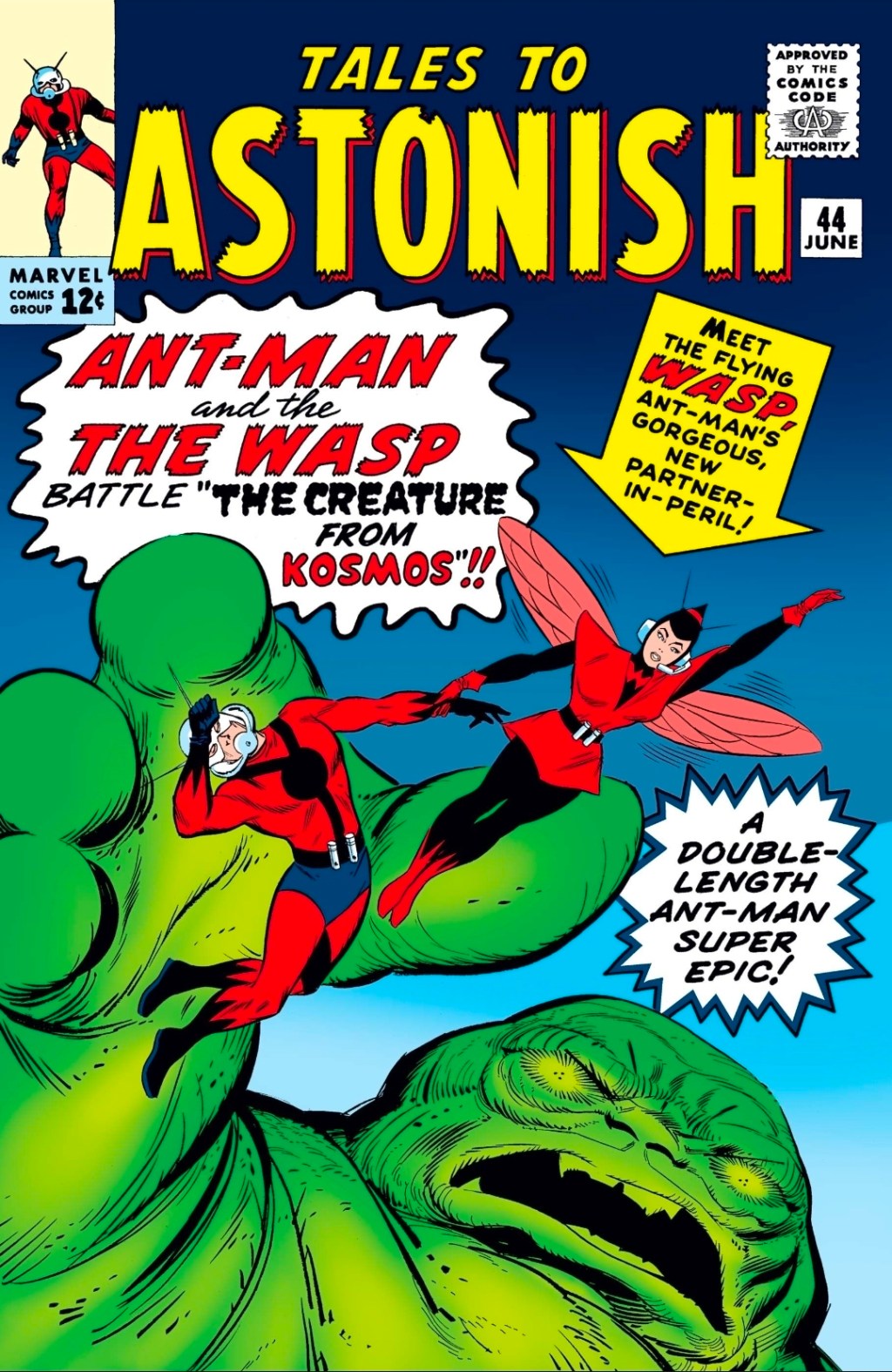
Plot by Stan Lee – Script by H.E. Huntley – Art by Jack Kirby – Inks by Don Heck – Letters by Art Simek
The credits also tell an interesting story. H.E. Huntley scripts the issue from Stan Lee’s plot, marking the first time the series has brought in another writer.
Jack Kirby also returns to the title, now paired with Don Heck on inks. The collaboration plays to both artists’ strengths. Heck lends warmth and personality to the characters, while the action is pure Kirby—dynamic, imaginative, and constantly in motion.
Those creative changes also coincide with a turning point for the series itself. Up to now, Tales to Astonish had been steadily refining Ant-Man’s adventures. What it still lacked was the kind of emotional foundation that allowed Marvel’s strongest books to build ongoing stories.
Issue #44 changes that immediately.
Janet Van Dyne arrives.
And with her arrival, the series suddenly has a heart.
It’s easy to overlook how important this moment is. The Wasp would go on to become one of Marvel’s defining heroines, an original Avenger, and one of the foundational figures of the Marvel Universe. More than sixty years later, she’s still a fixture across comics, animation, film, and television.
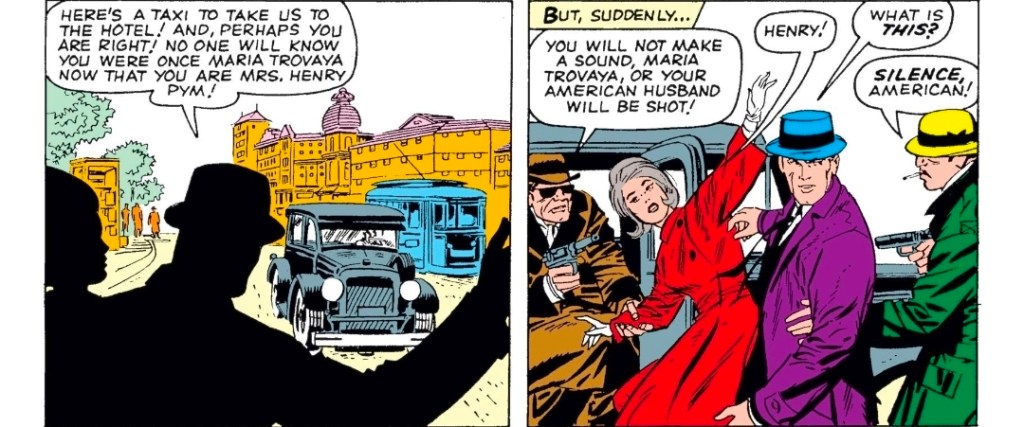
Before introducing the Wasp, however, Marvel quietly rewrites Hank Pym’s past. We learn he was once married to Maria Trovaya. During their honeymoon in Hungary, Maria—a refugee who had fled behind the Iron Curtain—is abducted and murdered while Hank is left unconscious.
The tragedy sends Pym into a nervous breakdown severe enough to land him in prison. It’s remarkably heavy material for early Marvel.
More importantly, it reframes Hank Pym’s entire character. His experiments with shrinking are no longer simply the pursuit of scientific discovery. They’re driven by grief, a desire for revenge, and a determination to ensure no one else suffers the same fate as Maria.
That tragedy quickly echoes into the present. Dr. Vernon Van Dyne visits Pym seeking help with a gamma-ray experiment designed to detect alien life. Accompanying him is his daughter Janet. Pym immediately notices how much she resembles Maria.
The tragedy repeats itself almost immediately. An alien criminal escapes to Earth using Van Dyne’s experiment, destroys the laboratory, and kills Janet’s father.
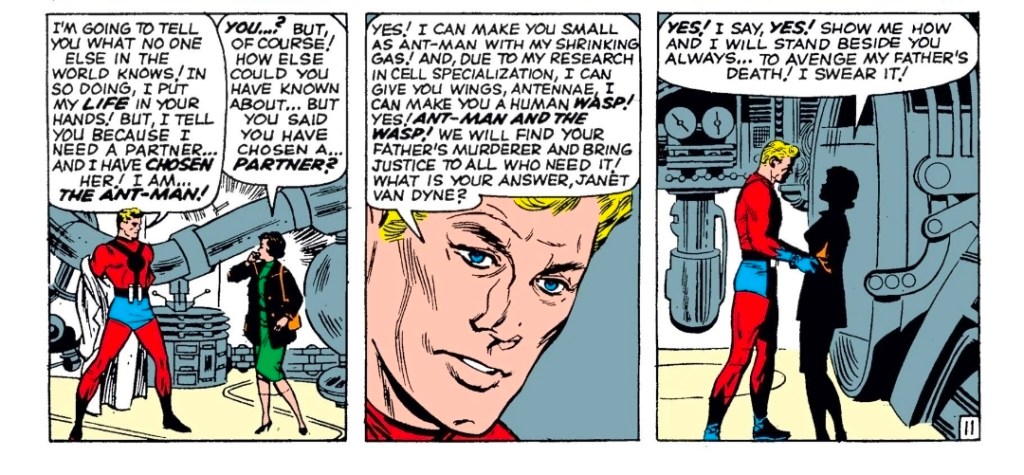
Recognizing the same desire for justice that once drove him, Pym reveals his identity as Ant-Man and offers Janet the chance to become his partner.
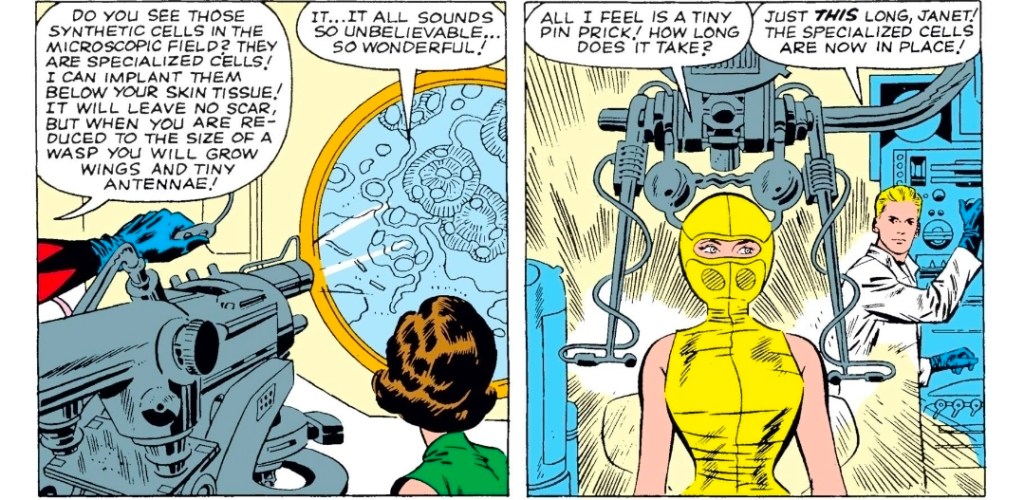
The Wasp becomes only Marvel’s second female superhero after Sue Storm, but unlike the Invisible Girl, Janet enters the series with tremendous energy. She’s impulsive. Optimistic. Fearless. She immediately changes the rhythm of the comic simply by being present.
She also gives the series its first real ongoing subplot.
Almost immediately Janet falls in love with Hank. Pym, who refuses her advances, insisting she’s too young and declaring he could never love again after Maria’s death.
It’s melodramatic. But it also gives the book an emotional thread that had been missing.
The villain himself is largely secondary. A shapeless alien from Kosmos arrives on Earth, grows larger with every passing moment, and proceeds to smash military hardware with predictable ease.
The real attraction is watching Ant-Man and the Wasp learn to fight together.
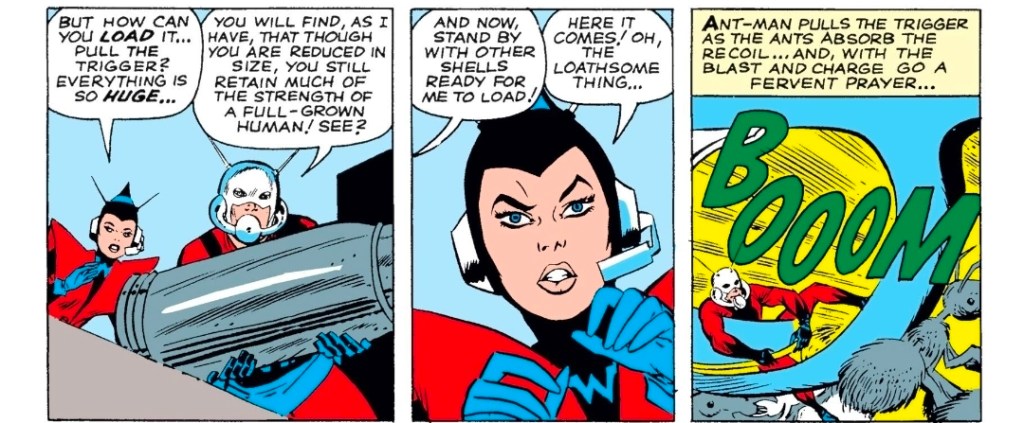
Faced with the seemingly unstoppable alien, Hank devises a shotgun powerful enough to destroy the creature.
The execution is wonderfully ridiculous.
Ants carry the weapon. Ant-Man braces himself behind it. And the tiny hero fires the shotgun using his entire body to pull the trigger.
It’s delightful Silver Age nonsense. But the plot is really secondary to the introduction of The Wasp.
With Janet’s arrival, Tales to Astonish finally stops feeling like a string of standalone one-dimensional adventures.
Now Hank has someone to talk to. Someone to challenge him. Someone to care about. And eventually someone to fall in love with.
For the first time, Ant-Man has an ongoing storyline that can evolve from issue to issue giving the series something it desperately needed.
A future.
Marvel in the 60s – Entry #56

 Everything (not really)
Leave a comment