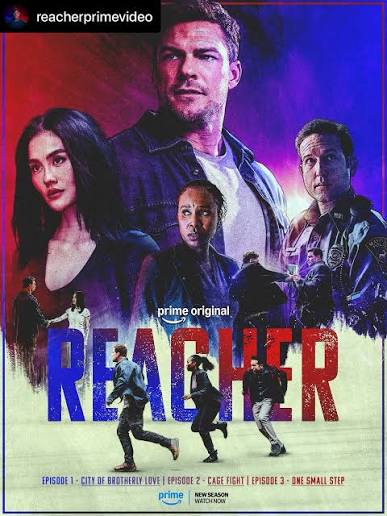
Developed by Nick Santora – Based on the novels by Lee Child – Starring Alan Ritchson
After witnessing a deadly encounter on a Philadelphia subway, Jack Reacher finds himself pulled into a mystery involving a woman he couldn’t save and several dangerous people who believe he has something they want.
Reacher is big, dumb television, and I mean that as a compliment.
The mysteries can get complicated and Reacher himself is usually the smartest person in the room, but the basic appeal is wonderfully simple. Reacher wanders into trouble, figures out what is going on, says something funny without realizing he’s funny, and eventually beats the hell out of someone who made the very poor decision to underestimate him.
I love it.
There’s something wonderfully nostalgic about Reacher. It feels like the kind of show that would have been right at home on television when I was growing up. It’s like The A-Team had a baby while sleeping with Burn Notice, Kung Fu, and The Incredible Hulk. We don’t know who the father is, but they all stuck around to help raise the .
Season four doesn’t mess with that formula. Based on Lee Child’s Gone Tomorrow, the premiere begins with Reacher noticing a woman on a subway whose behavior immediately sets off alarm bells. His ability to observe people and situations has always been as important to the character as his ability to throw someone through a wall, and the first episode makes sure to remind us of that.
It also gets at something I’ve always liked about the character. Reacher presents himself as cold and detached. He owns almost nothing, has few attachments, and wanders from place to place seemingly content to remain disconnected from everyone around him. But underneath all of that, he has a pretty enormous soft spot for people who need help. Put someone smaller or more vulnerable in the path of a bully and Reacher suddenly has a reason to stick around. Usually the bully regrets that.
One of the things Reacher does particularly well is give us a mystery with enough moving parts to keep me guessing without losing the simple pleasures of the show. There are clues to follow and people whose motives aren’t immediately clear, but everything keeps moving. Before long, somebody inevitably decides the best solution to their Reacher problem is violence. That never goes particularly well.
Alan Ritchson remains perfectly suited to the role. Obviously, he looks like someone capable of doing all the ridiculous things Reacher does, but the humor is just as important. The one-liners work because Ritchson rarely plays them like jokes. Reacher simply says what he thinks, completely straight-faced, while everyone around him has to figure out how to respond to this enormous, extremely strange man.
And then there is the action. Reacher understands that part of the reason we’re here is to watch Reacher beat people up. The fights are physical, occasionally ridiculous, and enormously satisfying. There’s always something amusing about watching a group of bad guys look at this human refrigerator and collectively decide that attacking him is a reasonable course of action. Spoiler alert: it isn’t.
That’s why I keep coming back to the nostalgia of it all. Reacher reminds me of an older kind of television where the premise itself was enough. The location can change. The supporting characters can change. The mystery can change. But eventually our wandering hero finds people in trouble, discovers some larger injustice, and decides to do something about it.
There are plenty of shows asking me to spend hours with terrible people doing terrible things. Reacher gives me someone I can root for, a mystery I want to solve, some good jokes, and the promise that eventually the right person is going to get punched in the face.
TV Verdict: All In


Leave a Reply