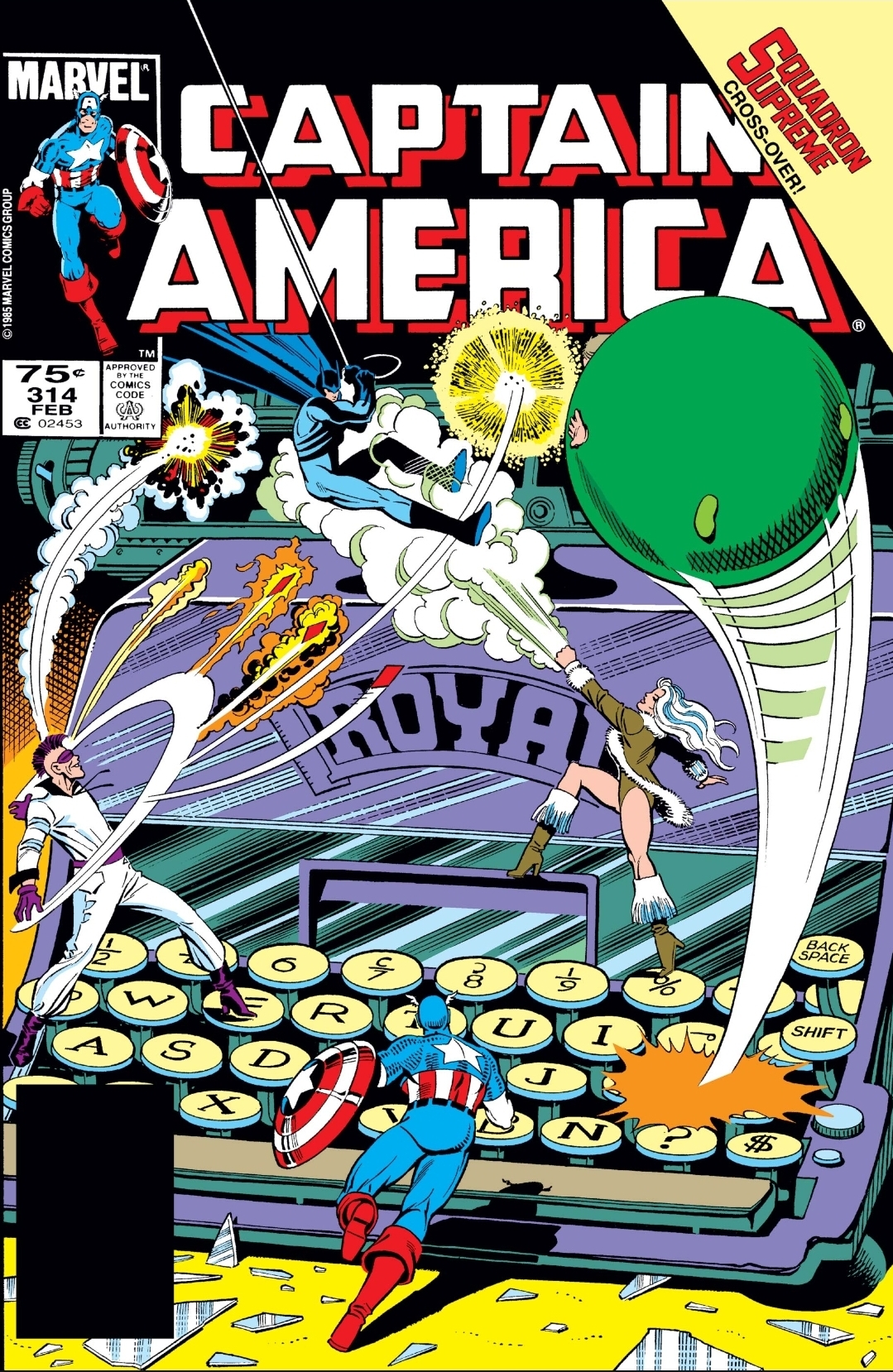
Written by Mark Gruenwald – Penciled by Paul Neary – Inked by Dennis Janke – Lettered by Diana Albers – Colored by Ken Feduniewicz
Meanwhile, in Captain America…

At the end of Squadron Supreme Issue #6, readers are told that the story continues in Captain America #314.
For a twelve-issue limited series now remembered as one of Marvel’s landmark works, that’s an interesting reminder of how differently the book was presented at the time.
This isn’t a disposable crossover or a guest appearance that can easily be skipped. Nighthawk has been absent since the first issue, and his return to the story happens here. Plot points that will presumably matter to the second half of Squadron Supreme are being developed in another monthly Marvel comic.
It reinforces an idea that bears repeating. For all the weight Squadron Supreme carries today, it wasn’t presented like what we would now think of as a prestige comic. Artists and letterers changed. The story existed alongside the rest of Marvel continuity. And now an important chapter in the series takes place in Captain America.
Mark Gruenwald’s Captain America

At the time, Gruenwald had just started what would become a ten-year run writing Captain America, and this crossover reminds us that Squadron Supreme wasn’t the only place where he used traditional superhero comics to play with more complicated ideas.
Gruenwald repeatedly challenged Steve Rogers’ ideas about patriotism, violence and authority. He introduced the Serpent Society, turning supervillainy into something resembling a business. The Power Broker turned superhuman strength into a commodity. John Walker offered a very different vision of what Captain America could represent. Steve would eventually surrender the Captain America identity rather than compromise his principles.
The specifics changed, but Gruenwald kept finding ways to question the institutions, assumptions and morality of the superhero world.
What makes Gruenwald’s approach so interesting is that he never needed to stop writing superhero comics to do it. He never had to deconstruct the genre.
There were still costumes, fights, colorful villains and ridiculous concepts. Gruenwald used all of them to tell the kinds of stories he wanted to tell.
That makes Squadron Supreme feel less like an anomaly in Gruenwald’s career. It’s a particularly concentrated example of something he was doing throughout his work.
Interdimensional Help Wanted

Nighthawk has finally decided that the Squadron needs to be stopped. He seeks help from Professor Imam, the Wizard Supreme of his world, who can’t physically join the fight but can send him to another Earth where he might find allies.
That brings Nighthawk to the regular Marvel Universe and Captain America.
Gruenwald uses their meeting to deliver the recap you’d expect from a crossover. Nighthawk catches Cap up on the Squadron’s history with the Avengers, the Overmind and everything that has happened since the Utopia Program began. For someone reading Squadron Supreme, much of this is old information. For someone who picked up Captain America #314 in 1986, it quickly brings them into the story.
Captain America takes Nighthawk’s request to the Avengers, where something unusual happens for a superhero comic. Instead of immediately jumping through a portal and punching Hyperion, they have a meeting.
The Avengers and members of the Fantastic Four debate whether they have any right to interfere with the government of another world. Some argue that it isn’t their place, while others point out that Marvel’s heroes regularly intervene when they encounter tyrannical governments elsewhere in the universe.
That leaves Captain America wrestling with a contradiction. What the Squadron is doing feels wrong, but crossing dimensions to overthrow another world’s government doesn’t necessarily feel right either.
It’s an interesting contrast with the Squadron meetings we’ve been watching. There’s disagreement here, but the disagreement isn’t treated as an obstacle. They listen to one another, wrestle with the implications and ultimately decide that this isn’t their fight.
Captain America breaks the news to Nighthawk. The Avengers won’t help him overthrow the Squadron, but Cap does agree to help him look for someone who will.
Strange Bedfellows

That search leads Nighthawk to three familiar faces from his own world: Mink, Remnant and Pinball.
After some detective work and a fairly traditional superhero fight, Captain America joins the battle and the three villains are quickly defeated. Then Gruenwald gives the situation another twist.
The villains don’t want to go home.
Master Menace sent them to this dimension because they were afraid of being captured by the Squadron and subjected to Behavior Modification. They would rather remain on this world and voluntarily go to prison than return to the supposedly utopian society the Squadron is creating. They ask Captain America for asylum.
Cap offers another possibility. Instead of running from their world, perhaps they should join Nighthawk and fight for it.
After spending the issue looking for heroes from another dimension, Nighthawk begins to realize that if the Squadron is going to be stopped, the resistance should come from their own world.
Mink, Remnant and Pinball agree to return with him, giving Nighthawk the beginnings of that resistance.
Before they disappear, Captain America silently wishes them luck. He may have decided that overthrowing the Squadron isn’t his fight, but there’s no ambiguity about which side he believes is right.
Final Thoughts

Captain America #314 is an unusual but important chapter in Squadron Supreme.
For six issues, Gruenwald has resisted turning the debate over the Utopia Program into a simple conflict between heroes and villains.
Putting Captain America into the story changes the perspective. Cap agrees that something is wrong. He doesn’t believe that gives him or the Avengers the right to enter another world and overthrow its government, but when Nighthawk decides to build his own resistance, Captain America believes he’s fighting for the right side.
The crossover also helps explain something about why Squadron Supreme works as well as it does. Gruenwald isn’t standing outside superhero comics looking down on their conventions. This is unmistakably a Marvel superhero comic.
And that’s where Gruenwald does his work. He uses those conventions to ask questions about political power, free will, intervention and what gives superheroes the right to impose their morality on other people.
Squadron Supreme doesn’t need to break the superhero genre apart to examine it.
Gruenwald does it from the inside.
Squadron Supreme Entry #8




Leave a Reply