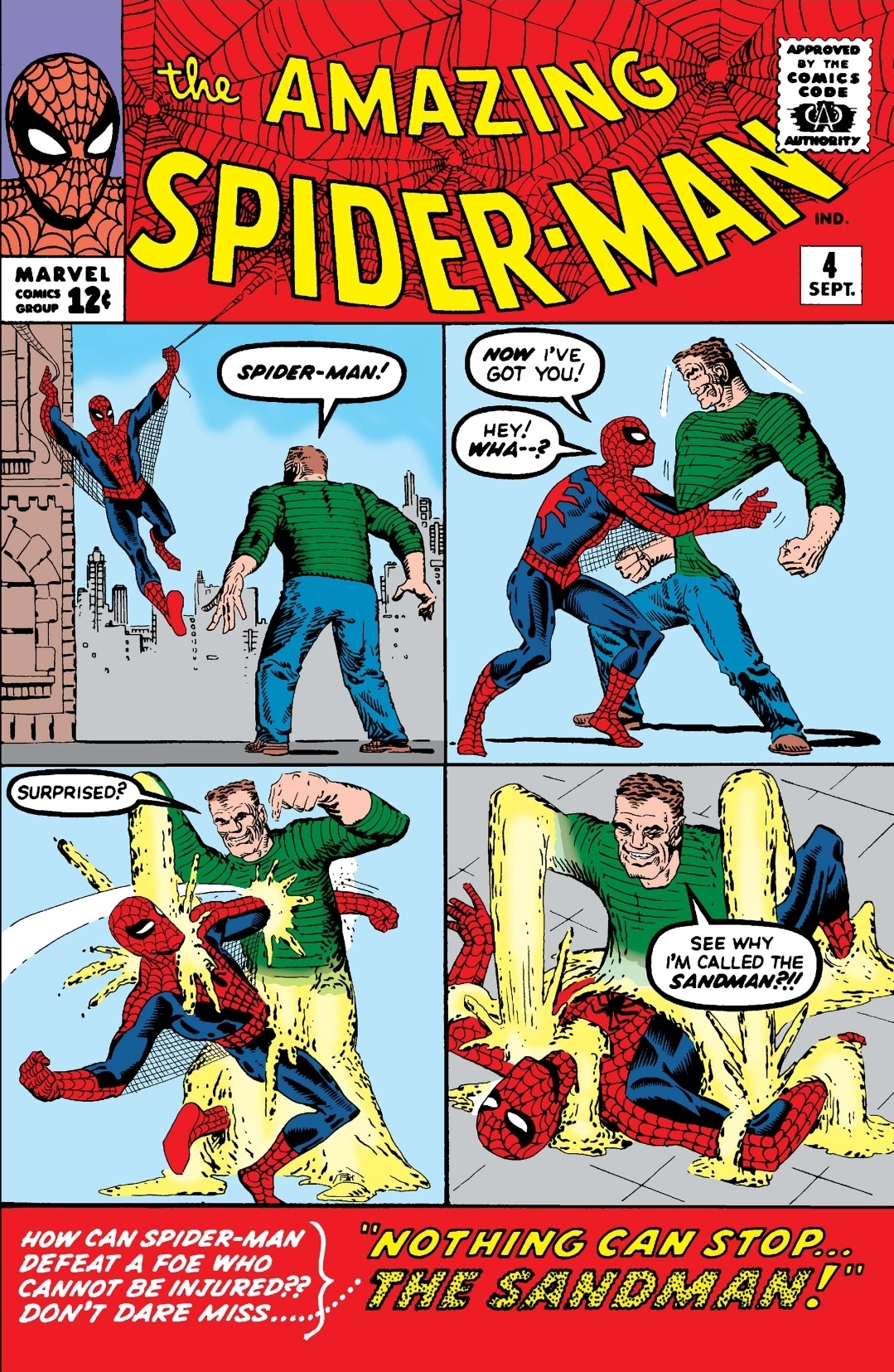
Written by Stan Lee – Art by Steve Ditko
Four issues. Four new villains. Each one still a recognizable Marvel character more than sixty years later.
Amazing Spider-Man #4 introduces the Sandman, continuing what is becoming a remarkable run of character creation from Stan Lee and Steve Ditko. The Chameleon debuted in the first issue. The Vulture followed in #2. Doctor Octopus arrived in #3.
Now Flint Marko joins them.

Even before the story begins, Sandman gets a full-page introduction showing off one of the most visually inventive powers Marvel has created so far. His body can stretch, dissolve, reform, and transform into different shapes.
Sandman is a perfect character for Ditko to flex his artistic muscles.
The issue begins with Spider-Man encountering a group of thieves before they’ve actually committed a crime. Peter intervenes, only for the men to start shouting that Spider-Man attacked them without provocation.
When a police officer arrives, Peter panics and swings away rather than sticking around to explain himself.
It’s an important reminder that Spider-Man is still a kid figuring out how to be a superhero.

Peter soon encounters Sandman, who’s on the run from the police, giving Ditko his first opportunity to demonstrate what the new villain can do. Sandman’s body shifts and reforms as Spider-Man struggles to land a meaningful attack.
Sandman eventually gets the better of him and tears open Peter’s mask, forcing him to retreat before his identity is exposed.
Back home, Peter repairs his costume while watching a conveniently informative television report that gives us Sandman’s origin. Flint Marko escaped from prison and wandered onto an atomic testing site.
Basically, radiation plus sand equals Sandman.

But the more interesting part is everything happening around it.
Aunt May catches Peter wearing his robe and immediately assumes he’s sick. Now Peter has to repair his costume, hide his secret identity, deal with an overprotective aunt, and know that Sandman is still somewhere outside causing trouble.
The mundane problem and superhero problem are the same problem. That already feels distinctly Spider-Man.
Peter’s delay allows Sandman to escape again, and Peter feels responsible because he knows he could have helped.
Meanwhile, J. Jonah Jameson continues his campaign against Spider-Man, only to discover that the wall-crawler has left webbing on his chair. Spider-Man can be juvenile and petty. Especially with authority figures.
Jameson then sends Peter out for more Spider-Man photographs. Peter asks for an advance. Jameson throws him out.
Lee and Ditko already seem to know exactly how Spider-Man’s supporting characters behave around each other.

Sandman decides the perfect place for a wanted criminal to hide is Peter Parker’s high school.
And while he’s there, he demands a diploma.
Apparently Sandman wants his criminal career to have some academic credibility.

It gives Ditko an incredible setting for the inevitable fight. Spider-Man and Sandman battle through the cramped hallways and staircases of a Queens high school, and Ditko makes Sandman’s powers feel almost limitless. Arms stretch across panels. Hands transform into giant hammers. His face dissolves. His entire body collapses into piles of sand before reforming somewhere else.
Ditko also uses several dense nine-panel pages, packing an enormous amount of movement into relatively small spaces. Where Kirby often makes action feel explosive, Ditko makes it feel strange, elastic, and unpredictable.
Peter eventually realizes he can’t simply overpower Sandman. So he outthinks him.
Spider-Man tricks Sandman into getting close enough to an industrial vacuum cleaner and sucks him inside, trapping him in a canister.
Then Peter stages photographs of himself fighting Sandman so he has something to sell Jameson. Because defeating the supervillain isn’t enough. Peter Parker still needs money.

That might be the defining trick of Amazing Spider-Man this early in its run. The superhero story never replaces Peter Parker’s life. It keeps colliding with it.
Peter gets a date with Liz Allan, then has to abandon it because he’s Spider-Man. Flash Thompson keeps tormenting him, but Peter has to stop himself from fighting back because he knows what his powers could do. The police don’t entirely trust Spider-Man. Jameson uses Peter’s own photographs to make him look dangerous.
By the end, Peter is miserable and wondering why he keeps doing this.
Four issues into Amazing Spider-Man, Lee and Ditko aren’t searching for a character. They’ve found him.
Doing the responsible thing continually makes Peter Parker’s life harder, and he keeps doing it anyway.
And while they’re establishing all of that, they’ve somehow introduced the Chameleon, Vulture, Doctor Octopus, and Sandman in four consecutive issues.
Not a bad start.
Marvel in the 60s – Entry #74

Leave a Reply