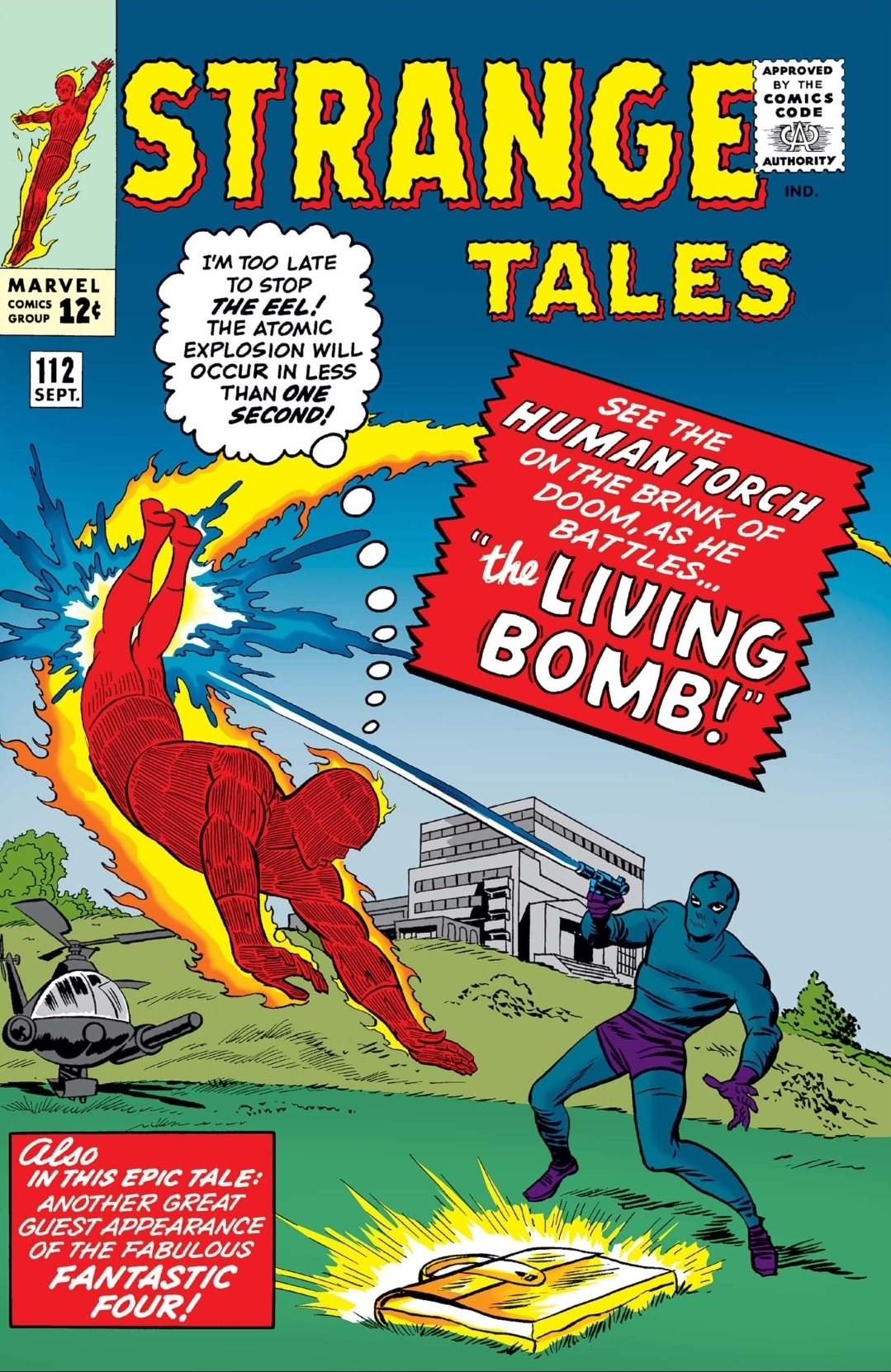
Plot by Stan Lee – Script by Joe Carter – Art by Dick Ayers – Letters by Sam Rosen
There’s something noteworthy about Strange Tales #112 before the story even begins.
Joe Carter isn’t Joe Carter. It’s Jerry Siegel.
The co-creator of Superman is writing the Human Torch. And once you know that, this issue starts to make a lot more sense.
Because as I read this, I kept thinking, “This is bad.”
But there’s a reason it feels so out of place.

Johnny Storm begins the story wondering why nobody seems particularly excited to see the Human Torch. He discovers that the public has turned against him thanks to television commentator Ted Braddock.
Braddock has been using his nightly editorials to portray the Torch as a reckless glory hound. Johnny confronts Braddock on television and flames on during the broadcast.
Then a new supervillain shows up. The Eel is Leopold Stryke, an aquarium caretaker who puts on a costume and begins committing crimes.
And somehow owns a helicopter.

The introduction of the Eel is significant. Marvel’s anthology books have been throwing monsters, aliens, spies, gangsters, and whatever disposable threats they could at their heroes.
But increasingly, we’re getting supervillains.
The Eel steals a bag labeled PROJECT X. Project X turns out to be a miniature radioactive atomic pile, eventually turning the Eel into a walking bomb.
From there, the story follows a remarkably straightforward superhero rhythm. There’s a dangerous invention. A costumed criminal steals it. The hero has to find him. There’s some mistaken identity comedy involving the Thing. Johnny eventually confronts the Eel, separates him from the atomic pile, and gets caught in the resulting explosion.

For a moment, everyone believes the Human Torch is dying. And Siegel goes big with it. Ben is devastated. Police officers cry. Criminals celebrate. Braddock abandons his campaign against Johnny.
The whole world seems to stop and mourn the Human Torch.
Then Johnny recovers and everyone celebrates. In the streets. Like it’s VE Day.
And that’s when it clicked for me.
This isn’t really a bad 1963 Marvel story. It’s an old-fashioned superhero story.
The villain has a colorful costume and gimmick. The threat revolves around an absurd scientific invention. The hero makes a noble sacrifice. The public realizes it judged him unfairly. Everyone learns their lesson and celebrates when the hero survives. Even Ayers’ artwork has a classic 1950s feel to it.
This feels like Golden Age superhero storytelling dropped into the Silver Age. Which makes perfect sense. Jerry Siegel is writing it. That’s what makes Strange Tales #112 such an oddity. It doesn’t fit comfortably beside what Lee, Kirby, and Ditko are doing. But maybe that’s exactly what makes it interesting.
Marvel in the 60s is breaking away from older comic-book conventions and creating its own style of superhero storytelling, but at times it can feel like a slow, gradual shift.
For one issue, Golden Age superhero storytelling wanders into the Marvel Age and shows us just how far that shift has already come.
Marvel in the 60s – Entry #76

Leave a Reply