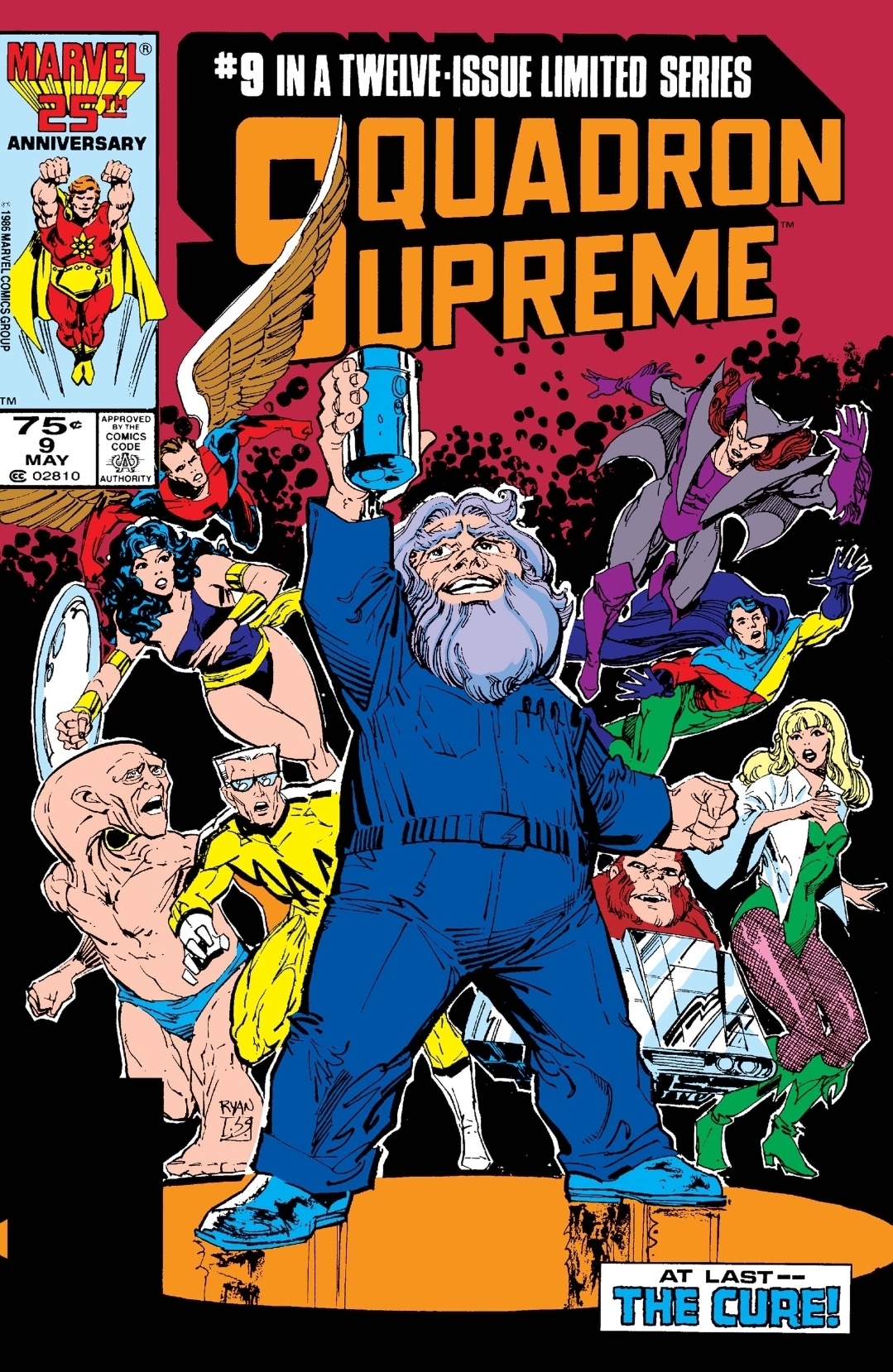
Written by Mark Gruenwald – Pencils by Paul Ryan – Inks by Sam De La Rosa – Lettered by Rick Parker – Colored by Max Scheele
Aftermath

A month has passed since Hyperion’s battle with his counterpart, and the consequences are significant. The impostor is dead. This world’s Hyperion has been blinded.
Doctor Decibel is performing ocular surgery, one of several attempts to restore Hyperion’s sight. Each failure has led Tom Thumb to create a more powerful laser. Decibel understands how risky using such a powerful laser to reattach Hyperion’s optic nerves could be. Despite his reservations, he goes ahead with it.
Hyperion is dealing with his own guilt about killing his counterpart. For most of this series, Hyperion has presented himself as remarkably controlled and morally certain. Last issue, faced with someone who had stolen his identity, deceived Power Princess and murdered her husband, Hyperion decided the solution was to eliminate him.
He beat him to death.
Whatever justification Hyperion felt in the moment, the rage is gone now. He has to live with the fact that he murdered someone because he decided that was what needed to be done.
Power Princess is trying to make sense of what happened too. She believes her feelings for the impostor may have actually come from feelings she already had for the real Hyperion. After discovering that her relationship was built on a lie and watching the real Hyperion kill him, she’s trying to find somewhere for those feelings to go.
It doesn’t necessarily resolve anything, but it gives her a way through the emotional wreckage left behind by the two Hyperions.
And that fits an issue filled with people improvising solutions to problems without looking at the root cause. The result is moral compromises and palliative solutions.
A Shallow Veneer

The members of the former Institute of Evil have been Behavior Modified for a while now, but Foxfire gives us one of our clearest looks yet at what that actually means.
She’s watching old reels from the Squadron’s files about herself, the Institute and the Scarlet Centurion, and she’s openly critical of how incomplete the Squadron’s information is.
There’s no sense that she considers the woman on the screen to be somebody she used to be. She remembers her criminal life. She knows she’s been modified. She hasn’t suddenly become ashamed of her past or adopted an entirely different personality.
Foxfire is still Foxfire.
We get an even better demonstration when Doctor Spectrum sneaks up behind her. Foxfire immediately reacts aggressively. Then she realizes who it is. Behavior Modification kicks in and she becomes apologetic.
But her personality hasn’t changed. Before long, she’s propositioning him for sex.
It’s a revealing sequence because Behavior Modification hasn’t eliminated Foxfire’s impulses. The machine has simply imposed restrictions on what she’s allowed to do.
The Behavior Modification Machine did not replace the hard work of rehabilitation. It just papered over it.
A Matter of Trust

Blue Eagle checks in on Quagmire, who is still recovering from what happened at the chemical plant. He admits that he never particularly liked him. Blue Eagle sees himself as straight-laced while Quagmire is essentially a punk, and that difference fueled some of his hostility toward allowing the former Institute members into the Squadron.
Logically, Blue Eagle knows Quagmire has been Behavior Modified. He knows there are things Quagmire simply isn’t allowed to do anymore.
But knowing that doesn’t make him trust him.
There’s a difference between knowing someone has been prevented from betraying you and believing they wouldn’t choose to betray you.
Behavior Modification skips everything that normally allows that trust to develop. Quagmire hasn’t earned Blue Eagle’s trust. A machine has simply told Blue Eagle that he’s safe.
It takes what happened at the chemical plant, leaving Quagmire in a coma, for Blue Eagle’s perspective to change.
At the same time, Nighthawk is continuing to build his resistance against the Squadron. He and the former Institute members working with him seek out another recruit.
Unlike Blue Eagle, Nighthawk has to trust them. These villains haven’t been Behavior Modified. There is nothing preventing them from walking away, betraying Nighthawk, or making choices he doesn’t like.
The Squadron tried to manufacture trust by removing choice.
Nighthawk has to trust people precisely because they still have one.
A Palliative Panacea

Tom Thumb and Ape-X have been working together on another ambitious project: a way to freeze people suffering from currently incurable diseases until medicine advances enough to save them.
It’s an idea with particular relevance for Tom. His cancer is progressing, and he hasn’t told anyone except his AI companion, AIDA. He has directed her not to tell the other Squadron members, but when Tom passes out, AIDA is caught between two directives: preserve Tom’s life and keep his illness secret.
The conflict visibly strains AIDA as she tries to reconcile two commands she can’t simultaneously obey. Eventually, preserving Tom’s life wins out, and she tells Ape-X.
Tom reveals that he has tried to find a cure and failed. The only one he has ever encountered was the panacea offered by the Scarlet Centurion in exchange for betraying Hyperion.
Ape-X comes up with a solution. Lie and steal it.
Like Foxfire, Ape-X hasn’t necessarily changed. She may be prevented from doing certain things, but that doesn’t mean she no longer believes those things can be justified.
Tom initially refuses. His moral code won’t allow him to steal, which is a strange line for him to draw after some of the compromises we’ve already seen him make for the Utopia Program. Perhaps stealing the panacea primarily to save himself feels different.
But with Ape-X’s help, Tom finds a way around his own rule. They won’t steal the panacea. They’ll take it, analyze it and return it.
Ape-X can’t participate because of her Behavior Modification, so they enlist Lamprey to travel into the future with Tom. But Tom doesn’t tell Lamprey what they’re really doing. He tells him that someone in the future has stolen something they need to recover.
If Lamprey knew what they were actually doing, his Behavior Modification might prevent him from helping. Tom gets around that by giving him false information.
The two travel into the future and find the panacea, although a fight with security destroys nearly all of it. With only one container remaining, Tom decides to take it.
And after all of that, he discovers it won’t save him. The miracle cure of the 40th century is essentially penicillin and vitamins. Humanity has changed so much by then that something relatively simple is enough to cure their illnesses.
For Tom, living thousands of years earlier, it’s useless.
And then, in a black panel of text, Gruenwald tells us that Tom Thumb dies a week later.
It’s an oddly abrupt ending for Tom, accompanied by a strangely heroic epitaph after a series that has repeatedly shown him to be morally compromised.
Final Thoughts

Issue #9 highlights a problem with the Squadron’s approach to the Utopia Program. It’s a kludge. An improvised solution that addresses an immediate problem without fixing its root cause.
That idea runs throughout the issue. Doctor Decibel keeps escalating his attempts to repair Hyperion’s eyesight. Power Princess tries to find somewhere for her feelings to go. Tom Thumb and Ape-X can’t cure certain diseases, so they develop a way to preserve people until someone can.
Even Tom’s search for a panacea becomes a series of workarounds.
The same thing is happening with people.
Behavior Modification is a shortcut. It can prevent certain actions, but it can’t manufacture trust or rehabilitate the Institute of Evil. The Squadron has found a way to stop people from committing crimes without addressing why they commit them or doing the much harder work of helping them change.
And that extends well beyond Behavior Modification. Throughout the series, the Squadron has responded to complicated problems with solutions designed to make the immediate problem go away.
Crime. Violence. Guns. Dissent. Even the problems they create for themselves.
They keep finding ways to treat the symptoms.
They haven’t invested in finding a cure.
Squadron Supreme Entry #11


Leave a Reply