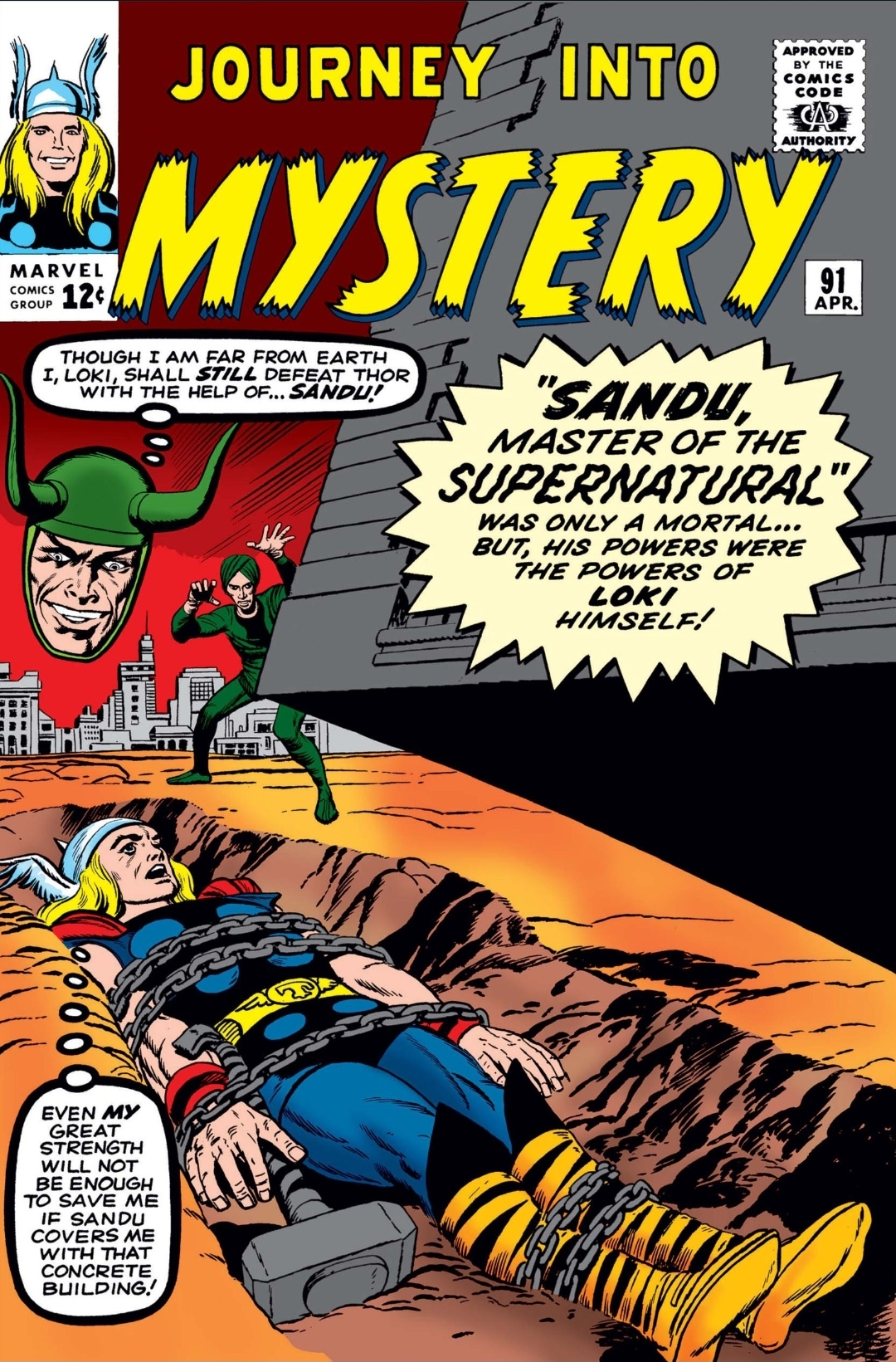
Plot by Stan Lee – Script by Larry Lieber – Art by Joe Sinnott – Letters by Terry Szenics
For the second consecutive issue, Journey into Mystery introduces something that would become a lasting part of Thor’s mythology.
The stories themselves remain uneven, but the character is steadily becoming more recognizable.
That process continues with another notable change behind the scenes as well.
This issue marks Joe Sinnott’s first superhero work for Marvel.
History would remember Sinnott less as a penciler than as one of comics’ greatest inkers, particularly through his legendary partnership with Jack Kirby on Fantastic Four.
Sinnott’s storytelling is clean and cinematic, but far more restrained than Kirby’s. His characters look like ordinary people rather than larger-than-life mythic figures. The hairstyles, clothing, and facial expressions all have a distinctly 1950s feel, giving the book an old-fashioned charm that never quite convinces me I’m reading about a Norse god.
This issue also marks one of Terry Szenics’ early contributions to Marvel’s growing superhero line. Handling the lettering here, she was among the pioneering women helping shape Marvel during its formative years.

The story itself leans more heavily into Norse mythology than many of Thor’s earlier adventures.
Odin references Thor’s Belt of Strength, quietly planting the idea that Asgard contains magical artifacts beyond Mjolnir.
Thor himself also begins speaking in the familiar “thee” and “thy” style readers now associate with the character. It’s inconsistent. But it’s there.
Little by little, Thor is beginning to sound like Thor.
The plot is another matter.

Strange events begin occurring throughout the city. Buildings disappear. Money flies through the air. Chaos erupts seemingly at random. Thor naturally assumes Loki is responsible.
He’s half right.
Although still imprisoned in Asgard, Loki manipulates events from afar by empowering Sandu, a carnival mind reader. It’s exactly the sort of scheme Loki should be orchestrating.
He isn’t trying to overpower Thor. He’s trying to frustrate him.
The relationship finally begins resembling the trickster-versus-warrior dynamic that would define them for decades.

Sandu himself is…fine.
Like many early Marvel villains, he’s less interesting than the larger ideas surrounding him.
The climax arrives when Sandu drops an entire building onto Thor. Odin responds by sending Thor his Belt of Strength via the Valkyries.
It’s an important moment. Because Asgard once again reaches into the mortal world. Thor’s victories are no longer coming solely from his own powers. They’re increasingly tied to a larger mythology filled with gods, magical objects, and ancient traditions.

The issue ultimately ends with Sandu exhausting his stolen powers while attempting to overcome Mjolnir’s enchantment.
It’s another forgettable plot, much like several that came before it. But almost every issue now adds another recognizable piece of Thor’s mythology.
Last issue it was Odin forbidding Thor from revealing his identity to Jane Foster.
This month it’s Loki’s schemes, Thor’s distinctive voice, and Asgard’s expanding mythology.
This series still hasn’t completely found its footing.
But the character is getting there.
Marvel in the 60s – Entry #48


Leave a Reply