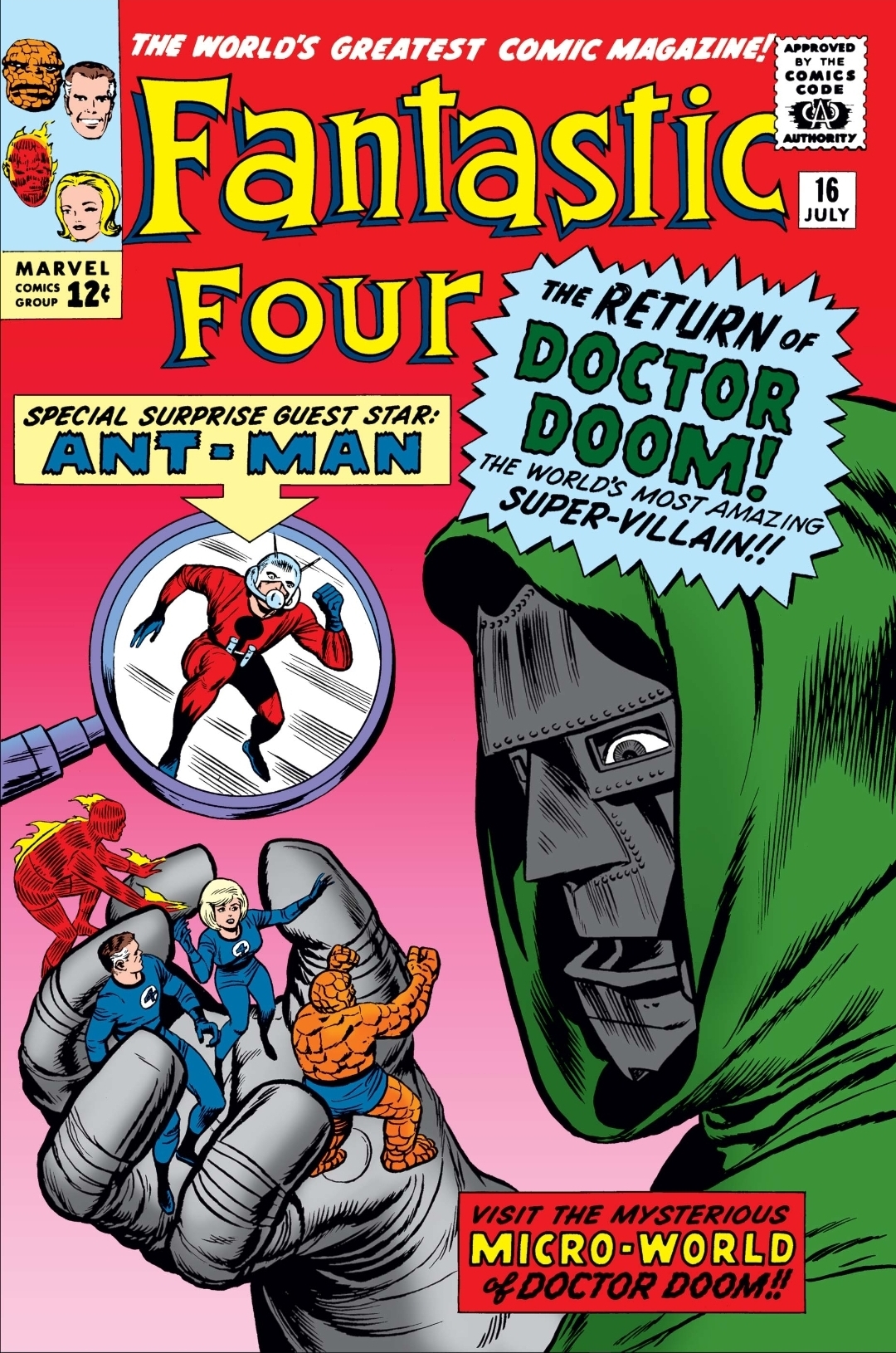
Written by Stan Lee • Art by Jack Kirby • Inks by Dick Ayers • Letters by Artie Simek
One of the joys of reading Marvel chronologically is watching ideas appear in their simplest forms before evolving into something much larger.
Fantastic Four #16 does exactly that.

The issue is built around a rather flimsy premise. One by one, the members of the Fantastic Four reveal they’ve been mysteriously shrinking to toy size for days but never mentioned it because they assumed no one would believe them.
Considering they’ve already fought shape-shifters, monsters, gods, and alien conquerors, it’s a pretty unconvincing excuse.
Still, whatever gets the plot rolling along.

The shrinking naturally brings Ant-Man and the Wasp into the story, making for another early Marvel crossover.
There’s something genuinely fun about watching Marvel’s two resident super-scientists collaborate. Instead of the obligatory superhero fight, Hank Pym and Reed Richards immediately put their heads together to solve the problem.
Meanwhile, Reed continues searching for a cure for Ben Grimm. The transformation once again proves temporary, but the emotional fallout is more interesting than the science. Ben begins worrying that Alicia may only love him because he’s the Thing, planting insecurities Marvel would return to for decades to come.

The groundwork for Marvel’s enduring concepts doesn’t end there.
The shrinking is revealed to be the work of Doctor Doom, who survived his apparent death by becoming trapped within an entire microscopic civilization. Rather than simply undoing Doom’s previous defeat, Lee and Kirby accidentally create one of Marvel’s most enduring concepts: the microscopic world that would eventually become the Microverse—and later the Quantum Realm.
Like many early Marvel concepts, the execution is rough around the edges, but the imagination is unmistakable.

Kirby fills this microscopic kingdom with bizarre machinery, towering architecture, underground prisons, a monarchy Doom turned into slaves, and the Tok, a race of reptilian humanoids. It’s more evidence that no one in comics could invent worlds quite like Jack Kirby.
The action that follows is entertaining enough, especially once Ant-Man joins the battle. Watching Doom face another Marvel hero helps make the shared universe feel increasingly interconnected rather than a collection of isolated titles.
The ending arrives rather abruptly. Doom escapes once again, the microscopic civilization is liberated, and Johnny Storm somehow finds time to flirt with yet another princess before heading home.

It’s a messy issue. The opening barely holds together, and several plot turns exist simply because the story needs them to. There are also three separate montage sequences that exist mostly to remind new readers what each member of the Fantastic Four can do.
But Fantastic Four #16 captures something Marvel was becoming remarkably good at. Even when the stories stumbled, the concepts endured. It’s easy to see why Marvel would eventually become known as the House of Ideas.
Marvel in the 60s – Entry #63

Leave a Reply