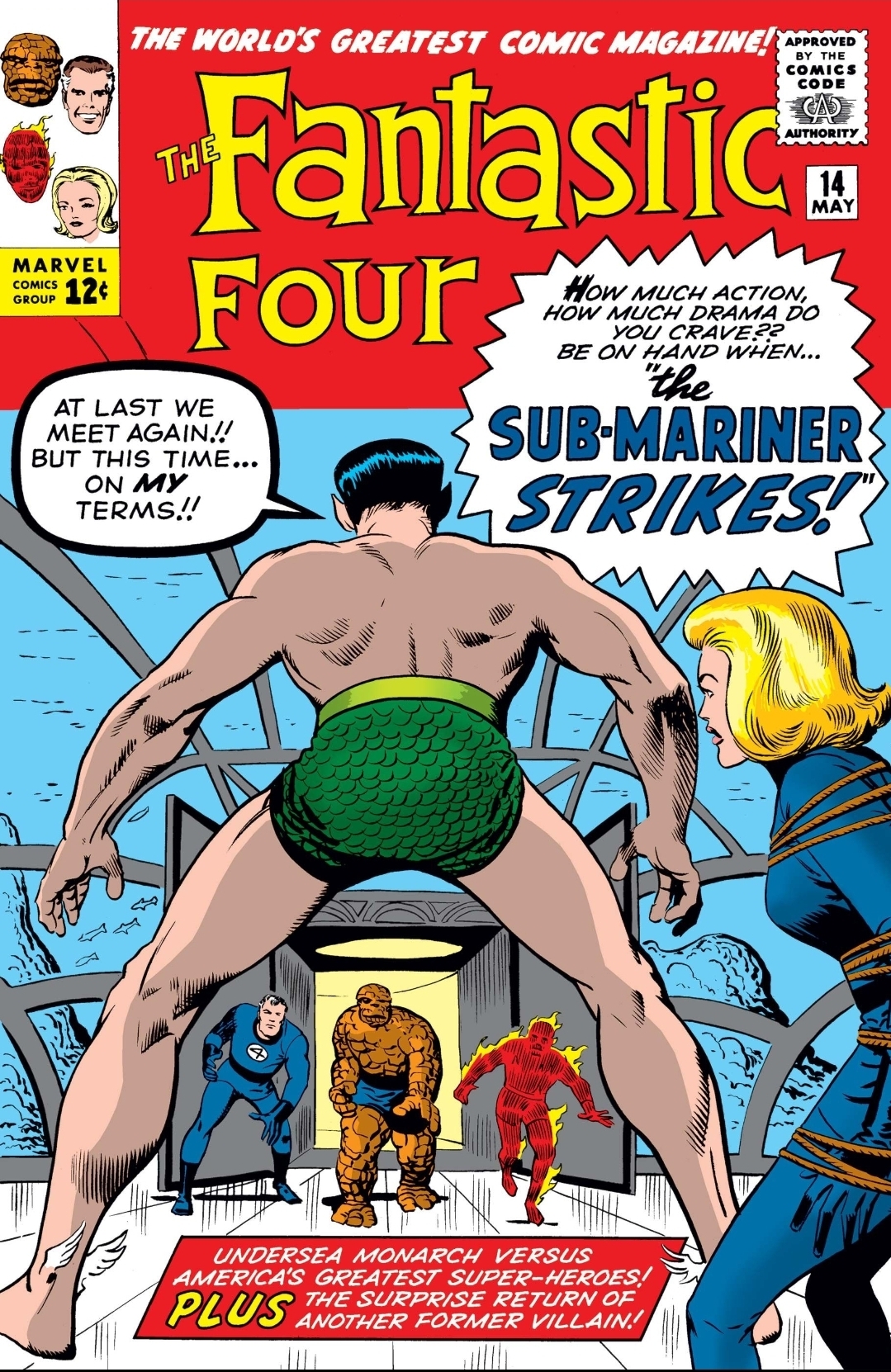
Written by Stan Lee – Art by Jack Kirby – Inks by Dick Ayers – Letters by Art Simek
One of the most important things about Fantastic Four #14 happens before the story even begins. For perhaps the first time, a Marvel comic genuinely feels like it’s picking up where the previous issue left off.

The Fantastic Four return home after their journey to the Moon and immediately reap the rewards of their adventure. Reporters surround them. Agents want to represent them. Fans mob the team hoping to catch a glimpse of Marvel’s newest celebrities.
It may not seem revolutionary today, but it’s another important step forward. The Fantastic Four aren’t simply resetting for another adventure. Their lives continue from one month to the next.
Marvel is slowly beginning to trust its readers to remember what happened last issue.
That growing sense of continuity extends beyond the opening.
The Fantastic Four are becoming celebrities as much as superheroes. The frenzy around the team feels remarkably close to Beatlemania, with everyone hoping to cash in on their fame.
Meanwhile, Johnny unveils another new power, creating a funnel of heated air capable of carrying the entire team through the sky. Like several early Human Torch abilities, it doesn’t seem destined to last, but it reminds us Marvel is still experimenting with these characters’ powers.
Not every aspect of the issue has aged as gracefully.

Sue Storm continues to be Marvel’s most inconsistent major character. After helping save the world, she returns to the Baxter Building only to decide the place needs cleaning while Reed tells her to keep the noise down. It’s another reminder that Lee and Kirby still haven’t quite figured out what role the Invisible Girl should play.
The Reed-Sue-Namor love triangle also continues to feel awkward.
Unlike the teenage romances in The Amazing Spider-Man that would later become one of Stan Lee’s strengths, this dynamic never quite clicks. Reed and Sue are adults with an established relationship, while Namor’s obsession often feels more possessive than romantic.
The main plot begins when we discover the Puppet Master survived his apparent death and has spent time institutionalized before being declared cured.
Naturally, the moment he’s released he resumes plotting revenge. This time he uses his radioactive clay to control none other than the Sub-Mariner.
More interestingly, Namor isn’t simply looking to conquer the surface world anymore. He’s searching for his lost people.
It’s a subtle but important shift in the character. Lee and Kirby are beginning to give Namor motivations beyond simple villainy, planting the seeds for the conflicted antihero he would eventually become.

The Puppet Master uses Namor to abduct Sue, luring the Fantastic Four beneath the sea.
From there, Jack Kirby is given another excuse to unleash his imagination.
Just as the previous issue let him design impossible lunar civilizations, this one fills the undersea world with bizarre creatures and hazards. Flame-eating sea life. Needle coral capable of piercing even the Thing’s rocky hide. Strange fungus that traps its victims inside hardened shells. And, naturally, a giant octopus.

The emotional center of the story belongs to Namor.
As the Puppet Master’s control tightens, Namor struggles between obeying his commands and following his own sense of honor. It’s one of the earliest hints that Marvel’s villains don’t all have to be evil for evil’s sake.
Some can simply be conflicted.
Eventually the Puppet Master’s scheme collapses under its own weight when his final attempt to control the giant octopus destroys his own submarine, leaving his fate uncertain once again.
Namor regains control of himself. Sue returns to the Fantastic Four. And the Prince of Atlantis resumes his search for his missing people.
That’s what stands out most. The story doesn’t simply end. It points toward the next one.
Only a few months ago, most Marvel comics felt like standalone adventures.
Now the Fantastic Four are beginning to resemble an ongoing saga, with consequences carrying from one issue to the next, characters evolving over time, and story threads left deliberately unresolved.
Marvel had flirted with continuity before.
With Fantastic Four #14, Lee and Kirby begin embracing it.
Marvel in the 60s – Entry #51


Leave a Reply